Jeff Sessions Could Reverse Years Of Progress On Marijuana Policy
Drug reform advocates have a few concerns about President-elect Donald Trump’s attorney general nomination.
11/18/2016 07:04 pm ET
8k
Matt Ferner National Reporter, The Huffington Post
CARLO ALLEGRI / REUTERS
President-elect
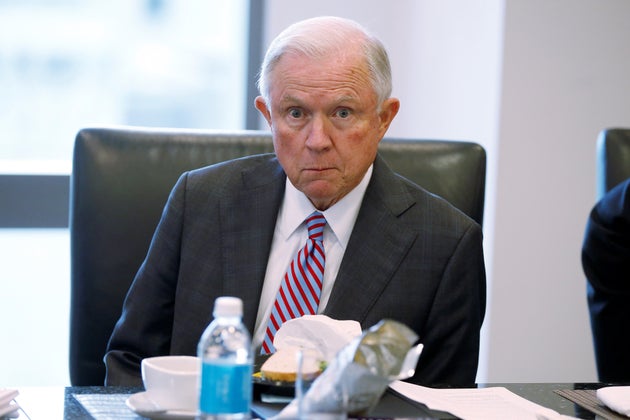
Donald Trump has nominated hardline drug policy reform opponent Sen. Jeff Sessions (R-Ala.) to be attorney general of the United States, a move that sent shockwaves through the marijuana legalization movement on Friday.
Marijuana remains illegal under the federal Controlled Substances Act, despite the expansion of recreational programs in Colorado, Washington state, Oregon, Alaska and Washington, D.C. (The District, however, continues to ban sales, unlike the state programs.) Four new states approved legalization on Election Day, and 29 states in total have legalized marijuana for medical purposes. This movement has only been able to press forward because of
guidance urging federal prosecutors to refrain from targeting state-legal marijuana operations.
Under
President Barack Obama, the Department of Justice has allowed states to forge their own way on marijuana policy. But that guidance could be reversed when the Trump administration enters the White House. If confirmed, Sessions would sit atop the DOJ, the federal agency that oversees federal prosecutors and enforces federal law on the plant.
“Jeff Sessions should scare every regulator, government official, cannabis industry operator, patient and consumer across the country,” said John Hudak, a senior fellow at the Brookings Institution who writes extensively on marijuana policy.
An Attorney General Sessions could reverse the federal guidance allowing state marijuana programs “with the stroke of a pen,” Hudak said.
He could also use the FBI to crack down on marijuana operations nationwide and use the Drug Enforcement Agency to enforce federal prohibition outside of the jurisdiction of the U.S. 9th Circuit Court ― the court that
ruled in August that a federal rider blocks federal officials from prosecuting state-legal marijuana operators and patients. This rider that the 9th Circuit affirmed must be reapproved each year, and Sessions could order DEA enforcement nationwide if it were allowed to expire. He could also file lawsuits that seek to shut down state and local governments enforcing marijuana reforms and administering regulatory programs.
“In all, [he] could undo much of what has become the Obama Doctrine with regard to marijuana policy in the United States,” Hudak said. “That policy reversal is the worst-case scenario for the marijuana industry.”
Advocates for drug policy reform have blasted Trump for selecting Sessions.
“Donald Trump’s decision heralds a return to the worst days of the drug war,” said Bill Piper, senior director of national affairs at Drug Policy Alliance, a drug policy reform group.
Donald Trump’s decision heralds a return to the worst days of the drug war.Bill Piper, senior director of national affairs at Drug Policy Alliance
“Jeff Sessions is a drug war dinosaur, which is the last thing the nation needs now,” said Ethan Nadelmann, DPA’s executive director. “Those who counted on Donald Trump’s reassurance that marijuana reforms ‘should be a state issue’ will be sorely disappointed.”
Trump has said he would respect states’ rights on the issue, but Sessions’ track record of opposing marijuana reform is deeply troubling to people who favor progressive drug laws.
During a Senate hearing earlier this year, Sessions spoke out against marijuana and urged the federal government to send the message to the public that “
good people don’t smoke marijuana.” He
went on to say that “we need grown-ups in Washington to say marijuana is not the kind of thing that ought to be legalized” and blasted Obama’s stance on the issue. He called the legalization of marijuana “
a mistake” last year.
In 1986, when Sessions had been nominated to be a federal judge, a former assistant U.S. attorney accused him of saying that he thought the
Ku Klux Klan was acceptable until he found out members smoked marijuana. Sessions allegedly made the statement in connection with the prosecution of a Klan member who had hanged a black man.
Despite Sessions’ retrograde views on the plant, the trend of state-level legalization reflects a broader cultural shift toward
acceptance of marijuana, the most commonly used illicit substance in the United States. National support for the legalization of marijuana has risen dramatically in recent years, reaching
historichighs in multiple polls just last month. States
like Colorado have established regulated marijuana marketplaces, and successes there have debunked some lawmakers’ and law enforcers’
predictions that such polices would result in disaster.
X
And although many drug policy reformers are disappointed in the Sessions pick, some are holding out hope that they’ll be able persevere should he be confirmed.
“While the choice certainly isn’t good news for marijuana reform, I’m still hopeful the new administration will realize that any crackdown against broadly popular laws in a growing number of states would create huge political problems they don’t need and will use lots of political capital they’d be better off spending on issues the new president cares a lot more about,” said Tom Angell, chairman of Marijuana Majority.
Mason Tvert, communications director for Marijuana Policy Project, said he expects appointees who “serve at the pleasure of the president” to stick the president’s position.
“It would certainly be controversial if Sen. Sessions completely defied the president who appointed him,” Tvert said.
Rep. Earl Blumenauer (D-Ore.), who has been at the forefront of efforts to reform marijuana laws at the federal level, called Sessions potentially helming the nation’s justice system “deeply disturbing,” considering his opposition to reform on issues like criminal justice, immigration and marijuana.
“I am hopeful that the next administration, regardless of the attorney general’s personal feelings, will respect the 10th Amendment and states’ rights to set their own policy in regards to cannabis,” Blumenauer said, calling on the Senate to reject Sessions’ nomination.
But Rep. Dana Rohrabacher (R-Calif.), a leading conservative voice on marijuana policy reform, told The Huffington Post that people shouldn’t be concerned about Sessions interfering with state marijuana policies as long as Trump upholds his campaign promise.
“The president of the United States will be making that decision and Trump has publicly stated during the election that he was in favor of letting the states make the decision on this policy,” Rohrabacher said. “Jeff Sessions is a loyal man with integrity, he will do what his boss wants him to do.”
He added that Trump likely picked Sessions because of the senator’s views on immigration, not weed.
“They have probably never discussed marijuana,” he said.
Still, Hudak said Trump’s notorious tendency to waffle on any number of issues is a reason for concern, and noted there is no indication that Sessions would help the marijuana industry.
“The only question is how much will he be allowed and to what extent, he will harm the industry,” he said.