TELL ME YA CHEESIN FAM?
I walk around a little edgy already
Texas man close to exoneration after computer algorithm leads to new suspect
Lydell Grant was supposed to be in prison for murder. But an emerging form of DNA technology, which has also come under scrutiny, is helping to free him in an unprecedented case.

Lydell Grant, center, celebrates his release on bond with his mother, Donna Poe, and Alonzo Poe, his brother, in Houston on Nov. 26, 2019.Jon Shapley / Houston Chronicle via AP file
Feb. 16, 2020, 4:56 AM CST
By Erik Ortiz
Nearly a decade into his life sentence for murder, Lydell Grant was escorted out of a Texas prison in November with his hands held high, free on bail, all thanks to DNA re-examined by a software program.
"The last nine years, man, I felt like an animal in a cage," Grant, embracing his mother and brother, told the crush of reporters awaiting him in Houston. "Especially knowing that I didn't do it."
Now, Grant, 42, is on a fast track to exoneration after a judge recommended in December that Texas' highest criminal court vacate his conviction. His attorneys are hopeful a ruling is made in the coming weeks.
For Grant to get to here hinged on two prongs: the DNA evidence, which was reanalyzed through an emerging software that has also come under scrutiny, and an unprecedented decision to use the findings to conduct an FBI criminal database search that was initiated by a third party not part of the initial investigation. That led to the discovery of a new suspect, who has been charged after police said he confessed.
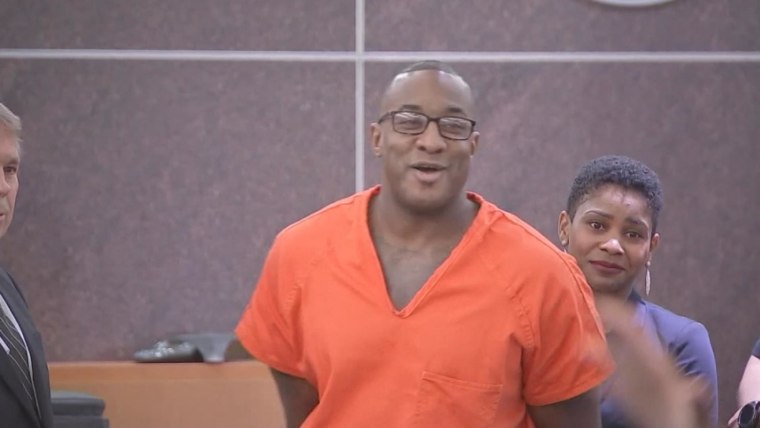
November 2019: New DNA evidence may clear Texas man convicted of 2010 murder
The search process used in Grant's case has enormous potential to solve cold cases or re-evaluate other convictions that could pave the way for more exonerations nationwide, forensic scientists say.
"There's probably 5,000 or 6,000 innocent people in Texas prisons alone," said lawyer Mike Ware, executive director of the Innocence Project of Texas, which is representing Grant. "How many of them could benefit from such a reanalysis of DNA that was used to convict them? I don't really know, but this is a historic case that could open the door for those who thought it was shut forever."
A match in the database
Grant's ordeal began in December 2010, when Aaron Scheerhoorn was stabbed outside a Houston gay bar. Authorities said Scheerhoorn, who was bleeding from his abdomen, had run to the bar's entrance seeking help from horrified bar patrons and employees. The witnesses described the killer as a black man, about 25 to 30 years old and around 6 feet tall. Police told local media that it may have been a "crime of passion."
More A Texas jury found him guilty of murder. A computer algorithm proved his innocence.
nikka nerds doing the Lord's work

Lydell Grant was supposed to be in prison for murder. But an emerging form of DNA technology, which has also come under scrutiny, is helping to free him in an unprecedented case.
Lydell Grant, center, celebrates his release on bond with his mother, Donna Poe, and Alonzo Poe, his brother, in Houston on Nov. 26, 2019.Jon Shapley / Houston Chronicle via AP file
Feb. 16, 2020, 4:56 AM CST
By Erik Ortiz
Nearly a decade into his life sentence for murder, Lydell Grant was escorted out of a Texas prison in November with his hands held high, free on bail, all thanks to DNA re-examined by a software program.
"The last nine years, man, I felt like an animal in a cage," Grant, embracing his mother and brother, told the crush of reporters awaiting him in Houston. "Especially knowing that I didn't do it."
Now, Grant, 42, is on a fast track to exoneration after a judge recommended in December that Texas' highest criminal court vacate his conviction. His attorneys are hopeful a ruling is made in the coming weeks.
For Grant to get to here hinged on two prongs: the DNA evidence, which was reanalyzed through an emerging software that has also come under scrutiny, and an unprecedented decision to use the findings to conduct an FBI criminal database search that was initiated by a third party not part of the initial investigation. That led to the discovery of a new suspect, who has been charged after police said he confessed.
November 2019: New DNA evidence may clear Texas man convicted of 2010 murder
The search process used in Grant's case has enormous potential to solve cold cases or re-evaluate other convictions that could pave the way for more exonerations nationwide, forensic scientists say.
"There's probably 5,000 or 6,000 innocent people in Texas prisons alone," said lawyer Mike Ware, executive director of the Innocence Project of Texas, which is representing Grant. "How many of them could benefit from such a reanalysis of DNA that was used to convict them? I don't really know, but this is a historic case that could open the door for those who thought it was shut forever."
A match in the database
Grant's ordeal began in December 2010, when Aaron Scheerhoorn was stabbed outside a Houston gay bar. Authorities said Scheerhoorn, who was bleeding from his abdomen, had run to the bar's entrance seeking help from horrified bar patrons and employees. The witnesses described the killer as a black man, about 25 to 30 years old and around 6 feet tall. Police told local media that it may have been a "crime of passion."
More A Texas jury found him guilty of murder. A computer algorithm proved his innocence.
nikka nerds doing the Lord's work