

A professor's case for African-American reparations
Q: There has been debate over what reparations should look like if pursued. What are your thoughts on what form they should take?
A: There seems to be an impulse to — and this is true for white and African-American reparations experts — shy away from cash payments and go directly to educational benefits, pension payments, health care benefits, and so on. [These alternatives] ensure that wealth is being created, and have an intergenerational effect [by ensuring] that the benefits don’t just evaporate after the first generation of reparations recipients. I think those ideas are valid, but we have to be clear that it’s very paternalistic thinking.
Then the question of whether we should treat African-Americans with more paternalism than white Americans arises. For example, there are no laws in this country that tell heirs of estates what they can do with their [inheritance] and whether they have to spend it on education, health care or whether they can spend it frivolously. So, can we really tell African-American heirs that they must spend their money wisely?
Q: As a white reparations researcher, how would you imagine reparations being paid in America?
A: My personal preference would be that there be a substantial cash component. Simply because [there were cash payments] made to Japanese-American World War II internees. Basically, they received a letter of apology from the U.S. president at the time, and I believe $20,000 in cash. That’s not very much, but I should also mention that Japanese-American internment was much shorter than the enslavement of African-Americans in terms of the overall time. It lasted three years, whereas, with African-American enslavement, we’re talking about hundreds of years and a much larger segment of the population. So naturally, the cash component would have to be larger and it would have to be fair in comparison to other reparations cases.
But, other than that I can imagine all kinds of different policies. I should also mention that slavery is not the only thing that created the wealth gap in the United States between African Americans and white Americans. There was a century of Jim Crow discrimination, there was explicit anti-black discrimination during the New Deal era, and during World War II and in the post-war era. [In addition], discriminatory housing policies where white Americans received government-insured mortgages under better conditions than African-Americans, who were explicitly excluded from these mortgage [opportunities] based only on their race.
And in regard to education, the GI Bill was administered in a colorblind way but discrimination during World War II, which barred African-Americans from certain positions, meant they didn’t qualify for certain GI Bill benefits afterward. So, all of these things have to be taken into consideration and repaired as well because they had intergenerational wealth implications and contributed to the wealth gap.
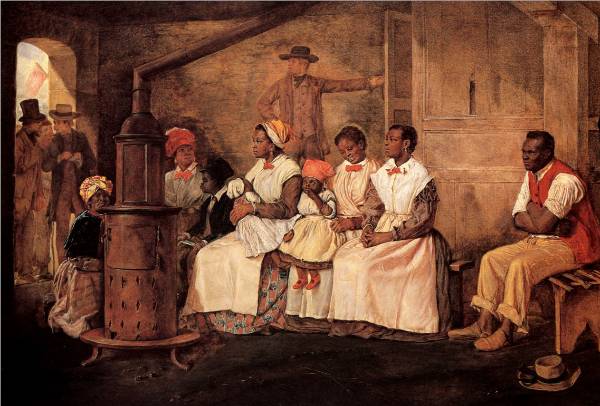
WIKIPEDIA
Slaves Waiting for Sale: Richmond, Virginia. Painted upon the sketch of 1853
Q: How much would the United States owe in reparation payments, and what is your counter to the argument that the problem is too big to solve?
A: The United States has never shied away from a big project. The moon landing was big, and it was complicated, and it was achieved. The fact that it’s big and complicated should be a challenge for Americans to address it.
The estimate that I came up with was huge. Using a very conservative interest rate, reparation payments would equal one year’s worth of the United States Gross Domestic Product. [In 2015, when I released my research and estimates], the number was approximately 14 trillion (based on 2009 estimates), and it seemed difficult to pay back. But, at the same time, it also shows you the magnitude of the historical crime. African-Americans were basically forced to give the United States an involuntary loan to build the U.S. economy.
It will have to be paid back sooner rather than later because the wealth that was created is earning interest in more and more diffused hands. It’s earning compound interest which grows exponentially, so the debt grows exponentially. Every year we wait, it’ll be more.
Today, that number is approximately $19 or $20 trillion.
Q: In the Trump era, how realistic is it to believe Americans would support reparations given that polls suggest that it’s not very popular with the general population?
A: Let me start off by saying that I did not see the Obama era coming, I did see not the Trump era coming, and I did not see reparations being suddenly elevated to a mainstream topic. All these are surprises to me. But I would say it’s more realistic in the Trump era than in the Obama era because [during Obama’s eight years in office] we would have had to demand reparations from a black president in a country that self-styled itself as post-racial.
Whereas in the Trump era, Trump has basically missed no racial slur, whether explicit or implicit or through dog whistle, and has created a climate of explicit racism. And I think that makes it easier for the other side to speak out and to make unusual demands that some might find radical.