

The Children of Save. Stolen or Saved ?
RWANDA

RWANDA
At the eve of the decolonisation of the Belgian colonial territories, some 300 to 400 children of mixed descent were brought from the orphanage of Save (Rwanda) to Belgium where they stayed with foster families. The initiative, the modalities and motives of this 'evacuation' are today still far from clear and constitute the core of this research project.

CONGO DRC
Orphanage of Save
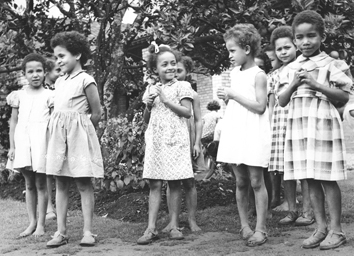
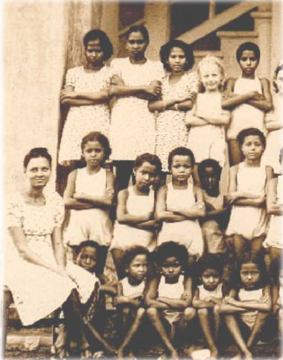
Photo collection Jacqueline Goegebeur – orphanage of Save (1950s)On a social, political and judicial level, children of mixed race occupied a delicate position in a colonial world structured by racial segregation. The so-called 'mulattos' formed a separate group within the population, approached with mixed feeling by the colonial administration as well as by the black community.
In many cases, the white father soon disappeared. He either left for Europe at the end of his term or he left the mother to care for the child on her own. These single mothers often could not count on the support of the black community. Consequently, a lot of these mulatto children were left to fend for themselves. With the approval of the colonial administration, orphanages were founded where the children, who technically speaking were not orphans, were placed. They received a catholic education and were trained for a profession with a special “status” (e.g. clerk, midwife, instructor). In the region of the Great Lakes, the children from Rwanda, Urundi and Kivu were entrusted to the orphanage of the White Sisters of the Mission of Save. At the age of twelve, the boys were separated from the girls and placed in an institution of the Marist Brothers (Byimana Rwanda, Nyangezi-Kivu).
In the period of 1958-1961, the children of Save were brought to Belgium and placed with foster homes in Flanders, Brussels and Wallonia. The motives for this 'evacuation' remain in the dark: judicial uncertainty about the status of 'half-blood', the rejection of the children of mixed race by the local population, the first ethnic troubles in the region and the feelings of responsibility of the persons in charge of the orphanage no doubt all played a role. Did this transfer take place on the initiative of the responsible of the orphanage ? Where the Belgian authorities consulted ? Did the black mother consent in the transfer of her child to the metropolis ? Did she relinquish her rights ? How did the children come to Belgium and what happened to them upon their arrival ?
The history of the children of Save constitutes an important element of the national colonial past. For those concerned, questions about their past, birth and identity increasingly arise. The questions of mentality and identity as a result of racial segregation and of miscegenation are today the themes of important historical research. What does it mean to be 'mixed', 'mulatto', 'half-blood' ? Not just in the colonial context but also in the more recent past ? On the one hand, a reconstruction of the events could offer a form of justice and solace to the persons concerned. On the other hand, it is also important to put the events into perspective and in the spirit of a colonial world under pressure.
similar cases have happened in Mali and the Belgian Congo
Documentary in french...english subtitle
Bon baiser des colonies ( start the video and click on "CC")
les enfants du blanc ( the children of the white men)
RWANDA
RWANDA
At the eve of the decolonisation of the Belgian colonial territories, some 300 to 400 children of mixed descent were brought from the orphanage of Save (Rwanda) to Belgium where they stayed with foster families. The initiative, the modalities and motives of this 'evacuation' are today still far from clear and constitute the core of this research project.
CONGO DRC
Orphanage of Save
Photo collection Jacqueline Goegebeur – orphanage of Save (1950s)On a social, political and judicial level, children of mixed race occupied a delicate position in a colonial world structured by racial segregation. The so-called 'mulattos' formed a separate group within the population, approached with mixed feeling by the colonial administration as well as by the black community.
In many cases, the white father soon disappeared. He either left for Europe at the end of his term or he left the mother to care for the child on her own. These single mothers often could not count on the support of the black community. Consequently, a lot of these mulatto children were left to fend for themselves. With the approval of the colonial administration, orphanages were founded where the children, who technically speaking were not orphans, were placed. They received a catholic education and were trained for a profession with a special “status” (e.g. clerk, midwife, instructor). In the region of the Great Lakes, the children from Rwanda, Urundi and Kivu were entrusted to the orphanage of the White Sisters of the Mission of Save. At the age of twelve, the boys were separated from the girls and placed in an institution of the Marist Brothers (Byimana Rwanda, Nyangezi-Kivu).
In the period of 1958-1961, the children of Save were brought to Belgium and placed with foster homes in Flanders, Brussels and Wallonia. The motives for this 'evacuation' remain in the dark: judicial uncertainty about the status of 'half-blood', the rejection of the children of mixed race by the local population, the first ethnic troubles in the region and the feelings of responsibility of the persons in charge of the orphanage no doubt all played a role. Did this transfer take place on the initiative of the responsible of the orphanage ? Where the Belgian authorities consulted ? Did the black mother consent in the transfer of her child to the metropolis ? Did she relinquish her rights ? How did the children come to Belgium and what happened to them upon their arrival ?
The history of the children of Save constitutes an important element of the national colonial past. For those concerned, questions about their past, birth and identity increasingly arise. The questions of mentality and identity as a result of racial segregation and of miscegenation are today the themes of important historical research. What does it mean to be 'mixed', 'mulatto', 'half-blood' ? Not just in the colonial context but also in the more recent past ? On the one hand, a reconstruction of the events could offer a form of justice and solace to the persons concerned. On the other hand, it is also important to put the events into perspective and in the spirit of a colonial world under pressure.
similar cases have happened in Mali and the Belgian Congo
Documentary in french...english subtitle
Bon baiser des colonies ( start the video and click on "CC")
les enfants du blanc ( the children of the white men)
