
You are using an out of date browser. It may not display this or other websites correctly.
You should upgrade or use an alternative browser.
You should upgrade or use an alternative browser.
Afro Vibes in Kazan, Russia
- Thread starter Phitz
- Start date
More options
Who Replied?

Fill Collins
Able to get note from doctor
this fukking blackface?! 


Lmao Is there anything redeeming about Russia? Literally the WOAT in all categories
this fukking blackface?!
Those girls are black
Fill Collins
Able to get note from doctor
that's even worseThose girls are black


Nkrumah Was Right
Superstar
Propaganda from Putin

Nkrumah Was Right
Superstar
I’m guessing some of those folks are the children of those people who came to Russia during the Soviet era and stayed.
I’m guessing some of those folks are the children of those people who came to Russia during the Soviet era and stayed.
a mix of them and African students looks like
Nkrumah Was Right
Superstar
Wait. Isn’t puttin drafting the youth for the war with Ukraine? Like Russia is not the place to be for any young person. Much less a nonwhite person.
Not sure if they’re snatching them off the street like in Ukraine.
Russia is doing a mix of drafting, offering incentives to prisoners, and paying people (especially ex soldiers) to sign up
Cash for soldiers: Russian regions paying staggering sums to induce soldiers to sign up

Mister Terrific
It’s in the name
Lost in Translation: How African migrants are tricked and threatened into Russian military serviceWait. Isn’t puttin drafting the youth for the war with Ukraine? Like Russia is not the place to be for any young person. Much less a nonwhite person.
Mikhail Kalinin
7 November 2024
Since the start of 2024, a total of 3,344 foreign nationals who went to fight in Ukraine have received Russian citizenship, according to the Russian Ministry of Internal Affairs. Kremlin propaganda frequently features stories of so-called volunteers from “friendly” or “neutral” African nations joining the Russian army. Some of these recruits are approached in Russian universities, while others are drawn to the front lines through deceit or even coercion. The Insider spoke with Africans who traveled to Russia seeking better opportunities but ended up in trenches — and, later, in Ukrainian captivity. One claims he unknowingly signed a military contract that was presented as a job offer. Another was promised a position as a security guard.
In May 2024, for instance, the Pskov-based news program Vesti aired a segment showing a group of foreigners preparing to deploy to Ukraine. Among them was Lamin Jatta, a Gambian native who spoke on camera about his admiration for Russia and his desire to fight for it. However, a friend told The Insider that Lamin had initially arrived in Belarus on a student visa in the summer of 2023, though studying was never his true intention.
Along with other migrants, Lamin had planned to illegally cross the Belarus-Latvia border to reach Germany or the Netherlands. After an unsuccessful attempt, he went to Russia to find work, where he was caught in a police raid. According to his friend, Lamin was given a choice: deportation to his home country or a contract with Russia’s Ministry of Defense. In August, Lamin’s family received news of his death in the war in Ukraine.
Lamin was given a choice: deportation to his home country or a contract with Russia’s Ministry of Defense. In August, Lamin’s family received news of his death in the war in Ukraine
Lamin is not the only one who traveled to Belarus or Russia hoping to transit to Europe — only to end up on the front lines in Ukraine. Recruiters are employing similar tactics to enlist Syrian citizens. The Insider previously reported on one of these front companies. Initially, a firm owned by Perm businessman Sergey Merzlyakov and his partner Khaled al-Amiri organized flows of refugees from African and Middle Eastern countries in an effort to trigger a migration crisis at the border between Belarus and the EU. Now, this same network is reportedly being used to recruit migrants into the military. Social media platforms openly advertise to Arab citizens, inviting them to sign a contract with Russia’s Ministry of Defense for a monthly salary of $2,200.
The Russian authorities also offer various non-monetary incentives for mercenary service. According to a decree issued by Vladimir Putin in January 2024, foreign nationals who sign a service contract for at least one year during the “special military operation” can qualify for Russian citizenship.
The papers were in Russian; I didn't know what I was signing”
Sources interviewed by The Insider reveal that foreign mercenaries often find themselves in the Russian military against their will. Richard, from Sierra Leone — a small country in West Africa that has experienced seven successful and six unsuccessful military coups in the last fifty years, and where a civil war raged from the mid-1990s to the early 2000s — came to Russia in November 2023 in search of regular civilian work. He had served in the armed forces of his home country for over 10 years.
“I dropped out of school at an early age when my father died, and I had no relatives to take care of me. To earn a living, I joined my country’s army in Sierra Leone. Now I have two children — a boy and a girl. My daughter has always been smart and told me she wants to become a doctor. I told her, 'Okay, I will do everything I can to help you achieve your dream.'
In Sierra Leone, salaries are among the lowest not only in Africa, but in the world [around $40 per month]. I saved money for several years and finally found a way to come to Russia on a tourist visa. Traveling to other countries required $15,000 to $20,000, while moving to Russia cost me about half that: $7,000. I planned to find work and start sending money home to my family right away.”
After borrowing money from relatives and gathering all his savings, Richard went to Guinea to obtain a tourist visa, as there is no Russian embassy in his home country of Sierra Leone. On November 24, 2023, the visa was ready, and Richard flew to St. Petersburg on a route that involved several layovers. Finding employment in Russia without a work permit and knowledge of the Russian language proved to be more challenging than Richard had anticipated. Upon his arrival in St. Petersburg, he sat idle, only paying for his hotel and food.
After a couple of weeks, Richard decided to reach out to the travel agent who had assisted him in obtaining the visa, seeking help with finding employment. While his entry documents were being processed, Richard communicated with an employee of Azimut Tour Service through messaging apps:
“I couldn't meet him in person even after arriving in St. Petersburg. When I tried to call him directly, he didn't answer. It was strange. The agent said, 'I'll send a taxi to take you to a place where someone is waiting to process your documents.' No one asked me whether I wanted to sign a contract for military service or not. The papers were in Russian, and I didn't understand what they said. All they needed was my signature.
After some time, the agent called back and said, 'Hey, Richard, they accepted your contract.' I asked, 'What contract?' He replied that it was for a job, but I would first need to undergo training to gain experience. I agreed. My contract was accepted on December 7, 2023. On December 10, I was told to take all my belongings, and we left St. Petersburg for Rostov.”
In Rostov-on-Don, Richard was met, placed on a bus, and taken to an undisclosed location: “The windows were covered in snow, and I could barely see anything outside. I realized I had ended up at a military base only when we got off the bus.”
Richard was told that he would undergo two weeks of military training before being sent to the combat zone in Donbas.
“They took our documents and phones. A couple of days later, they returned my phone, and I texted the agent: 'What am I doing at a military base?' He replied, 'Richard, you signed a contract with the army. This is the easiest way to get your documents, and they will pay you for signing the contract.' He didn’t tell me the exact amount, but he said my monthly salary would be $2,000. The agent promised that after a year of service, I would receive citizenship and they would find me housing.
I said, 'No, this is not what I want. I don’t want to be in the army because I have already served for many years.' He replied that he couldn’t do anything about it since the contract was already signed. I kept insisting that I didn’t want this contract, and then he blocked my number, and I could no longer contact him.”
After two weeks, Richard and his fellow soldiers were transferred to a new location — which turned out to be on Ukrainian territory.
“I had a Russian comrade who spoke a little English. I asked him, 'Where are we?' He replied, 'You are now in Ukraine.' Confused, I asked, 'What am I doing here?' He responded, 'Don't you know? You signed a contract.' I was very scared. Training began, and I continued to insist that I didn't want to serve. The commander then replied that canceling the contract was beyond his authority.”
At the base in Donetsk, the Russians kept the recruits under strict guard.
“Wherever we went, armed men followed us. Even to the bathroom. Later, I learned that many of the Russian soldiers were convicts who signed contracts to gain freedom after a year on the front lines. I thought, ‘why should we be treated the same way?’ We weren’t in prison and had no legal problems. Why were we kept under the same control?”
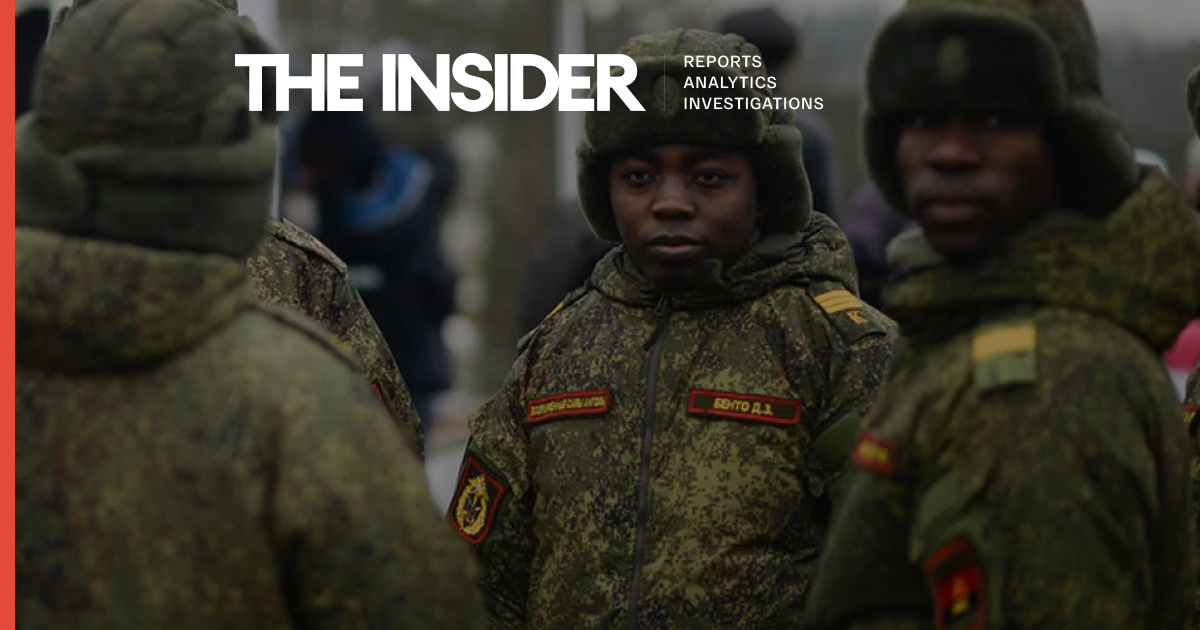
Lost in Translation: How African migrants are tricked and threatened into Russian military service
Since the start of 2024, a total of 3,344 foreign nationals who went to fight in Ukraine have received Russian citizenship, according to the Russian Ministry of Internal Affairs. Kremlin propaganda frequently features stories of so-called volunteers from “friendly” or “neutral” African nations...
 theins.ru