

88m3
Fast Money & Foreign Objects

U.S. Democratic presidential candidate Bernie Sanders and his wife board their campaign plane in Minneapolis, Minnesota.Brian Snyder / Reuters
Whether you like it or not, socialism is back in fashion and it is gaining support among America’s youth. A recent YouGov survey found that 43 percent of respondents under the age of 30 had a favorable view of socialism. Only 32 percent had a favorable view of capitalism.
Another recent survey, this one by Republican pollster Frank Luntz, found in the words of U.S. News’s Ken Walsh that “[58] percent of young people choose socialism over capitalism [which was chosen by 33 percent of young people] ... as the most compassionate system. Sixty-six percent say corporate America ‘embodies everything that is wrong with America,’ compared with 34 percent who say corporate America embodies what's right with America. A plurality of 28 percent say the most pressing issue facing the country is income inequality—one of [Senator Bernie] Sanders’ top themes.”
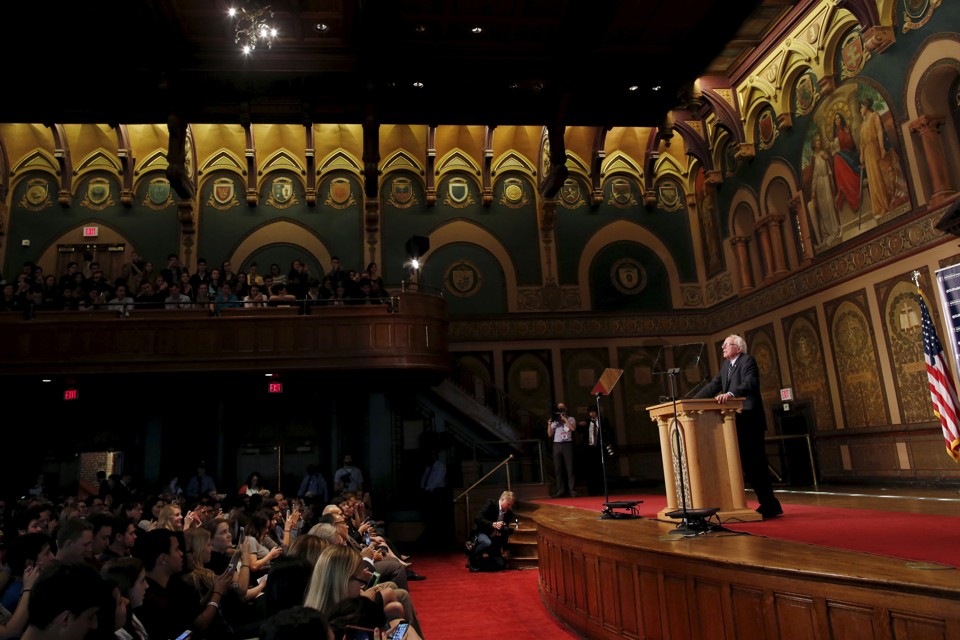
Bernie Sanders Makes His Pitch for Socialism
In the meantime, Sanders beat Hillary Clinton by 70 percent among young people in Iowa, and leads Clinton among young people nationwide.
As someone who grew up under socialism and is still, barely, in his 30s, I hope to relate a few ideas to the young people who are “feeling the Bern.” First, Sanders is not a socialist, but a social democrat. Second, the United States does not have a strictly capitalist economy, but a mixed one. As such, it combines a high level of private ownership of capital and the means of production with relatively onerous regulation and taxation. Third, to the extent that what anti-capitalist Sanders supporters really want is a Scandinavian-style social democracy, with its high level of wealth redistribution and income equality, they should consider that even some of the most socially democratic countries on earth are, in one crucial way, more capitalist than the United States.
Bernie Sanders is not a socialist, but a social democrat.
Let us start at the well of the socialist renewal, the Vermont senator. Sanders, as everyone knows, calls himself a “democratic socialist.” The word “democratic” is fundamental here, because historically socialism has not, typically, come about as a result of free and fair elections. In most socialist countries, like the Czechoslovak Socialist Republic where your humble author was born, socialism was imposed at the point of a gun. Sanders, therefore, is wise to distance himself from the socialists of yesteryear and insist that socialism in America should be chosen, freely and fairly, by the electorate.
As many of Sanders’s supporters have repeatedly and rightly pointed out, socialism is not communism. In fact, for most of the 20th century, socialism wasunderstood to be a halfway house between capitalism and communism. The latter was a utopian vision of the future characterized by classless, stateless, andmoneyless communal living. Strictly speaking, therefore, no communist country was ever “communist”—not even the Soviet Union (a.k.a., the Union of Soviet Socialist Republics).
What then was socialism? Socialism was an economic system where the means of production (e.g., factories), capital (i.e., banks), and agricultural land (i.e., farms) were owned by the state. In some socialist countries, like Poland, small privately owned farms were allowed to operate. In other countries, like Yugoslavia, small mom-and-pop shops also remained in private ownership. Strict limits on private enterprise limited accumulation of wealth and supposedly provided for a relatively high degree of income equality.
Two important caveats need to be kept in mind. First, lack of private enterprise resulted in low economic growth and, consequently, low standards of living. Thus, while income equality was relatively high (if party bosses and their cronies were excluded from the calculations), people in Soviet-bloc countries were much poorer than their counterparts in the West. Nobody has yet figured out a way of combining genuine socialism with high rates of growth over a long period of time.
Second, top members of the communist parties, which ran socialist countries, were generally exempted from limits on wealth accumulation. As such, communist leaders from Josip Broz Tito in Yugoslavia to Kim Il Sung in North Korea enjoyed luxuries unimaginable to the rest of the populace. Most importantly, top members of the government were above the law. They could not be accused, arrested, or convicted of ordinary or even extraordinary crimes (e.g., Stalin, Mao, and Pol Pot). As such, inequality of status between the governing class and the governed masses in socialist countries was as great, if not greater, as it was under feudalism.
Sanders is not a typical socialist. Sure, he believes in a highly regulated and heavily taxed private enterprise, but he does not seem to want the state to own banks and make cars. Considering the negative connotations of “socialism” in America, it is a bit of a puzzle why Sanders insists on using that word. It would be much less contentious and more correct if he gave his worldview its proper name: not “democratic socialism,” which implies socialism brought about through a vote, but social democracy.
In a social democracy, individuals and corporations continue to own the capital and the means of production. Much of the wealth, in other words, is produced privately. That said, taxation, government spending, and regulation of the private sector are much heavier under social democracy than would be the case under pure capitalism.
Capitalism means different things to different people. To many people on the left, unfettered capitalism implies individual greed, vast income inequality, and lack of government protections for the poor. Capitalism is often confused with “crony” capitalism—an odious nexus of corporate and political power that crushes the worker and cheats the consumer. Close linkages between big business and the government have existed before (e.g., fascist Italy, national-socialist Germany, Peronist Argentina, etc.). However, most academics do not refer to such systems as exhibiting “crony capitalism,” but “corporatism.”
In any case, few would argue that the power of big business in the United States today is comparable to the power of big businesses in, say, fascist Italy, though it might be argued that “crony capitalism,” if left unchecked, could one day lead to “corporatism.”
Bernie Is Not a Socialist and America Is Not Capitalist
relevant graphs in link
Thoughts?


