

88m3
Fast Money & Foreign Objects
Arizona's chaotic primary election demonstrates what’s bound to happen in light of the now-gutted federal Voting Rights Act.

Voters waiting in line in Arizona for the state's March 22 presidential primary. (REUTERS/Nancy Wiechec)
Arizona’s primary election on Tuesday was disastrous, especially for manyblack, Latino, and Native American voters. In Phoenix, people waited hours in line—some past midnight— to vote because the state closed 140 polling places that were open for the 2012 elections. Why would local election supervisors commit to so many closures during one of the most electrifying presidential elections in decades?
Helen Purcell, Maricopa County’s director of the Office of Records, who made that decision, said she was trying to save money, and also that she didn’t expect that many voters would turn out. This miscalculation has triggered an investigation into her office by Arizona Secretary of the State Michele Reagan, who said the long waiting lines were “completely unacceptable.”
Former Maricopa County Attorney Barnett Lotstein, 74, called what happened straight-up “voter suppression” after he and his wife were denied opportunities to vote because they couldn’t stand for hours in line. Some voters had been waiting in line so long that they started ordering pizzas.
Purcell denies that race had anything to do with this kludge, despite the fact that polling locations were closed in a number of black, Latino, and Navajocommunities. But Phoenix Mayor Greg Stanton isn’t convinced that this is just a coincidence. He has requested that U.S. Attorney General Loretta Lynch alsocome in to investigate the polling place closings, which he sees as possibly racially motivated. Stanton wrote in his letter to Lynch on Wednesday:
Maricopa County officials approved a plan that cut polling locations by 85 percent compared to the 2008 presidential preference election (and 70 percent compared to the lower-turnout 2012 presidential preference election), and distributed fewer polling locations to parts of the county with higher minority populations. For example, in Phoenix, a majority-minority city, County officials allocated one polling location for every 108,000 residents. The rations were far more favorable in predominantly Anglo communities: In Cave Creek/Carefree, there was one polling location for 8,500 residents; in Paradise Valley, one for 13,000 residents; in Fountain Hills, one for 22,500 residents and in Peoria, one for every 54,000 residents.
“There is no excuse for the top elections officials to not have known, remembered, or expected the growing participation of Latino voters,” said Petra Falcón of Promise Arizona, whichgives assistance to Latinos and immigrants, in a press statement. “We can all remember how, four years ago in Maricopa County, voters in Latino communities had to wait for hours to vote, while many polling locations ran out of ballots. Turnout for that election was high, even after the county recorder repeatedly sent the wrong date to Latino voters. Our leaders should be clearing paths to the ballot box, not constructing barriers, or worse, eliminating polls all together.”
As Ari Berman wrote at The Nation, these racial disparities could have been caught before problems arose if the Voting Rights Act was operating at full strength. Prior to a 2013 U.S. Supreme Court ruling that reduced powers of the civil rights law, Arizona was one of 16 states covered by Section 5 of the Voting Rights Act. What that meant was that any proposed changes to Arizona’s elections system needed to be cleared by the U.S. Department of Justice or a federal court before implementation. In either case, the federal officials would scan the proposed change to make sure that it wouldn’t result in making voting more difficult for people of color. If federal officials found evidence of potential discrimination at the polls, they’d file an objection stopping the changes from moving forward.
This process is called “preclearance,” and it is the key function of Section 5 of the Voting Rights Act. A state or jurisdiction would become subjected to preclearance if it has a history of racial discrimination—particularly discrimination at the polls, but not that kind exclusively. Congress created a formula to determine the kind of discriminatory history that qualified a state for preclearance status. That formula is embedded in Section 4 of the Voting Rights Act.
Arizona became a preclearance state in 1975, when the Section 4 formula wasamended to include places that discriminated against non-English-speakers. Arizona’s decades-long struggles with accommodating its indigenous American Indian population and its long-growing Latino population placed it under federal preclearance supervision.
One of the first federal objections Arizona earned while under preclearance came in March 1980, and it concerned changes in polling locations. Apache County officials had closed 15 polling places that were all on a Navajo reservation, and three more nearby. Similar to Maricopa County’s current controversial policy, Apache County had opened up its remaining polling centers to all voters across precincts and districts. Still, the U.S. Justice Department found that the closures “imposed a greater burden upon Navajo than upon white voters.” Arizona’s election change requests were rejected 22 times in total.
The federal government reviewed over 126,000 requests from jurisdictions seeking to make similar polling location changes between 1965 and 2013. This was, by far, the top request from places covered under Section 5, most of which were not rejected. Still, the sheer frequency of these polling-location changes gives some indication of how often this is considered in places where voters of color are concentrated. But in 2013, the U.S. Supreme Courtinvalidated the formula used for determining which jurisdictions would be subject to preclearance.
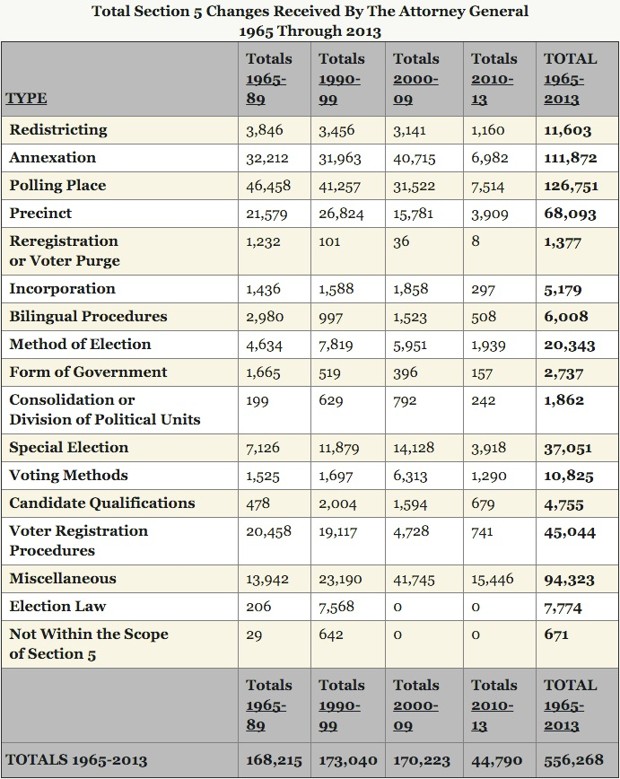
(U.S. Department of Justice)
That 2013 ruling meant that Arizona and other states across the South—including North Carolina, Alabama, Virginia, and Texas—no longer had to seek the federal government’s approval when making changes to election policies. It also means that these states no longer have to consider the effects of such changes on people of color, even if the states have clear histories of racial discrimination. All of the states mentioned above are currently mired in legal battles over the massive election changes they’ve recently instituted— most of those changes made in the immediate aftermath of the 2013 SCOTUS Voting Rights Act ruling.
Arizona voters have since been caught in a fog of gerrymandering confusion as SCOTUS deliberates whether its redistricting policies violate the Voting Rights Act’s remaining protections. Meanwhile, Latino and Native American first-time voters are being asked to provide more proof of their citizenship than the average person in America when registering to vote. It doesn’t help that the federal government disagrees with itself about these policies, or that somecourts have ruled them unconstitutional. Topping it all off is a law Arizona passed earlier this month making it a felony for anyone to gather voters’ ballots to drop off at polls. This is a service that many civil rights groups offer to elderly and disabled voters who would otherwise have difficulty getting to polling locations. It’s also a system that many Navajo voters rely upon, since reservations are often dozens of miles away from the nearest polling place.
None of these changes could have been made prior to SCOTUS’s gutting of the Voting Rights Act without the state considering the effects on Latino and Navajo voters. Perhaps it wasn’t the Supreme Court’s goal to make voting harder for people of color in states like Arizona, but without the Voting Rights Act’s full powers, this is always going to be the logical outcome.
Phoenix Mayor Stanton said in his letter to the U.S. Attorney General that Arizona has indulged itself in “consistent activity that has created a culture of voter disenfranchisement.”
It was this kind of “consistent activity” that the Voting Rights Act preclearance provision was created to curtail. A new bill called the Voting Rights Advancement Act would update the preclearance formula, and still protects voters from election changes that could encumber their rights. It’s currently lingering in Congress, hoping someone will push it forward. For that to happen, supporters need to get to the polls to vote for the candidates who will champion it. So far, that’s been difficult in states that need these protections the most, like Arizona—in no small part because of long waiting lines.
As Loyola Law School professor and elections expert Justin Levitt wrote in his 2013 study about polling place lines, “We need not wait any longer to ensure that we need not wait any longer.”
The Gutted Voting Rights Act Was Hard at Work in Arizona's Chaotic Primary Election
@Abogado @NZA
Hillary must've really planed this out, huh?!
- BRENTIN MOCK
- @brentinmock
- Mar 24, 2016
- Comments
Voters waiting in line in Arizona for the state's March 22 presidential primary. (REUTERS/Nancy Wiechec)
Arizona’s primary election on Tuesday was disastrous, especially for manyblack, Latino, and Native American voters. In Phoenix, people waited hours in line—some past midnight— to vote because the state closed 140 polling places that were open for the 2012 elections. Why would local election supervisors commit to so many closures during one of the most electrifying presidential elections in decades?
Helen Purcell, Maricopa County’s director of the Office of Records, who made that decision, said she was trying to save money, and also that she didn’t expect that many voters would turn out. This miscalculation has triggered an investigation into her office by Arizona Secretary of the State Michele Reagan, who said the long waiting lines were “completely unacceptable.”
Former Maricopa County Attorney Barnett Lotstein, 74, called what happened straight-up “voter suppression” after he and his wife were denied opportunities to vote because they couldn’t stand for hours in line. Some voters had been waiting in line so long that they started ordering pizzas.
Purcell denies that race had anything to do with this kludge, despite the fact that polling locations were closed in a number of black, Latino, and Navajocommunities. But Phoenix Mayor Greg Stanton isn’t convinced that this is just a coincidence. He has requested that U.S. Attorney General Loretta Lynch alsocome in to investigate the polling place closings, which he sees as possibly racially motivated. Stanton wrote in his letter to Lynch on Wednesday:
Maricopa County officials approved a plan that cut polling locations by 85 percent compared to the 2008 presidential preference election (and 70 percent compared to the lower-turnout 2012 presidential preference election), and distributed fewer polling locations to parts of the county with higher minority populations. For example, in Phoenix, a majority-minority city, County officials allocated one polling location for every 108,000 residents. The rations were far more favorable in predominantly Anglo communities: In Cave Creek/Carefree, there was one polling location for 8,500 residents; in Paradise Valley, one for 13,000 residents; in Fountain Hills, one for 22,500 residents and in Peoria, one for every 54,000 residents.
“There is no excuse for the top elections officials to not have known, remembered, or expected the growing participation of Latino voters,” said Petra Falcón of Promise Arizona, whichgives assistance to Latinos and immigrants, in a press statement. “We can all remember how, four years ago in Maricopa County, voters in Latino communities had to wait for hours to vote, while many polling locations ran out of ballots. Turnout for that election was high, even after the county recorder repeatedly sent the wrong date to Latino voters. Our leaders should be clearing paths to the ballot box, not constructing barriers, or worse, eliminating polls all together.”
As Ari Berman wrote at The Nation, these racial disparities could have been caught before problems arose if the Voting Rights Act was operating at full strength. Prior to a 2013 U.S. Supreme Court ruling that reduced powers of the civil rights law, Arizona was one of 16 states covered by Section 5 of the Voting Rights Act. What that meant was that any proposed changes to Arizona’s elections system needed to be cleared by the U.S. Department of Justice or a federal court before implementation. In either case, the federal officials would scan the proposed change to make sure that it wouldn’t result in making voting more difficult for people of color. If federal officials found evidence of potential discrimination at the polls, they’d file an objection stopping the changes from moving forward.
This process is called “preclearance,” and it is the key function of Section 5 of the Voting Rights Act. A state or jurisdiction would become subjected to preclearance if it has a history of racial discrimination—particularly discrimination at the polls, but not that kind exclusively. Congress created a formula to determine the kind of discriminatory history that qualified a state for preclearance status. That formula is embedded in Section 4 of the Voting Rights Act.
Arizona became a preclearance state in 1975, when the Section 4 formula wasamended to include places that discriminated against non-English-speakers. Arizona’s decades-long struggles with accommodating its indigenous American Indian population and its long-growing Latino population placed it under federal preclearance supervision.
One of the first federal objections Arizona earned while under preclearance came in March 1980, and it concerned changes in polling locations. Apache County officials had closed 15 polling places that were all on a Navajo reservation, and three more nearby. Similar to Maricopa County’s current controversial policy, Apache County had opened up its remaining polling centers to all voters across precincts and districts. Still, the U.S. Justice Department found that the closures “imposed a greater burden upon Navajo than upon white voters.” Arizona’s election change requests were rejected 22 times in total.
The federal government reviewed over 126,000 requests from jurisdictions seeking to make similar polling location changes between 1965 and 2013. This was, by far, the top request from places covered under Section 5, most of which were not rejected. Still, the sheer frequency of these polling-location changes gives some indication of how often this is considered in places where voters of color are concentrated. But in 2013, the U.S. Supreme Courtinvalidated the formula used for determining which jurisdictions would be subject to preclearance.
(U.S. Department of Justice)
That 2013 ruling meant that Arizona and other states across the South—including North Carolina, Alabama, Virginia, and Texas—no longer had to seek the federal government’s approval when making changes to election policies. It also means that these states no longer have to consider the effects of such changes on people of color, even if the states have clear histories of racial discrimination. All of the states mentioned above are currently mired in legal battles over the massive election changes they’ve recently instituted— most of those changes made in the immediate aftermath of the 2013 SCOTUS Voting Rights Act ruling.
Arizona voters have since been caught in a fog of gerrymandering confusion as SCOTUS deliberates whether its redistricting policies violate the Voting Rights Act’s remaining protections. Meanwhile, Latino and Native American first-time voters are being asked to provide more proof of their citizenship than the average person in America when registering to vote. It doesn’t help that the federal government disagrees with itself about these policies, or that somecourts have ruled them unconstitutional. Topping it all off is a law Arizona passed earlier this month making it a felony for anyone to gather voters’ ballots to drop off at polls. This is a service that many civil rights groups offer to elderly and disabled voters who would otherwise have difficulty getting to polling locations. It’s also a system that many Navajo voters rely upon, since reservations are often dozens of miles away from the nearest polling place.
None of these changes could have been made prior to SCOTUS’s gutting of the Voting Rights Act without the state considering the effects on Latino and Navajo voters. Perhaps it wasn’t the Supreme Court’s goal to make voting harder for people of color in states like Arizona, but without the Voting Rights Act’s full powers, this is always going to be the logical outcome.
Phoenix Mayor Stanton said in his letter to the U.S. Attorney General that Arizona has indulged itself in “consistent activity that has created a culture of voter disenfranchisement.”
It was this kind of “consistent activity” that the Voting Rights Act preclearance provision was created to curtail. A new bill called the Voting Rights Advancement Act would update the preclearance formula, and still protects voters from election changes that could encumber their rights. It’s currently lingering in Congress, hoping someone will push it forward. For that to happen, supporters need to get to the polls to vote for the candidates who will champion it. So far, that’s been difficult in states that need these protections the most, like Arizona—in no small part because of long waiting lines.
As Loyola Law School professor and elections expert Justin Levitt wrote in his 2013 study about polling place lines, “We need not wait any longer to ensure that we need not wait any longer.”
The Gutted Voting Rights Act Was Hard at Work in Arizona's Chaotic Primary Election
@Abogado @NZA
Hillary must've really planed this out, huh?!


