

Amerikan Melanin
Veteran
REPARATIONS ARE OWED!!!
——————-** There were nearly a million black farmers in 1920. Why have they disappeared?
There were nearly a million black farmers in 1920. Why have they disappeared?
Today there are just 45,000 African American farmers. One man is fighting to save them
by Summer Sewell in Baskerville, Virginia, and Shreveport, Louisiana
Main image: John Boyd Jr, at his 210-acre farm in Baskerville, Virginia. Boyd is a fourth-generation farmer, still fighting for black farmers’ rights and equal treatment. Photograph: Greg Kahn/The Guardian
Supported by
 About this content
Mon 29 Apr 2019 04.00 EDTLast modified on Wed 18 Sep 2019 17.09 EDT
Shares
3,112
John Boyd Jr’s grandfather Thomas, the son of a slave, slept with the deed to his farm under his mattress. He worried constantly that his land would be taken from him.
Twenty miles away and three generations later, Boyd lives on his own 210-acre farm, in a big white colonial house with rows of soybeans that go almost up to the front door, like other people have grass. One hundred cattle, a cluster of guinea hogs, three goats and a small herding dog named Fatso, whom Boyd calls his best friend, live there.
Advertisement
He feels more secure on his plot of land than Thomas did. But Boyd is an aberration.
The number of black farmers in America peaked in 1920, when there were 949,889. Today, of the country’s 3.4 million total farmers, only 1.3%, or 45,508, are black, according to new figures from the US Department of Agriculture released this month. They own a mere 0.52% of America’s farmland. By comparison, 95% of US farmers are white.
The black farmers who have managed to hold on to their farms eke out a living today. They make less than $40,000 annually, compared with over $190,000 by white farmers, which is probably because their average acreage is about one-quarter that of white farmers.
As a fourth-generation farmer, Boyd has witnessed other black farmers do the same thing he’s done: claw at the dirt in an attempt to hold on to it. And Boyd has devoted himself to helping other black farmers, always remembering the words he heard his grandfather Thomas mumble over and over: “The land don’t know color. The land never mistreated me, people do.”
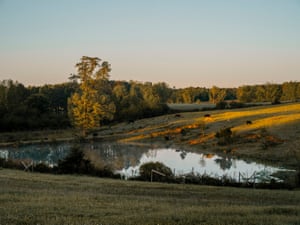
Cattle graze near the pond on John Boyd Jr’s farm just after sunrise in Baskerville, Virginia. Photograph: Greg Kahn/The Guardian
Today he’s come to understand two things: how the long fight he put up is just a drop in a rusted-out bucket, and exactly why there are so few black farmers left.
Advertisement
In Baskerville, Virginia, huge sunrises turn ponds into fiery gulfs. Strangers in cars wave as they pass. Food is fried and smothered. Things move slowly. This is also Trump country, with support displayed on bumper stickers and hand-painted roadside signs. “Dixieland”, as Boyd calls it, has palpable racial tension.
He is a big man with deep-set eyes usually in the shadow of a cowboy hat brim. His voice could rumble floorboards. Boyd, 53, seems most content bouncing in the seat of his tractor, smoke tufts marking his trail. He’ll harvest the soybeans he’s busy planting today in the fall, once they’re about knee-high.
He needs 45 bushels from each acre to make a profit. To avoid being docked – getting priced down for moisture or debris in the bushels – he will ask his wife, Kara Brewer Boyd, to enlist her white stepfather to sell the beans for him. When the other man takes Boyd’s beans, he’s not docked but complimented.
“I lose money if I sell them myself,” he says. “In 2019, that shouldn’t be happening. I shouldn’t be losing money because I’m black.”
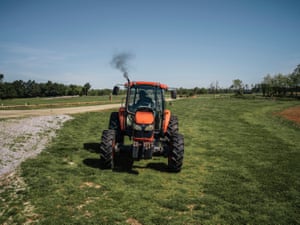
John Boyd Jr takes his new Kubota cab tractor for a spin to see how well it prepares his land for planting soybeans. Photograph: Greg Kahn/The Guardian
Boyd’s had time to get used to this mistreatment. His struggle for equal footing started as soon as he bought his first farm for $51,000 at age 18 in 1984. He went to the Farmers Home Administration, a lending branch of the USDA, about 90 miles from Baskerville to apply for operating loans. Year after year, his applications were denied or delayed.
Advertisement
“Looked at your application and we ain’t gonna be able to help you this year,” he says the loan officer would tell him. Once, Boyd says, a white farmer interrupted their meeting, exchanged quick pleasantries with the loan officer, and walked out, having not even applied, with a check for $157,000. “And I’m begging for $5,000,” Boyd recalls, shaking his head.
In subsequent visits, the loan officer told Boyd he better learn to talk to him like other black folks did, took naps during meetings, threw Boyd’s applications straight into the trash and spat his chewing tobacco on Boyd’s shirt, claiming to have missed his spittoon.
The officer only took meetings with the nine black farmers in the county on Wednesdays. “He would leave the door open and speak loudly and boastfully so that we could hear just how bad he was talking to each one of us,” Boyd says.
Boyd filed six complaints against the officer for discriminatory treatment and eventually the USDA Civil Rights Office of Virginia investigated the officer, who admitted to the treatment Boyd noted in his complaints. Boyd then filed and won the first-ever discrimination lawsuit against the USDA.

