

88m3
Fast Money & Foreign Objects
The Australian city is using trees and water to fight the urban heat island effect.

One year ago, tennis fans cooled off during a heat wave that disrupted the 2014 Australian Open in Melbourne. (EPA/Joe Castro)
MELBOURNE, Australia — This city’s strategy to save its urban landscape — and protect itself from the perils of climate change — was borne of patience. Followed by despair. Followed by tragedy.
Patience, from waiting for more than a decade for an epic drought that began in the late 1990s to pass. Despair, from realizing that the water shortage was lasting beyond the city’s ability to cope. Then tragedy, from a brutal heat wave in 2009 that brought wildfires and so many heat-related deaths that inaction became unthinkable.

That goal is to be achieved through a combination of measures ranging from the deceptively simple — planting more trees, and lots of them — to innovative ideas that effectively cool the air. For example, rather than letting water fall and flow into rivers and oceans, the rains are captured under city streets and diverted to feed the urban landscape, which in turn helps Greater Melbourne’s 4 million people cope with the effects of a warming planet.
Melbourne’s Lord Mayor Robert Doyle says of the 2009 heat wave, whichpeaked at 45 degrees Celsius (113 degrees Fahrenheit), sparked major power outages and culminated in wildfires that claimed 173 lives that February: “The city itself started to shut down, telecommunications failed, elevators and lifts all over the city started to fail, we were worried about public transport shutting down … it was the wake-up call we needed, not just because of the deaths but because of the health of the city itself. And that included the trees. Forty percent of those trees were either in decline or were going to die. So for us it was just a question of, ‘We just have to do something’.”
The new normal
To put Doyle’s description in perspective, note that Melbourne is a sophisticated city whose renaissance frequently lands it atop lists of the planet’s “most livable” cities. Moreover, while it sits in the south-eastern corner of one of the hottest countries on earth, Melbourne is better known in Australia as “Bleak City”—derided more for its wet, windy winters than for weeks of endless sunshine. The past 15 years have affirmed that the old clichés no longer hold true.
One of Melbourne’s signature policies in response is to use the “urban canopy” to counter what’s known as the “urban heat island”—that’s the phenomenon where all the roads and buildings of the inner city send temperatures soaring way above that in surrounding suburbs. The ambitious plan is to plant 30,000 trees in the central business area governed by Doyle’s Melbourne City Council, sedating the concrete jungle with a forest of natural towers.
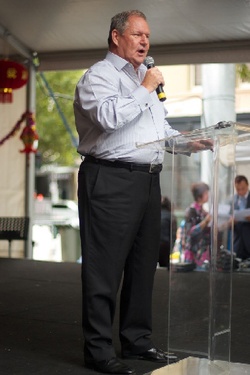
Melbourne Lord Mayor Robert Doyle says heat is the biggest killer among natural hazards in Australia. (Vikas Nambiar/Flickr/CC)
Doyle offers the starkest statistic to illustrate why it’s necessary. The 2013 State of Australian Cities report put the city’s average annual heat-related deaths— mainly among the elderly—at about 200 a year. In 2009, more people died from heat than the wildfires. “It’s not generally known that heat is the biggest killer in Australia,” Doyle says of comparable statistics for natural disasters. He also cites the massive hit to economic activity both in 2009, and again when a January 2014 heat wave made global headlines. It even temporarily shut down the Australian Open tennis tournament, where players battled to stay upright on court. (Temperatures for this year’s tournament, which wraps up this weekend, have been cooler than usual.)
Rob Adams is Melbourne council’s director of city design and the driving force behind the city’s 30-year effort to revive its downtown with a booming population and cultural enhancements. He says that as the climate-change debate took off, local governments were better placed to heed the warning signs than state or national administrations.
“I think this is something that cities around the world experience,” Adams told me. “Local governments are recognizing it first because in many cases they can see the direct impact. They look after the parks and gardens. They see when the trees get stressed.”
In Melbourne, that stress on local landscapes, from street trees to parks and gardens to the green median strips along roads, was profound. “People said, ‘Australia has always had droughts’,” Adams recalls. “But once it got past [a few years] we realized it was no longer a drought. It was the onset of something different. It depleted water stocks to the point we were told to stop watering landscapes — we couldn’t put water back into the ground to support our landscapes. We very nearly lost a huge proportion of our landscapes.”
Stephen Livesley, a climate-change expert at the University of Melbourne, says desperation during the drought became self-defeating. “They stopped irrigating their trees, and that led to mass mortality of trees. Trees are a long-living investment and it was just short-sighted to starve and kill those trees.”
Planting science
After 2009, surrender to drought gave way to the fight—and a decision to spend $6 million a year spraying the city with greenery. The city sought expert guidance on the types of trees that could thrive in drought conditions, where to plant them and in what numbers.
Cutting-edge technology played a big part, says Adams.
“With heat imaging you can actually see it,” he says. “You take a photo of a tree next to a building, you can see the building is cooler—because the tree, through its natural process, is putting off moisture and cooling the atmosphere.”
“So one of the most effective ways is to put in an urban landscape adjacent to all the buildings,” Adams says. “This is a really important aspect of how dense cities are going to have to operate in the future. They’re going to need to have these landscapes. And they are challenging. [It’s] not as easy as just planting a tree in the park.”
Complementing the massive tree-planting scheme are more resilient methods of watering them. One such project, in Darling Street on the central city’s eastern fringe, was launched two years ago. The street was identified as an ideal experimental site: downhill, with parkland adjacent and located within the area that had borne the brunt of the drought.
Councillor Arron Wood, chair of the city’s environment portfolio, calls the Darling Street scheme “a milestone” that is now being replicated at other sites. A giant underground tank captures stormwater, treats it and stores it for reuse in nearby parks and other green areas.
“Darling Street is unique because the stormwater tank is located in the road, where usually we build these tanks in parks,” Wood says. “The road provides the optimum point for water collection in this area. The area now looks like any other street in Melbourne. But underground, a sophisticated stormwater tank is helping to save more than 20 million litres of water and keeping the surrounding parks healthy and green. The system also improves stormwater quality, and reduces runoff into our rivers, creeks and our bay.”
The wider stormwater harvesting network now helps capture 25 percent of the water required to feed the landscape annually. That’s just the beginning. “We aim to source 50 percent of our water requirements from non-potable sources by 2030,” Wood says. “Even during future drought. This network will provide us with water security in a cost-effective manner.”
Local power
Livesley points out that as important as the urban canopy is to combating climate change, it is but one of many changes governments need to consider. He notes that Melbourne City Council may be a world leader, but that it only covers a small footprint in a sprawling metro area. (The council’s downtown jurisdiction covers only 116,000 of the urban area’s 4 million residents.) Urban sprawl, transport issues and particularly energy generation are challenges every broader metropolis needs to confront.
“[Local government] is where we’re able to trial and demonstrate some of the cutting-edge approaches,” Livesley says. “There are things we know inherently make sense. But in order to make more and more councils embrace it and realize the worth of it, they want numbers. They want to know that if they make this change, what’s the temperature-degree benefit? What’s the biodiversity benefit? What’s the megaliters of water benefit? That’s what they want. And I can understand that. Why would you invest in something unless you know the benefit?”
Melbourne’s approach has won recognition from awards programs that spot innovations in cities, including the City Climate Leadership Awards and theGuangzhou International Award for Urban Innovation. Cities around the world are finding inspiration in Melbourne’s approach, says Lord Mayor Doyle. He recalls speaking to the mayor of Dar Es Salaam at the UN’s climate change summit in Copenhagen in 2009. As global leaders floundered, the mayor from Tanzania told him: “The reality is, we’ll go back to our cities and we’ll do things."
This story originally appeared on Citiscope, an Atlantic partner site.
http://www.citylab.com/weather/2015...perature-by-7-degrees/385050/?utm_source=SFFB
@Melbournelad
- NEIL MCMAHON
- @Citiscope
- 10:14 AM ET
- 1 Comment
One year ago, tennis fans cooled off during a heat wave that disrupted the 2014 Australian Open in Melbourne. (EPA/Joe Castro)
MELBOURNE, Australia — This city’s strategy to save its urban landscape — and protect itself from the perils of climate change — was borne of patience. Followed by despair. Followed by tragedy.
Patience, from waiting for more than a decade for an epic drought that began in the late 1990s to pass. Despair, from realizing that the water shortage was lasting beyond the city’s ability to cope. Then tragedy, from a brutal heat wave in 2009 that brought wildfires and so many heat-related deaths that inaction became unthinkable.
- How Singapore makes biodiversity an important part of urban life
- How Greece's economy crisis produced an emerging civil society in Athens
- Bringing bribery out into the open
That goal is to be achieved through a combination of measures ranging from the deceptively simple — planting more trees, and lots of them — to innovative ideas that effectively cool the air. For example, rather than letting water fall and flow into rivers and oceans, the rains are captured under city streets and diverted to feed the urban landscape, which in turn helps Greater Melbourne’s 4 million people cope with the effects of a warming planet.
Melbourne’s Lord Mayor Robert Doyle says of the 2009 heat wave, whichpeaked at 45 degrees Celsius (113 degrees Fahrenheit), sparked major power outages and culminated in wildfires that claimed 173 lives that February: “The city itself started to shut down, telecommunications failed, elevators and lifts all over the city started to fail, we were worried about public transport shutting down … it was the wake-up call we needed, not just because of the deaths but because of the health of the city itself. And that included the trees. Forty percent of those trees were either in decline or were going to die. So for us it was just a question of, ‘We just have to do something’.”
The new normal
To put Doyle’s description in perspective, note that Melbourne is a sophisticated city whose renaissance frequently lands it atop lists of the planet’s “most livable” cities. Moreover, while it sits in the south-eastern corner of one of the hottest countries on earth, Melbourne is better known in Australia as “Bleak City”—derided more for its wet, windy winters than for weeks of endless sunshine. The past 15 years have affirmed that the old clichés no longer hold true.
One of Melbourne’s signature policies in response is to use the “urban canopy” to counter what’s known as the “urban heat island”—that’s the phenomenon where all the roads and buildings of the inner city send temperatures soaring way above that in surrounding suburbs. The ambitious plan is to plant 30,000 trees in the central business area governed by Doyle’s Melbourne City Council, sedating the concrete jungle with a forest of natural towers.
Melbourne Lord Mayor Robert Doyle says heat is the biggest killer among natural hazards in Australia. (Vikas Nambiar/Flickr/CC)
Doyle offers the starkest statistic to illustrate why it’s necessary. The 2013 State of Australian Cities report put the city’s average annual heat-related deaths— mainly among the elderly—at about 200 a year. In 2009, more people died from heat than the wildfires. “It’s not generally known that heat is the biggest killer in Australia,” Doyle says of comparable statistics for natural disasters. He also cites the massive hit to economic activity both in 2009, and again when a January 2014 heat wave made global headlines. It even temporarily shut down the Australian Open tennis tournament, where players battled to stay upright on court. (Temperatures for this year’s tournament, which wraps up this weekend, have been cooler than usual.)
Rob Adams is Melbourne council’s director of city design and the driving force behind the city’s 30-year effort to revive its downtown with a booming population and cultural enhancements. He says that as the climate-change debate took off, local governments were better placed to heed the warning signs than state or national administrations.
“I think this is something that cities around the world experience,” Adams told me. “Local governments are recognizing it first because in many cases they can see the direct impact. They look after the parks and gardens. They see when the trees get stressed.”
In Melbourne, that stress on local landscapes, from street trees to parks and gardens to the green median strips along roads, was profound. “People said, ‘Australia has always had droughts’,” Adams recalls. “But once it got past [a few years] we realized it was no longer a drought. It was the onset of something different. It depleted water stocks to the point we were told to stop watering landscapes — we couldn’t put water back into the ground to support our landscapes. We very nearly lost a huge proportion of our landscapes.”
Stephen Livesley, a climate-change expert at the University of Melbourne, says desperation during the drought became self-defeating. “They stopped irrigating their trees, and that led to mass mortality of trees. Trees are a long-living investment and it was just short-sighted to starve and kill those trees.”
Planting science
After 2009, surrender to drought gave way to the fight—and a decision to spend $6 million a year spraying the city with greenery. The city sought expert guidance on the types of trees that could thrive in drought conditions, where to plant them and in what numbers.
Cutting-edge technology played a big part, says Adams.
“With heat imaging you can actually see it,” he says. “You take a photo of a tree next to a building, you can see the building is cooler—because the tree, through its natural process, is putting off moisture and cooling the atmosphere.”
“So one of the most effective ways is to put in an urban landscape adjacent to all the buildings,” Adams says. “This is a really important aspect of how dense cities are going to have to operate in the future. They’re going to need to have these landscapes. And they are challenging. [It’s] not as easy as just planting a tree in the park.”
Complementing the massive tree-planting scheme are more resilient methods of watering them. One such project, in Darling Street on the central city’s eastern fringe, was launched two years ago. The street was identified as an ideal experimental site: downhill, with parkland adjacent and located within the area that had borne the brunt of the drought.
Councillor Arron Wood, chair of the city’s environment portfolio, calls the Darling Street scheme “a milestone” that is now being replicated at other sites. A giant underground tank captures stormwater, treats it and stores it for reuse in nearby parks and other green areas.
“Darling Street is unique because the stormwater tank is located in the road, where usually we build these tanks in parks,” Wood says. “The road provides the optimum point for water collection in this area. The area now looks like any other street in Melbourne. But underground, a sophisticated stormwater tank is helping to save more than 20 million litres of water and keeping the surrounding parks healthy and green. The system also improves stormwater quality, and reduces runoff into our rivers, creeks and our bay.”
The wider stormwater harvesting network now helps capture 25 percent of the water required to feed the landscape annually. That’s just the beginning. “We aim to source 50 percent of our water requirements from non-potable sources by 2030,” Wood says. “Even during future drought. This network will provide us with water security in a cost-effective manner.”
Local power
Livesley points out that as important as the urban canopy is to combating climate change, it is but one of many changes governments need to consider. He notes that Melbourne City Council may be a world leader, but that it only covers a small footprint in a sprawling metro area. (The council’s downtown jurisdiction covers only 116,000 of the urban area’s 4 million residents.) Urban sprawl, transport issues and particularly energy generation are challenges every broader metropolis needs to confront.
“[Local government] is where we’re able to trial and demonstrate some of the cutting-edge approaches,” Livesley says. “There are things we know inherently make sense. But in order to make more and more councils embrace it and realize the worth of it, they want numbers. They want to know that if they make this change, what’s the temperature-degree benefit? What’s the biodiversity benefit? What’s the megaliters of water benefit? That’s what they want. And I can understand that. Why would you invest in something unless you know the benefit?”
Melbourne’s approach has won recognition from awards programs that spot innovations in cities, including the City Climate Leadership Awards and theGuangzhou International Award for Urban Innovation. Cities around the world are finding inspiration in Melbourne’s approach, says Lord Mayor Doyle. He recalls speaking to the mayor of Dar Es Salaam at the UN’s climate change summit in Copenhagen in 2009. As global leaders floundered, the mayor from Tanzania told him: “The reality is, we’ll go back to our cities and we’ll do things."
This story originally appeared on Citiscope, an Atlantic partner site.
http://www.citylab.com/weather/2015...perature-by-7-degrees/385050/?utm_source=SFFB
@Melbournelad


 Thats probably an old article posted when we were having them record breaking heat waves


 No unfortunately i havent had the previlege of being bitten or mauled by an Australian icon, i live a sheltered life
 i nearly hit a kangaroo while i was driving once


 Photo: Sydney is ranked as the world's fifth most expensive according to the Economist Intelligence Unit's latest calculations. (Todd Warshaw: Getty Images)