http://www.theguardian.com/science/head-quarters/2015/feb/28/can-violence-be-moralIntuitively, we might think that any sort of violent act is immoral. But, as David Nussbaum and Séamus A Power argue, morality doesn’t always preclude violence
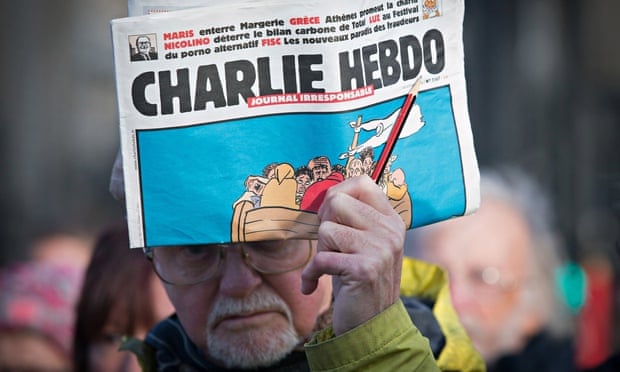
A man holds up a copy of Charlie Hebdo at a vigil in Bristol on 10 January 2015. Photograph: Matt Cardy/Getty Images
David Nussbaum and Séamus A Power
Saturday 28 February 2015 20.00 AEDT
Hours after the terrorist attacks on the Charlie Hebdo offices in Paris on January 7th, 2015, the US President Barack Obama, condemned the “cowardly, evil…and senseless attacks” perpetrated by the men who murdered twelve people. Leaders throughout the western world expressed similar sentiments. It is common for politicians to represent the perpetrators of violence as acting outside the boundaries of morality; their actions belong to an incomprehensible realm beyond our understanding of what is good and right. But the Charlie Hebdo killers were not acting at random – they were following a moral code. We don’t need to approve of their moral framework to understand that it exists and guides their behavior, and that understanding can bring us insights into the psychology of violence that we miss if we simply dismiss it as evil.
Generally speaking, we think of most interpersonal violence, not just terrorist attacks, as immoral. It’s very rare that you’ll see anybody claim that hurting someone else is an inherently moral thing to do. When people are violent, explanations for their behavior tend to invoke some sort of breakdown: a lack of self-control, the dehumanization of an “outgroup,” or perhaps sadistic psychological tendencies.
This is a comforting notion – one that draws a clear boundary between acceptable and unacceptable behavior. But according to the authors of a new book, it simply isn’t an accurate reflection of how people actually behave: morality, as understood and practiced by real-world human beings, doesn’t always prohibit violence. In fact they make the case that most violence is motivated by morality.
That’s the provocative thesis of Virtuous Violence, by Alan Page Fiske, an anthropologist at UCLA, and Tage Rai, a psychologist and post-doctoral scholar at Northwestern University’s Kellogg School of Management. Their research has led them to the conclusion, as they explained recently in New Scientist, that “across cultures and history, there is generally one motive for hurting or killing: people are violent because it feels like the right thing to do. They feel morally obliged to do it.” Those commonly invoked explanations for violence – empathy deficits, dehumanization, and simple sadism? They do play a role in violent behavior, the authors argue, but are rarely its sole triggers.
Central to Fiske and Rai’s thinking is their understanding that morality is fundamentally about maintaining the prevailing social order. Frequently that entails prohibiting violence, but at other times it actually requires it. When parents spank a child, for example, they are usually doing it to elicit appropriate behavior, and often have the child’s best interests in mind. They are generally not spanking their child because they want to do it, or enjoy it, but because they feel obligated to teach them to behave normatively, or to maintain and reinforce the proper parent-child hierarchy. Thus the familiar refrain: this is hurting me more than it’s hurting you. We may disagree with the practice of spanking, and prefer non-violent means of achieving similar ends, but we can easily understand that spanking is moral in the eyes of those who do it.
This same logic can be scaled up to truly heinous acts, like the recent terrorist attacks in Nigeria, France and Australia. Even these acts, argue Fiske and Rai, are motivated by a moral code that justifies or even requires them. When asked about the psychology behind the Charlie Hebdo killings in Paris, Rai states “that’s a case where as awful as those acts of violence are, these are cases where the perpetrators felt that they were retaliating against what they perceived to be a gross, abhorrent moral wrong.”
Fiske and Rai argue that understanding the moral nature of violence is actually essential to reducing it, because the best way to change someone’s behavior is to understand what motivated that behavior in the first place. If violence were simply based on people’s selfish desire to inflict harm on others, punishing violence would likely be an effective deterrent. But if violence is morally motivated, punishment is unlikely to be effective because, as the authors write, “people will do what is morally required if they feel their cause is righteous – whatever the consequences.”
It can be all too easy to brand violence as evil, but increasingly research is revealing this approach is too simplistic and offers no effective means of reducing violence. A similar insight is drawn by the Harvard psychologist, Steven Pinker, in his book The Better Angels of our Nature. He also argues that most perpetrators of violence throughout history are not pathological, but motivated to act within their own moral framework. Indeed, when asked about the Virtuous Violence hypothesis, Pinker reiterated a point made in his book, that “if you added up all the homicides committed in pursuit of self- help justice (i.e. taking the law into your own hands), the casualties of religious and revolutionary wars, the people executed for victimless crimes and misdemeanors, and the targets of ideological genocides, they would surely outnumber the fatalities from amoral predation and conquest.”
In Virtuous Violence, the argument is that violence is usually perpetrated by people who believe that they are doing good by the moral standards that they adhere to. Recognizing this fact offers us the best opportunity to understand the root causes of the violence and makes it possible to take steps to reduce it. Political leaders are right to condemn terrorist attacks – we do not have to accept the moral codes of others in order to acknowledge that they exist. However, long-term solutions to terrorist atrocities, as well as many other forms of violence in our society, might benefit from a taking a perspective that the perpetrators believe that what they are doing is good, just, and right.

You are using an out of date browser. It may not display this or other websites correctly.
You should upgrade or use an alternative browser.
You should upgrade or use an alternative browser.
Can violence be moral?
- Thread starter CHL
- Start date
More options
Who Replied?
Of course it can. 
AbsolutelyOf course it can.

joeychizzle
光復香港,時代革命
In the right manner, sparingly. Apply the sword too liberally and you risk becoming the evils you seek to to destroy 
In the right manner, sparingly. Apply the sword too liberally and you risk becoming the evils you seek to to destroy


Only because we aren't in a more evolved state in relation to mankinds level of maturity. once we as an overall species put behind us the pointless catalysts (such as Precious Resource Dependencies, Religious conflicts, and economic concerns) we'll always find ways to justify and make acceptable the idea of "Violence".
as I've said in another thread, biologically violence (more so War) serves a purpose (ONLY on a biological level). but on social level, violence makes absolutely no sense as it does not serve any positive purpose.
as I've said in another thread, biologically violence (more so War) serves a purpose (ONLY on a biological level). but on social level, violence makes absolutely no sense as it does not serve any positive purpose.
joeychizzle
光復香港,時代革命
fine lines, easily muddied.


I don't think morality is pertinent in a moment of necessity
I think this is a ruse of a question
this is like asking if a mother hunting for food is morally bound to not commit violence
In this moment, the true moral question is do we get up every day and work to know and to prevent the moment of necessity where morality is obviated?
the moral question is, are we preemptively responsible to the clock of our stomach, to the needs and cycle of the life giving planet in a way that respects our indomitable and natural sense of justice and our trained morality.
or are we lazy, fearful and abdicating of the responsibility morally inherent to our intelligence and prowess as man.
I think this is a ruse of a question
this is like asking if a mother hunting for food is morally bound to not commit violence
In this moment, the true moral question is do we get up every day and work to know and to prevent the moment of necessity where morality is obviated?
the moral question is, are we preemptively responsible to the clock of our stomach, to the needs and cycle of the life giving planet in a way that respects our indomitable and natural sense of justice and our trained morality.
or are we lazy, fearful and abdicating of the responsibility morally inherent to our intelligence and prowess as man.
Last edited:
Jhoon
Spontaneous Mishaps and Hijinks
Thread is pretty stupid, right?that's some low hanging fruit...
If you have a bigger gun, you make the rules. Morality is subjective.
no, subjective morality is no morality, just self-masturbationThread is pretty stupid, right?
If you have a bigger gun, you make the rules. Morality is subjective.
Let's assume that the propaganda that Goebbels was putting out there was believed 100% from Hitler down to the average nobody German citizen.
As far as they're concerned, there's a malevolent Jewish conspiracy to destroy Germany, and other nations are blissfully in denial.
How far are they morally justified in fighting this threat? Is violence justified in the case of Kristallnacht? In the roundup for the pogroms? In the Holocaust? Again, we're dealing with people that are absolute in their certainty that there's a seditious and treasonous element in their midst. At what point is it justified for citizens of other nations to use violence on their own part to counter the mistaken violence in Germany?
As far as they're concerned, there's a malevolent Jewish conspiracy to destroy Germany, and other nations are blissfully in denial.
How far are they morally justified in fighting this threat? Is violence justified in the case of Kristallnacht? In the roundup for the pogroms? In the Holocaust? Again, we're dealing with people that are absolute in their certainty that there's a seditious and treasonous element in their midst. At what point is it justified for citizens of other nations to use violence on their own part to counter the mistaken violence in Germany?

Brown_Pride
All Star
I think this right here is really at the heart of the matter. "Morality" is really just empathy and sympathy when you think about it. Most people, save psychopaths, experience some form of empathy or sympathy (to be hence forth referred to as pathy) which is inherent to humans...and perhaps some higher primates. "Immorality" is when we ignore these pathys. I've noticed people tend to ignore their inherent pathy when these pathy are placed against self preservation. In other words people are usually "immoral" when they have something to gain its at this point people justify their immorality. What's interesting though is that millions of times a day people the world over deny themselves the benefit of being immoral by NOT robbing or killing to better their position. This might be out of fear of consequences from government or society, i tend to lean towards man simply being content with his station and not needing to one up his current lot, particularly in stark contradiction to his gnawing pathys.or are we lazy, fearful and abdicating of the responsibility morally inherent [to] our intelligence and prowess as man.
Violence can then be moral, or at least justified, in many cases.
Yapdatfool
Superstar
According to Manifest Destiny, yes
Wonder who practices that...
:frogbiz: