

This maybe already known to some coli members...
At least 3,500 Americans have been detained inside a Chicago police warehouse described by some of its arrestees as a secretive interrogation facility, newly uncovered records reveal.
Of the thousands held in the facility known as Homan Square over a decade, 82% were black. Only three received documented visits from an attorney, according to a cache of documents obtained when the Guardian sued the police.
Despite repeated denials from the Chicago police department that the warehouse is a secretive, off-the-books anomaly, the Homan Square files begin to show how the city’s most vulnerable people get lost in its criminal justice system.
People held at Homan Square have been subsequently charged with everything from “drinking alcohol on the public way” to murder. But the scale of the detentions – and the racial disparity therein – raises the prospect of major civil-rights violations.
Documents indicate the detainees are a group of disproportionately minority citizens, many accused of low-level drug crimes, faced with incriminating themselves before their arrests appeared in a booking system by which their families and attorneys might find them.
The Chicago police department has maintained – even as the Guardian reported stories of people being shackled and held for hours or even days, all without legal access – that the warehouse is not a secret facility so much as an undercover police base operating in plain sight. “There are always records of anyone who is arrested by CPD, and this is no different at Homan Square,” the police asserted ina March statement.
But an independent Guardian analysis of arrestees’ records, obtained through the Freedom of Information Act, shows that Homan Square is far from normal:
But longtime civil rights lawyers who reviewed the results of the Guardian’s lawsuit condemned Chicago police and politicians for sweeping Homan Square “under the rug of denial”. The Chicago police department did not respond to a detailed list of questions seeking to clarify its own records.
“I am extremely troubled but sadly not shocked at the exceedingly broad scope and fundamentally racist nature of the unconstitutional police conduct at Homan Square that the Guardian’s most recent study documents,” said Flint Taylor, who played a major role in pressuring Emanuel and the city to create a reparations fund for victims of police torture.
“Hopefully, Chicago’s political leadership and its establishment media will finally take notice and stop collaborating to bury this story, so righteously championed by the Guardian, under the rug of denial and false ignorance.”
From raids to a lawyer-less moment: how Homan Square traps Chicago’s most vulnerable
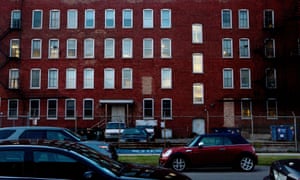
The Chicago police department’s Homan Square facility, on the city’s West Side. Photograph: The Guardian
One of the thousands of people documented in the Homan Square files is R, a man the Guardian is not naming because of potential retribution. R was only 18 years old on 11 March 2006 when his home on the South Side of Chicago was raided by plainclothes police officers over a small bag of marijuana and his father’s antique gun that was “collecting dust in the basement”.
R recalled he, his brother and father were arrested and taken to Homan Square, on the West Side, where R says they were left in a single cell for hours – one to two hours while police “had us handcuffed to the little pole on the wall” – with no phone or attorney access. The family’s primary interaction with the police, according to R, was when they were unshackled.
Eventually, R says, his father was released without charge. Shortly after, he and his brother were told they were being taken for processing at police headquarters, where they were charged with possession. Neither served time for the misdemeanor.
“We didn’t understand why we had to go to Homan Square first,” R said in an interview.
Lawyers and former police officers say that lack of access to a lawyer after the arrest and before booking – particularly during any interrogation, and particularly people from poor minority communities – puts a suspect’s rights in jeopardy.
Even when suspects claim to understand their rights, “they still tend to incriminate themselves” without an attorney present, Lorenzo Davis, a former police detective and attorney who himself commanded a unit at Homan Square, explained.
Despite the quadruple-digit number of arrestees held at Homan Square, the Chicago police proffered only three arrestees receiving visits from lawyers between 3 September 2004 and 1 July 2015. Two of them occurred on the same day in January 2013.
Unless approximately 3,500 people in custody waived their right to counsel, the revelation complicates – if not contradicts – the police’s March statement that “any individual who wishes to consult a lawyer will not be interrogated until they have an opportunity to do so”.
Former Homan Square detainees, lawyers and activists whom the Guardian has interviewed since February have claimed the majority of people held at Homan Square areblack and Hispanic. Since the police did not disclose data on race for the vast majority of the 3,621 acknowledged detentions, the Guardian conducted its own review of arrestees’ records.
In the tranche of detention records, more than four out of every five people taken to Homan Square are black; about 6.7% are Hispanic.
Similarly, white arrestees accounted for 8.5% of people the police identified as arrested at Homan Square.
“When I was a detective, occasionally I would arrest a white person,” Davis said, “and the white detectives would be overly interested in why I was arresting someone white.”
After further questioning by representatives for the Guardian, the Chicago police’s attorneys said that they cannot be sure more attorney visits did not occur – even though they were able to document only three.
A 2012 Chicago police general order says police personnel will “enter the visitor and/or attorney information in the section entitled ‘Interview/Visitor Logs’”, suggesting the data ought to be available, if any more lawyer visitations at Homan Square in fact occurred. The order also decrees: “An arrestee or person-in-custody will be notified as soon as practicable upon the arrival at the police facility of his or her legal representative.”
The Guardian has been able to document an additional eight times lawyers were present at Homan Square. Four of them are referenced in police data as accompanying their clients to Homan to turn themselves in, a different circumstance from when attorneys are able to gain access to the warehouse after learning their clients are held there. In at least one of those cases, an attorney who asked for anonymity to respect client confidentiality did not gain access to Homan Square itself. Two other lawyers have said in interviews that they were allowed in.
“Being a lawyer,” Davis said, “I can definitely say that is a civil rights issue.”
Charles’s family, M’s birthday and Mayor Emanuel’s rules
Twice detained and still fighting: Charles Jones’s Homan Square story. Video by Zach Stafford, Phil Batta, Valerie Lapinski and Spencer Ackerman
At least 3,500 Americans have been detained inside a Chicago police warehouse described by some of its arrestees as a secretive interrogation facility, newly uncovered records reveal.
Of the thousands held in the facility known as Homan Square over a decade, 82% were black. Only three received documented visits from an attorney, according to a cache of documents obtained when the Guardian sued the police.
Despite repeated denials from the Chicago police department that the warehouse is a secretive, off-the-books anomaly, the Homan Square files begin to show how the city’s most vulnerable people get lost in its criminal justice system.
People held at Homan Square have been subsequently charged with everything from “drinking alcohol on the public way” to murder. But the scale of the detentions – and the racial disparity therein – raises the prospect of major civil-rights violations.
Documents indicate the detainees are a group of disproportionately minority citizens, many accused of low-level drug crimes, faced with incriminating themselves before their arrests appeared in a booking system by which their families and attorneys might find them.
The Chicago police department has maintained – even as the Guardian reported stories of people being shackled and held for hours or even days, all without legal access – that the warehouse is not a secret facility so much as an undercover police base operating in plain sight. “There are always records of anyone who is arrested by CPD, and this is no different at Homan Square,” the police asserted ina March statement.
But an independent Guardian analysis of arrestees’ records, obtained through the Freedom of Information Act, shows that Homan Square is far from normal:
- Between September 2004 and June 2015, around 3,540 people were eventually charged, mostly with forms of drug possession – primarily heroin, as well as marijuana and cocaine – but also for minor infractions such as traffic violations, public urination and driving without a seatbelt.
- More than 82% of the Homan Square arrests thus far disclosed – or 2,974 arrests – are of black people, while 8.5% are of white people. Chicago, according to the 2010 US census, is 33% black and 32% white.
- Over two-thirds of the arrests at Homan Square thus far revealed – at least 2,522 – occurred under the tenure of Mayor Rahm Emanuel, the former top aide to Barack Obama who has said of Homan Square that the police working under him “follow all the rules”.
- A 42-year-old civil rights activist says he was abducted by masked officers, shackled, held on false charges and “with no food, no water, no access to the outside world” at the behest of “covert operations”. He is one of at least 118 people whom police have detained at Homan Square since the Guardian exposed the warehouse’s usage as a detention facility in February. His wife described the ordeal as feeling their family had been “lost” by the police.
- One young man, held at the warehouse for 14 hours without any public listing of his whereabouts, was just shy of his 18th birthday; the courts sentenced him to community service and probation.
- Another man, not included in the disclosed data, said he fled Chicago after resisting police pressure to become an informant during multiple stints inside Homan Square.
But longtime civil rights lawyers who reviewed the results of the Guardian’s lawsuit condemned Chicago police and politicians for sweeping Homan Square “under the rug of denial”. The Chicago police department did not respond to a detailed list of questions seeking to clarify its own records.
“I am extremely troubled but sadly not shocked at the exceedingly broad scope and fundamentally racist nature of the unconstitutional police conduct at Homan Square that the Guardian’s most recent study documents,” said Flint Taylor, who played a major role in pressuring Emanuel and the city to create a reparations fund for victims of police torture.
“Hopefully, Chicago’s political leadership and its establishment media will finally take notice and stop collaborating to bury this story, so righteously championed by the Guardian, under the rug of denial and false ignorance.”
From raids to a lawyer-less moment: how Homan Square traps Chicago’s most vulnerable
The Chicago police department’s Homan Square facility, on the city’s West Side. Photograph: The Guardian
One of the thousands of people documented in the Homan Square files is R, a man the Guardian is not naming because of potential retribution. R was only 18 years old on 11 March 2006 when his home on the South Side of Chicago was raided by plainclothes police officers over a small bag of marijuana and his father’s antique gun that was “collecting dust in the basement”.
R recalled he, his brother and father were arrested and taken to Homan Square, on the West Side, where R says they were left in a single cell for hours – one to two hours while police “had us handcuffed to the little pole on the wall” – with no phone or attorney access. The family’s primary interaction with the police, according to R, was when they were unshackled.
Eventually, R says, his father was released without charge. Shortly after, he and his brother were told they were being taken for processing at police headquarters, where they were charged with possession. Neither served time for the misdemeanor.
“We didn’t understand why we had to go to Homan Square first,” R said in an interview.
Lawyers and former police officers say that lack of access to a lawyer after the arrest and before booking – particularly during any interrogation, and particularly people from poor minority communities – puts a suspect’s rights in jeopardy.
Most arrests take place within 2.5 miles of Homan Square
Unusually for a police facility, people are taken to Homan Square from every corner of Chicago. Most arrests, however, take place in the predominantly black West Side and South Side. 54% of arrests took place within 2.5 miles of Homan Square.
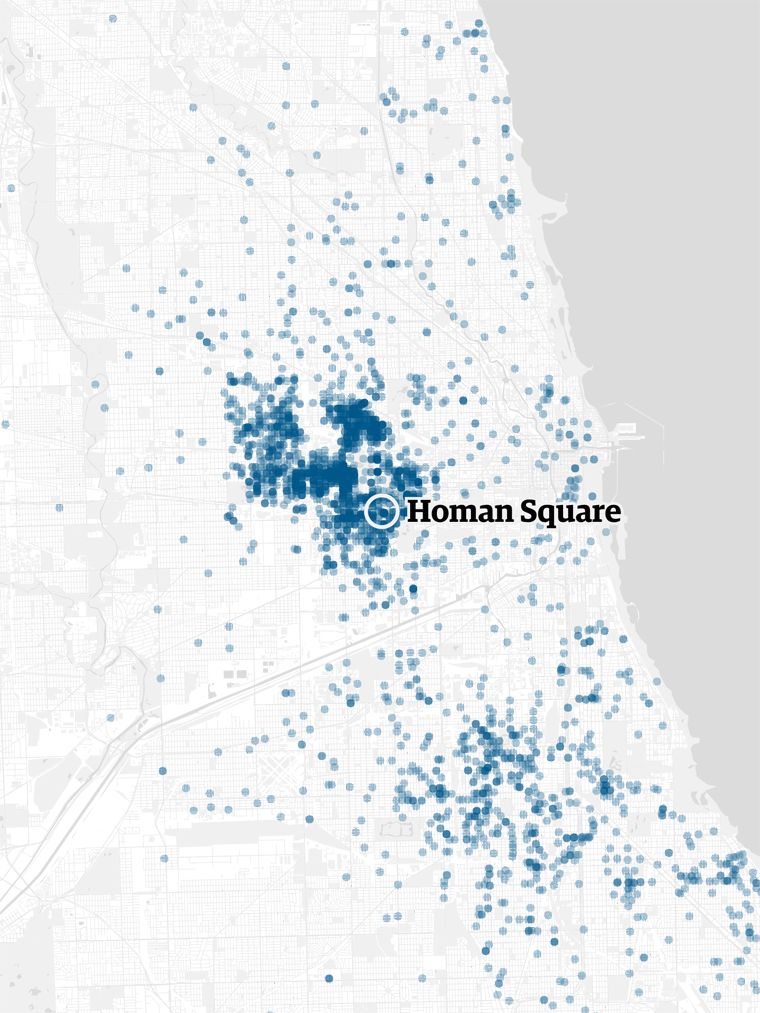
SOURCE: CHICAGO POLICE DEPARTMENT
“In Chicago, the police do not provide people with attorneys at the police station at the times they most need them: when they’re subject to interrogation,” said Craig Futterman of the University of Chicago Law School. “That’s what the Miranda warning is all about: the right to counsel while interrogated by police.”Unusually for a police facility, people are taken to Homan Square from every corner of Chicago. Most arrests, however, take place in the predominantly black West Side and South Side. 54% of arrests took place within 2.5 miles of Homan Square.
SOURCE: CHICAGO POLICE DEPARTMENT
Even when suspects claim to understand their rights, “they still tend to incriminate themselves” without an attorney present, Lorenzo Davis, a former police detective and attorney who himself commanded a unit at Homan Square, explained.
Despite the quadruple-digit number of arrestees held at Homan Square, the Chicago police proffered only three arrestees receiving visits from lawyers between 3 September 2004 and 1 July 2015. Two of them occurred on the same day in January 2013.
Unless approximately 3,500 people in custody waived their right to counsel, the revelation complicates – if not contradicts – the police’s March statement that “any individual who wishes to consult a lawyer will not be interrogated until they have an opportunity to do so”.
Former Homan Square detainees, lawyers and activists whom the Guardian has interviewed since February have claimed the majority of people held at Homan Square areblack and Hispanic. Since the police did not disclose data on race for the vast majority of the 3,621 acknowledged detentions, the Guardian conducted its own review of arrestees’ records.
In the tranche of detention records, more than four out of every five people taken to Homan Square are black; about 6.7% are Hispanic.
Arrestees taken to Homan Square are 82.1% black ...
Black
Hispanic
White
Arrestees
Black
Hispanic
White
Arrestees
82.1%
6.7%
8.5%
8.5%
... but Chicago itself is only 32.9% black
Population*
Population*
32.9%
28.9%
31.7%
31.7%
*Note: For US Census population statistics, Hispanic includes respondents of any race. White and black categories are non-Hispanic.
SOURCE: US CENSUS, CHICAGO POLICE DEPARTMENT
“It’s not unusual to me that close to 80% of those taken to Homan Square are black. Most of the gangs in Chicago are black. Being on the West Side in the 15th [district], you had numerous black gangs and they were all engaged in the dope traffic. A lot of their customers were white … occasionally you arrest the customer, but not too often,” Davis, who says Chicago’s police review board recently fired him for refusing to exonerate officers in wrongful shootings, said.SOURCE: US CENSUS, CHICAGO POLICE DEPARTMENT
Similarly, white arrestees accounted for 8.5% of people the police identified as arrested at Homan Square.
“When I was a detective, occasionally I would arrest a white person,” Davis said, “and the white detectives would be overly interested in why I was arresting someone white.”
After further questioning by representatives for the Guardian, the Chicago police’s attorneys said that they cannot be sure more attorney visits did not occur – even though they were able to document only three.
A 2012 Chicago police general order says police personnel will “enter the visitor and/or attorney information in the section entitled ‘Interview/Visitor Logs’”, suggesting the data ought to be available, if any more lawyer visitations at Homan Square in fact occurred. The order also decrees: “An arrestee or person-in-custody will be notified as soon as practicable upon the arrival at the police facility of his or her legal representative.”
The Guardian has been able to document an additional eight times lawyers were present at Homan Square. Four of them are referenced in police data as accompanying their clients to Homan to turn themselves in, a different circumstance from when attorneys are able to gain access to the warehouse after learning their clients are held there. In at least one of those cases, an attorney who asked for anonymity to respect client confidentiality did not gain access to Homan Square itself. Two other lawyers have said in interviews that they were allowed in.
“Being a lawyer,” Davis said, “I can definitely say that is a civil rights issue.”
Charles’s family, M’s birthday and Mayor Emanuel’s rules
Twice detained and still fighting: Charles Jones’s Homan Square story. Video by Zach Stafford, Phil Batta, Valerie Lapinski and Spencer Ackerman


 )
)


