
You are using an out of date browser. It may not display this or other websites correctly.
You should upgrade or use an alternative browser.
You should upgrade or use an alternative browser.
Chinese Government Spokesman: "9/11 Was An Inside Job"
- Thread starter Chronic
- Start date
More options
Who Replied?


GreenGhxst
Veteran
Of course they'd say that. China ain't shyt either
Their leadership...liars, swindlers, murderers all the same
Their leadership...liars, swindlers, murderers all the same

Dafunkdoc_Unlimited
Theological Noncognitivist Since Birth
- Joined
- Jul 25, 2012
- Messages
- 45,062
- Reputation
- 8,010
- Daps
- 122,436
- Reppin
- The Wrong Side of the Tracks
COVID-19 says, 'Hey, China, ....... !!!!'
!!!!'
!!!!'
Man fukk china and their opinion  the world got fukked up on massive proportions because these pieces of shyts purposedly hide the information when the virus became a serious problem. Are they gonna pay the damage they caused? fukk no they won't.
the world got fukked up on massive proportions because these pieces of shyts purposedly hide the information when the virus became a serious problem. Are they gonna pay the damage they caused? fukk no they won't.
WaveMolecules
Superstar
China has some fukking nerve talking shyt like theyre a force for good in the world.


JamesJabdi
Superstar
I think its more of him saying " your foreign policy is not working and here is example why"

Tianamen Square and Winnie the Pooh
Things you probably can't mention in any public discussion in China
Things you probably can't mention in any public discussion in China

Family Lives Matter
#FLM
You mean the country that is trying to dominate the world is trying to destabilise a super power that's in its way 

Mister Terrific
It’s Great to be a Michigan Wolverine
The Great Chinese Famine (Chinese: 三年大饥荒; lit. 'three years of great famine') was a period between 1959 and 1961 in the history of the People's Republic of China (PRC) characterized by widespread famine.[2][3][4][5][6] Some scholars have also included the years 1958 or 1962.[7][8][9][10] It is widely regarded as the deadliest famine and one of the greatest man-made disasters in human history, with an estimated death toll due to starvation that ranges in the tens of millions (15 to 55 million).[note 1] The most stricken provinces were Anhui (18% dead), Chongqing (15%), Sichuan (13%), Guizhou(11%) and Hunan (8%).[1]
 en.m.wikipedia.org
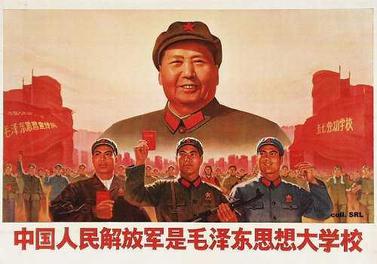
Launching the movement in May 1966 with the help of the Cultural Revolution Group, Mao charged that bourgeois elements had infiltrated the government and society with the aim of restoring capitalism. Mao called on young people to "bombard the headquarters", and proclaimed that "to rebel is justified". The youth responded by forming Red Guards and "rebel groups" around the country. A selection of Mao's sayings were compiled into the Little Red Book, which became a sacred text for Mao's personality cult. They held "denunciation rallies" against revisionists regularly, and grabbed powerfrom local governments and CPC branches, eventually establishing the revolutionary committees in 1967. The committees often split into rival factions and became involved in armed fights known as "violent struggles", to which the army had to be sent to restore order. Mao declared the Revolution over in 1969, but the Revolution's active phase would last until at least 1971, when Lin Biao, accused of a botched coup against Mao, fled and died in a plane crash. In 1972, the Gang of Four rose to power and the Cultural Revolution continued until Mao's death and the arrest of the Gang of Four in 1976.
The Cultural Revolution was characterized by violence and chaos. Death toll claims vary widely, with estimates of those perishing during the Revolution ranging from hundreds of thousands to millions. Beginning with the Red August of Beijing, massacres took place nationwide, including the Guangxi Massacre, in which massive cannibalism also occurred;[1][2] the Inner Mongolia incident; the Guangdong Massacre; the Yunnan Massacres; and the Hunan Massacres. Red Guards destroyed historical relics and artifacts, as well as ransacking cultural and religious sites. The 1975 Banqiao Dam failure, one of the world's greatest technological catastrophes, also occurred during the Cultural Revolution. Meanwhile, tens of millions of people were persecuted: senior officials, most notably Chinese president Liu Shaoqi, along with Deng Xiaoping, Peng Dehuai, and He Long, were purged or exiled; millions were accused of being members of the Five Black Categories, suffering public humiliation, imprisonment, torture, hard labor, seizure of property, and sometimes execution or harassment into suicide; intellectuals were considered the "Stinking Old Ninth" and were widely persecuted—notable scholars and scientists such as Lao She, Fu Lei, Yao Tongbin, and Zhao Jiuzhang were killed or committed suicide. Schools and universities were closed with the college entrance exams cancelled. Over 10 million urban intellectual youthswere sent to the countryside in the Down to the Countryside Movement.
 en.m.wikipedia.org

Great Chinese Famine - Wikipedia
Launching the movement in May 1966 with the help of the Cultural Revolution Group, Mao charged that bourgeois elements had infiltrated the government and society with the aim of restoring capitalism. Mao called on young people to "bombard the headquarters", and proclaimed that "to rebel is justified". The youth responded by forming Red Guards and "rebel groups" around the country. A selection of Mao's sayings were compiled into the Little Red Book, which became a sacred text for Mao's personality cult. They held "denunciation rallies" against revisionists regularly, and grabbed powerfrom local governments and CPC branches, eventually establishing the revolutionary committees in 1967. The committees often split into rival factions and became involved in armed fights known as "violent struggles", to which the army had to be sent to restore order. Mao declared the Revolution over in 1969, but the Revolution's active phase would last until at least 1971, when Lin Biao, accused of a botched coup against Mao, fled and died in a plane crash. In 1972, the Gang of Four rose to power and the Cultural Revolution continued until Mao's death and the arrest of the Gang of Four in 1976.
The Cultural Revolution was characterized by violence and chaos. Death toll claims vary widely, with estimates of those perishing during the Revolution ranging from hundreds of thousands to millions. Beginning with the Red August of Beijing, massacres took place nationwide, including the Guangxi Massacre, in which massive cannibalism also occurred;[1][2] the Inner Mongolia incident; the Guangdong Massacre; the Yunnan Massacres; and the Hunan Massacres. Red Guards destroyed historical relics and artifacts, as well as ransacking cultural and religious sites. The 1975 Banqiao Dam failure, one of the world's greatest technological catastrophes, also occurred during the Cultural Revolution. Meanwhile, tens of millions of people were persecuted: senior officials, most notably Chinese president Liu Shaoqi, along with Deng Xiaoping, Peng Dehuai, and He Long, were purged or exiled; millions were accused of being members of the Five Black Categories, suffering public humiliation, imprisonment, torture, hard labor, seizure of property, and sometimes execution or harassment into suicide; intellectuals were considered the "Stinking Old Ninth" and were widely persecuted—notable scholars and scientists such as Lao She, Fu Lei, Yao Tongbin, and Zhao Jiuzhang were killed or committed suicide. Schools and universities were closed with the college entrance exams cancelled. Over 10 million urban intellectual youthswere sent to the countryside in the Down to the Countryside Movement.
Cultural Revolution - Wikipedia


Black Man of the Nile
All Star
Everybody deep down inside knows this is the truth 


SleezyBigSlim
Banned
fukk China
