


Citigroup, the Bank the U.S. Taxpayer Saved From Insolvency in 2008, Is Operating a Dizzying Array of Dark Trading Pools Today
In 2008, the sprawling global bank, Citigroup, created under the controversial repeal of the Glass-Steagall Act, blew itself up with toxic debt hidden in the dark in the Cayman Islands in an exotic framework called Structured Investment Vehicles or SIVs. The unwilling taxpayer was forced into servitude to bail out this hubris that had occurred at the hands of captured regulators, infusing $45 billion in equity, over $300 billion in asset guarantees, and $2.5 trillion in below-market loans.
At the time of its implosion, Citigroup had over 2,000 subsidiaries, affiliates or joint ventures, many of which operated in the dark in foreign locales.
Flash forward to today: in March, the Federal Reserve said Citigroup had flunked its stress test and the Fed prevented it from boosting its dividend. (The so-called stress test is how the Fed measures a mega bank’s ability to withstand a major economic upheaval.) In rejecting Citigroup’s capital plan for 2014, the Fed said that Citigroup “reflected a number of deficiencies in its capital planning practices, including in some areas that had been previously identified by supervisors as requiring attention, but for which there was not sufficient improvement. Practices with specific deficiencies included Citigroup’s ability to project revenue and losses under a stressful scenario for material parts of the firm’s global operations.”
Most Americans, and, sadly, members of Congress, believe that Citigroup is the parent of all those branch banks holding FDIC-insured deposits across America and bearing that angelic red halo over the word “Citi.” But Citigroup is far more than that.
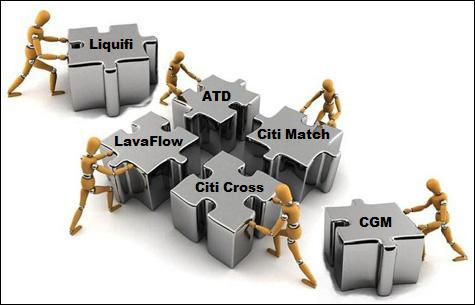
A recent record search by Wall Street On Parade suggests that Citigroup may be operating one of Wall Street’s largest collections of dark pools, trading stocks 24/7 around the globe in de facto unregulated stock exchanges which it operates under a dizzying array of different names.
For the first time ever, the Financial Industry Regulatory Authority has started releasing partial trading data for dark pools. For the week of May 26, 2014, FINRA data shows that Liquifi, a dark pool owned by a unit of Citigroup, traded 5,865,427 shares of stock; another dark pool owned by a unit of Citigroup, LavaFlow, traded 98,604,159 shares of stock; and Citi Cross, also owned by a unit of Citigroup, traded 37,547,262 shares of stock.
But there seems to be something wrong in the above report. At the end of the first quarter of this year, Citigroup filed a required SEC Rule 606 report which said it was identifying “the significant market centers” to which it routed its customers’ orders and was also identifying “the material aspects of Citigroup Global Markets’ relationship with those top market centers.”
The SEC Rule 606 report (as shown in part below) indicates that 52.02 percent of Citigroup’s customers’ orders in New York Stock Exchange Euronext listed stocks were routed to a company called Automated Trading Desk Financial Services. According to Citigroup’s disclosure, it owns that company and “potentially stands to profit by trading as principal with its customers’ orders.” Citigroup Global Markets (or ostensibly its dark pools) accounted for another 31.82 percent with LavaFlow receiving 2.30 percent. In short, Citigroup routed 92.23 percent of its customers’ orders in New York Stock Exchange Euronext traded stocks – to itself.
Read the rest of the article: http://wallstreetonparade.com/2014/06/citigroup’s-dark-pools-here’s-why-the-public-doesn’t-trust-wall-street/
Last edited by a moderator:
