President Obama’s Supreme Court nomination exemplifies the liberal politics of accommodation.
by Rob Hunter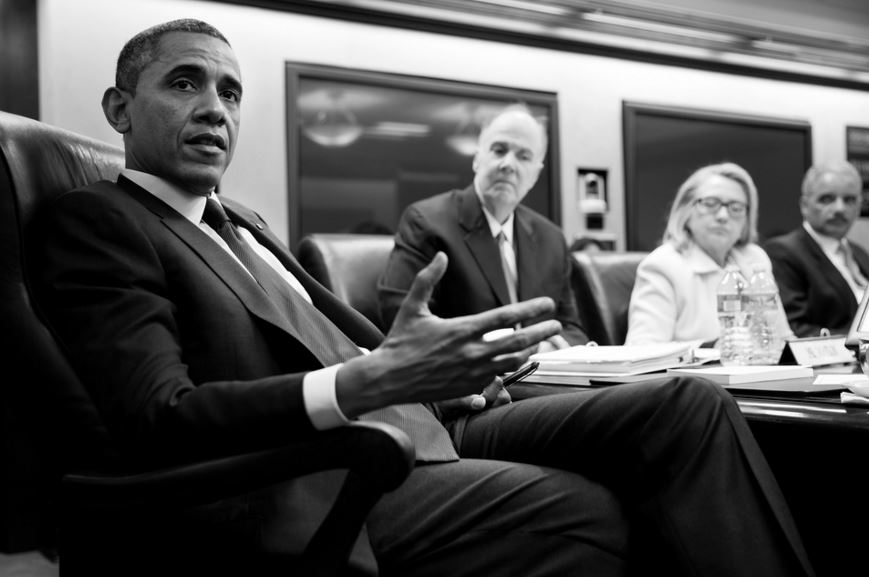
President Obama in the White House Situation Room on January 24, 2013. The White House / Flickr
To celebrate the release of our new issue, “Up From Liberalism,” subscriptions to Jacobin start at just $14.95.
- 961
President Obama has nominated Merrick Garland, a sixty-three-year-old federal judge, to fill Antonin Scalia’s vacancy on the Supreme Court. Widely regarded as the nominee with the most bipartisan appeal among those Obama could have plausibly chosen, Garland has received plaudits from Republicans and Democrats alike throughout his career.
According to one interpretation popular among liberal commentators, giving Garland the nod is a masterstroke. By nominating someone so unobjectionable to conservatives, the argument goes, Obama has laid bare the hypocrisy of Mitch McConnell and Senate Republicans, who refuse to consider any nominee by a lame-duck president.
At the Washington Post, E. J. Dionne hailed Obama for exposing the “extremism” of the Senate Republicans. Law professor Paul Campos pronounced Obama’s choice a “gangster move” that will visit political blowback upon Republicans for their proceduralist chicanery.
Other pundits have also applauded Obama’s apparent guile. Writing in Slate, Jim Newell praised Obama’s “rope-a-dope” approach: Garland will “take the bullet” from intransigent Republicans, who will “look especially foolish in their obstructionism.” The projected foolishness, other commentators agree, will rebound to the benefit of Democrats in the 2016 election, possibly even paving the way for a nominee ostensibly more palatable to core Democratic constituencies.
Newell’s colleague Dahlia Lithwick detects evidence of Obama’s “pragmatism” and “optimism” in his decision: he “sacrificed a player with a long and distinguished career, to save a future America that really can be greater than it is at the moment.”
But why should we think Garland is not to Obama’s liking? Why should we assume he’s a pawn, rather than a judge the president would be perfectly happy to see on the Court bench?
Obama — much like Chief Justice Roberts — has long rhapsodized about the virtues of consensus and judicial restraint. During his speech announcing Garland’s nomination, Obama lavished praise on the federal judge for his “even-handedness,” for being a “judge who follows the law.” He clearly finds Garland’s reputation for consensus-building and caution attractive.
Obama also urged that
at a time when norms and customs of political rhetoric and courtesy and comity are so often treated like they are disposable, this is precisely the time when we should play it straight and treat the process of appointing a Supreme Court justice with the seriousness and care it deserves, because our Supreme Court really is unique. It’s supposed to be above politics. It has to be. And it should stay that way.
This is the Obama we’ve grown to know: valuing unity above division, favoring aisle-crossing bonhomie over dogged fighting for basic aims. When making foundational decisions, his first consideration is given not to achieving stated policy goals, but to affirming norms of civility and deliberation. He exalts the pursuit of bipartisanship as a marker of political sagacity.
Of what interest is the coming nomination battle to the Left? After all, the particulars of personnel in the federal government’s most inherently reactionary institution are of comparatively small concern.
Garland’s history of deference to the National Labor Relations Board, some have noted, suggests he would be a (relatively) labor-friendly justice. But it would be dangerous indeed to substitute an enthusiasm for judicial politics for the difficult work of rebuilding the labor movement. With or without Garland, the Court will remain an institution empowered to frustrate democratic politics.
No, the coming contretemps over Garland’s nomination will be of interest because it will demonstrate the limits of a philosophy of governance that disparages division and antagonism. Obama’s prize, however he conceives it — entrenching his policy preferences on the Court, garnering legitimacy for his presidency, or securing his legacy — is not the specific object of our concern. Rather, it is the mode in which he conducts politics — his stubborn insistence that brokerage and ethical exhortations win out over popular mobilization.
This tendency to immediately discard contestation in favor of conciliation has become the hallmark of Obama’s interactions with congressional Republicans. It is no mere personal foible, however. It is emblematic of the Democratic Party’s decades-long rightward march. Today’s proud progressives happily espouse positions formerly held by their party’s opponents.
Today’s Democrats do not merely court the median voter located between their party and the Republicans’. They are committed to that pursuit even at the cost of not holding any firm ideological commitments. To do otherwise would carry the risk of messy contingency in the struggle for shared goals, in the face of concerted opposition. It would carry the risk of politics.
Much of the appeal of Bernie Sanders’s campaign can be found in his insistence that we needn’t operate within the coordinates of such a system — that we can instead transform it. The enthusiasm that has coalesced around his campaign has shown it is possible — and productive — to challenge old models and strategies rather than desperately cling to them.
Most of all, it has demonstrated that articulating new political possibilities and directly confronting political opponents are crucial tasks for building solidarity and support, not things to be avoided because they could alienate a pool of incorrigible centrists.
And yet, in response to Sanders’s program, Hillary Clinton has increased the tempo of the Democrats’ rightward march. She has ridiculed the idea of free higher education; claimed that single-payer health care, found throughout the industrialized world, is impossible to achieve and implement; and insinuated that means-testing public services is more egalitarian than providing them on a universal basis.
Obama’s decision to nominate Garland foreshadows the politics of accommodation likely to be pursued by the presumptive Democratic nominee. Both Obama and Clinton personify American liberalism — an ideology premised on a disdain for political antagonism and a fear of unresolved disagreement.
The nomination of Merrick Garland is only the latest illustration of this tendency in liberalism. Rather than articulate alternatives, state aims, and build coalitions to pursue them, liberals allow their opponents to define the terms of debate for them. Rather than seek the support and solidarity of those to their left, they await the arrival of conservatives they believe they can reason with.
We cannot rely on liberal politicians to abandon their ongoing tilt to the right — we have to make it impossible for them to stay the course.
The new issue of Jacobin is out now. Buy a copy, or a special discounted subscription today.
If you like this article, please subscribe or donate.

You are using an out of date browser. It may not display this or other websites correctly.
You should upgrade or use an alternative browser.
You should upgrade or use an alternative browser.
Cut-And-Run Liberalism
- Thread starter CHL
- Start date
More options
Who Replied?
JahFocus CS
Get It How You Get It
Rather than articulate alternatives, state aims, and build coalitions to pursue them, liberals allow their opponents to define the terms of debate for them. Rather than seek the support and solidarity of those to their left, they await the arrival of conservatives they believe they can reason with.
We cannot rely on liberal politicians to abandon their ongoing tilt to the right — we have to make it impossible for them to stay the course.

Liberals have no spine.
You gotta respect the conservatives for always going to bat and for that home run for their beliefs. They have their candidates in a race to who can go furthest right. Meanwhile liberals let the far right dictate the terms of the discussion and policies on the table

I'm starting to think the only time to deal with liberals is in a revolutionary situation (like pre-WWII Spain) when the other side is fascist. So basically, only in a popular front scenario. Even then, you should always be ready to pivot to turn the fight against them once the issue with the fascists is resolved.

Great article and it basically sums up the democratic party today.
Spineless b*stards that would rather live on their knees than die standing up.
Spineless b*stards that would rather live on their knees than die standing up.

Every thing said here is right.
This pick isn't Obama playing a game this is Obama's choice. He plays to the center then moves toward the right pissing the true liberals off in the process.
Him and Hillary love that shyt and then you got some people talking about "he's playing chess."
That's why they hate Bernie so much because he's exposing that shyt and so far has over 6 million people open to a true progressive party.
This pick isn't Obama playing a game this is Obama's choice. He plays to the center then moves toward the right pissing the true liberals off in the process.
Him and Hillary love that shyt and then you got some people talking about "he's playing chess."
That's why they hate Bernie so much because he's exposing that shyt and so far has over 6 million people open to a true progressive party.
Liberals have no spine.
You gotta respect the conservatives for always going to bat and for that home run for their beliefs. They have their candidates in a race to who can go furthest right. Meanwhile liberals let the far right dictate the terms of the discussion and policies on the table
I'm starting to think the only time to deal with liberals is in a revolutionary situation (like pre-WWII Spain) when the other side is fascist. So basically, only in a popular front scenario. Even then, you should always be ready to pivot to turn the fight against them once the issue with the fascists is resolved.
I have come to this realization as well. A lot of liberals are going to have to go once fascism is eradicated. The spinelessness is a massive cavity of weakness to any possible growth of a better society.
"The bourgeoisie does not and, because of its class position, cannot want revolution. It merely wants to strike a bargain with the monarchy against the revolutionary people; it merely wants to steal to power behind the backs of that people."
Lenin
Lenin

ADevilYouKhow
Rhyme Reason
I look forward to crucifying libertarians where the day comes
How much of that is due to organizational realities on the ground? I live in Florida, which is a true purple state during presidential elections. But our governor is Republican. Our state legislature is majority Republican (26-10). Our House delegation is majority Republican. (17-10). Once Bill Nelson dies or retires, he'll probably be replaced by a Republican and we'll have two Republican senators.
Hardcore Republicans aren't afraid to go to liberal college campuses and stir shyt up. But you rarely see a progressive roll into small town America and extol the virtues of gun control and abortion. I think Dems are too focused on being a national party. They need to organize in more local arenas. Once they have that foundation, they can vet their candidates on who's more progressive. But if they're losing at the local level, it kinda makes sense that they always gravitate to the center.
Hardcore Republicans aren't afraid to go to liberal college campuses and stir shyt up. But you rarely see a progressive roll into small town America and extol the virtues of gun control and abortion. I think Dems are too focused on being a national party. They need to organize in more local arenas. Once they have that foundation, they can vet their candidates on who's more progressive. But if they're losing at the local level, it kinda makes sense that they always gravitate to the center.
I look forward to crucifying libertarians where the day comes

ADevilYouKhow
Rhyme Reason
The funny thing is people think I'm kidding

that's because people talk a good game online and the reality is they don't show up to vote in those local and off-year elections.How much of that is due to organizational realities on the ground? I live in Florida, which is a true purple state during presidential elections. But our governor is Republican. Our state legislature is majority Republican (26-10). Our House delegation is majority Republican. (17-10). Once Bill Nelson dies or retires, he'll probably be replaced by a Republican and we'll have two Republican senators.
Hardcore Republicans aren't afraid to go to liberal college campuses and stir shyt up. But you rarely see a progressive roll into small town America and extol the virtues of gun control and abortion. I think Dems are too focused on being a national party. They need to organize in more local arenas. Once they have that foundation, they can vet their candidates on who's more progressive. But if they're losing at the local level, it kinda makes sense that they always gravitate to the center.