England and Wales now minority Christian countries, census reveals
Data shows Leicester and Birmingham have become UK’s first ‘minority majority’ cities in new age of ‘super-diversity’
 www.theguardian.com
Robert Booth, Pamela Duncan and Carmen Aguilar García
Tue 29 Nov 2022 08.07 EST
Data shows Leicester and Birmingham have become UK’s first ‘minority majority’ cities in new age of ‘super-diversity’
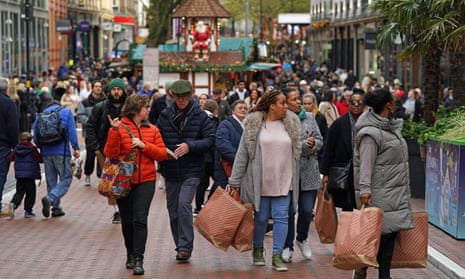
Shoppers on New Street in Birmingham. Minority ethnic people make up 51.4% of the population in the UK’s second largest city, where 20 years ago seven out of 10 people were white. Photograph: Jacob King/PA
England and Wales are now minority Christian countries, according to the 2021 census, which also shows that Leicester and Birmingham have become the first UK cities to have “minority majorities”.
The census revealed a 5.5 million (17%) fall in the number of people who describe themselves as Christian and a 1.2 million (43%) rise in the number of people who say they follow Islam, bringing the Muslim population to 3.9 million. In percentage-point terms, the number of Christians has dropped by 13.1, and the number of Muslims has risen by 1.7.
It is the first time in a census of England and Wales that fewer than half of the population have described themselves as Christian.
Less than half the population in England and Wales now describe themselves as Christians

Guardian graphic. Source: ONS 2011 Census and 2021 Census
Meanwhile, 37.2% of people – 22.2 million – declared they had “no religion”, the second most common response after Christian. It means that over the past 20 years the proportion of people reporting no religion has soared from 14.8% – a rise of more than 22 percentage points.
The archbishop of York, Stephen Cottrell, said the census result “throws down a challenge to us not only to trust that God will build his kingdom on Earth but also to play our part in making Christ known”.
He added: “We have left behind the era when many people almost automatically identified as Christian but other surveys consistently show how the same people still seek spiritual truth and wisdom and a set of values to live by.”
The chief executive of Humanists UK, Andrew Copson, said: “One of the most striking things about these census results is how at odds the population is from the state itself. No state in Europe has such a religious setup as we do in terms of law and public policy, while at the same time having such a non-religious population.”
Analysis by the Guardian shows areas with a higher proportion of people from ethnic minorities are also more religious. And places with a higher proportion of white population also have a bigger proportion of people with no religion. The places with the highest numbers of people saying they had no religion were Caerphilly, Blaenau Gwent and Rhondda Cynon Taf, all in south Wales, and Brighton and Hove and Norwich in England. They were among 11 areas where more than half the population are not religious, including Bristol, Hastings in East Sussex and Ashfield in Nottinghamshire, most of which had relatively low ethnic minority populations.
Over half the people in six areas of south Wales do not follow any religion

Guardian graphic. Source: ONS Census of England and Wales 2021
The places with the lowest number of non-believers were Harrow, Redbridge and Slough, where close to two-thirds of the populations are from minority ethnic backgrounds.
The slump in religion and emergence of minority ethnic populations as a combined majority in whole conurbations in England and Wales is revealed in data about the ethnicity, religion and language of close to 60 million people gathered in a snapshot census on 21 March 2021. The Office for National Statistics (ONS) cited differing patterns of ageing, fertility, mortality and migration as possible reasons for the change in religious profile of the countries.
The populations of Leicester, Luton and Birmingham are now greater than 50% black and minority ethnic

The populations of Leicester, Luton and Birmingham are now greater than 50% black and minority ethnic
Proportion of population identifying as BAME, 2021 census
Guardian graphic. Source: ONS Census of England and Wales 2021
Across the two countries, 81.7% of the population is now white, including non-British, down from 86% in 2011, 9.3% is Asian British, up from 7.5%, 2.5% is Black, Black British, Black Welsh, Caribbean-African and African, up from 1.8%, and 1.6% are other ethnicities.
Ushering in a new age of city-wide “super diversity”, the ONS data showed 59.1% of the people of Leicester are now from ethnic minority groups, a big change since 1991, when black and minority ethnic people made up just over a quarter of the city’s residents. Leicester’s Asian population first became well established after 20,000 people settled in the east Midlands manufacturing city after expulsion from Uganda in 1972.
Minority ethnic people also make up more than half the population in Luton (54.8%) and Birmingham (51.4%), the UK’s second largest city where 20 years ago seven out of 10 people were white. Since the second world war, Birmingham’s population has grown with immigration from the Caribbean and south Asia, as well as Gujaratis who had been in east Africa.


 over the last 20 years the internet usage has become mainstream and knowledge is more accessible. it's only natural that with more knowledge about the world, religion have less appeal and sway with people.