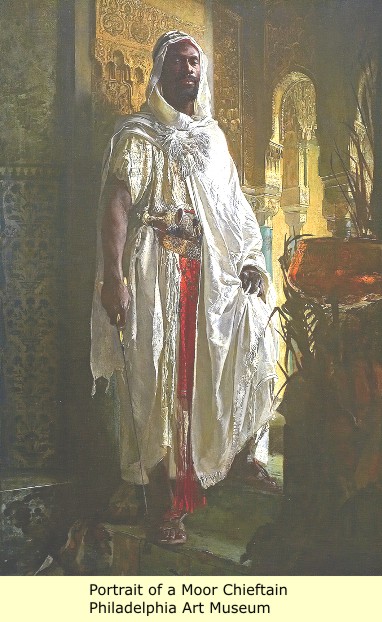
Before the Advent of the Black Moors of Africa who ruled parts of Spain for 700 years there was Medieval Europe a classic rat hole. Until the Blacks came in from Africa and cleaned it up.
European cities were buried in sewage. Town residents splashed the contents of garbage pails and washtubs out into the street on the heads of carefree passers-by. Stagnated slops made stinking pools; and a great number of town pigs crowned the whole picture. People emptied chamber pots right out of their windows making streets look like cesspools. Bathrooms were the rarest luxury. Fleas, lice and bugs swarmed in rich and poor houses of London and Paris.
Unsanitary conditions, diseases and starvation personify medieval Europe as it was. Even the noble class could not afford to eat their fill. Noble families were happy if at best two or three of ten children survived. Delivery was quite an undertaking for women: a third part of them died in labor. Street illumination also was poor oil lamps, splinters or wax candles at best. Hunger, smallpox, leprosy and syphilis disfigured peoples faces.
There were not any cleaning agents or the notion of personal hygiene in Europe up to the middle of the 19th century. One Italian nobleman said in his memoirs that in the 16th century it was impossible to walk along the streets that resembled a fetid stream of turbid water. He had to hold a scented handkerchief or a small bouquet to his nose not to vomit. But not only feces poisoned the air. Butchers slaughtered and disembowel cattle right in the streets. They would scatter guts around and pour blood out onto the pavement.
In late Middle Ages people learned to process wastes and feces. Urine, for example, was used to tan leather and bleach cloth, animals bones to produce flour. In days of old painters placed barrels for urine near the farms, they used it to knead paints. In Ancient Rome they sold even the urine from latrines to wool dyers and leather tanners. What could not be processed was left in the street.
The Moors came through and introduced them to bathrooms and its use, how to take a bath and showed them the purpose and means for soap and deodorant. The Moors, who ruled Spain for 800 years, introduced new scientific techniques to Europe, such as an astrolabe, a device for measuring the position of the stars and planets. Scientific progress in Astronomy, Chemistry, Physics, Mathematics, Geography and Philosophy flourished in Moorish Spain.
European cities were buried in sewage. Town residents splashed the contents of garbage pails and washtubs out into the street on the heads of carefree passers-by. Stagnated slops made stinking pools; and a great number of town pigs crowned the whole picture. People emptied chamber pots right out of their windows making streets look like cesspools. Bathrooms were the rarest luxury. Fleas, lice and bugs swarmed in rich and poor houses of London and Paris.
Unsanitary conditions, diseases and starvation personify medieval Europe as it was. Even the noble class could not afford to eat their fill. Noble families were happy if at best two or three of ten children survived. Delivery was quite an undertaking for women: a third part of them died in labor. Street illumination also was poor oil lamps, splinters or wax candles at best. Hunger, smallpox, leprosy and syphilis disfigured peoples faces.
There were not any cleaning agents or the notion of personal hygiene in Europe up to the middle of the 19th century. One Italian nobleman said in his memoirs that in the 16th century it was impossible to walk along the streets that resembled a fetid stream of turbid water. He had to hold a scented handkerchief or a small bouquet to his nose not to vomit. But not only feces poisoned the air. Butchers slaughtered and disembowel cattle right in the streets. They would scatter guts around and pour blood out onto the pavement.
In late Middle Ages people learned to process wastes and feces. Urine, for example, was used to tan leather and bleach cloth, animals bones to produce flour. In days of old painters placed barrels for urine near the farms, they used it to knead paints. In Ancient Rome they sold even the urine from latrines to wool dyers and leather tanners. What could not be processed was left in the street.
The Moors came through and introduced them to bathrooms and its use, how to take a bath and showed them the purpose and means for soap and deodorant. The Moors, who ruled Spain for 800 years, introduced new scientific techniques to Europe, such as an astrolabe, a device for measuring the position of the stars and planets. Scientific progress in Astronomy, Chemistry, Physics, Mathematics, Geography and Philosophy flourished in Moorish Spain.