

Fairfax County, USA
Hillary Clinton won rich suburbs in record numbers. But her campaign failed to mobilize workers of all races.
by Matt Karp

Hillary Clinton at the European Parliament in 2010. European Parliament / Flickr
In the wake of Donald Trump’s stunning and disastrous Electoral College victory, analysts have zeroed in on one demographic group that bears the burden for Hillary Clinton’s defeat: white voters without college degrees.
Crudely grouped under the rubric “white working class,” these voters helped push Trump past Clinton in the battleground states of Pennsylvania, Ohio, Michigan, and Wisconsin.
In the weeks since, this same group — a vast and heterogeneous cohort that represents more than 40 percent of the electorate in all four states — has been the subject of a maddeningly unhelpful public debate.
Were some of these voters drawn to the siren of Trump’s white nationalist campaign? Yes, obviously. Were some of them expressing frustration at the social and economic decline of their communities, and the manifest inability of Democratic politicians to address it? Yes, just as obviously. Might these things all be related, in some fundamental way? You’re better off asking President Obama than a liberal pundit.
But while a chunk of this amorphous group may have decided the election by defecting from Obama to Trump, white Midwesterners without college diplomas were not the only Americans who voted this November. Nor are they the only demographic that can tell us something about the nature of the campaign and the evolution of both major parties.
Chasing the Moderate Republican
In the Democratic primary, Hillary Clinton fended off Bernie Sanders’s challenge with the strong support of two key groups: wealthy, educated whites and mostly working-class nonwhite Democrats.
While Sanders gradually improved his standing with younger nonwhite voters, it was not enough to take the nomination. Clinton’s core coalition — an effective alliance between the Upper East Side and East Flatbush — held firm, leading Clinton to blowout wins in states like New York, Texas, and Florida.
Clinton counted on the same alliance to carry her to victory in the general election. Very quickly, though, Democratic leaders made it clear that in a campaign against Donald Trump, not all members of the coalition required equal attention.
Faced with a Republican opponent who openly touted his affinity for “the poorly educated,” Team Clinton focused on courting white voters at the opposite end of the class pyramid. Trump’s vulgarity and chauvinism, they hoped, would drive wealthy Republican moderates toward Clinton. Rather than aggressively contest Trump’s bogus populism, Democratic strategists concentrated on “moderate” suburban Republicans — the ideological cousins, and often the literal neighbors, of professional-class Democrats.
“For every one of those blue-collar Democrats [Trump] picks up,” former Pennsylvania governor Ed Rendell predicted in February, “he will lose to Hillary two socially moderate Republicans and independents in suburban Cleveland, suburban Columbus, suburban Cincinnati, suburban Philadelphia, suburban Pittsburgh, places like that.”
Electorally, of course, this strategy proved catastrophic. In the Midwestern swing states, Clinton hemorrhaged white “blue-collar Democrats” without winning nearly enough “moderate Republicans” to compensate.
Nevertheless, the election results show that the Democrats’ conscious effort to woo the rich wasn’t entirely for naught. Clinton ran nine points ahead of Obama’s 2012 tally among voters earning more than $100,000. Further up the income ladder, among voters making more than $250,000 annually, she bested Obama’s margin by a full eleven points.
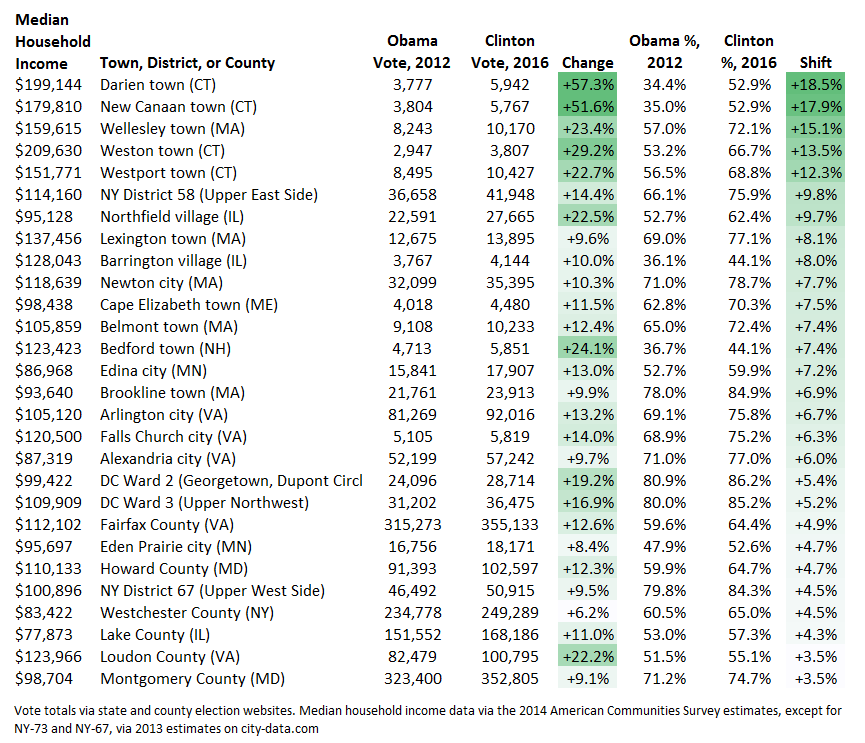
And although overall Democratic turnout declined substantially from 2012, it is wrong to say that nobody was excited to vote for Clinton. In the wealthy and well-educated suburbs of cities like Boston, Chicago, and Minneapolis — as in the effectively suburbanized enclaves of Manhattan and Washington, DC — Clinton’s vote total far surpassed Obama’s mark four years ago.
Nate Silver has compiled tables that show the huge shift from Obama to Clinton in America’s most educated counties. But his confident gloss that “education, not income” guided the electorate somewhat overstates the case, even according to his own data. A look at affluent suburban returns on a district and town level suggests that some combination of income, education, culture, and geography — in a word, “class” — drove Clinton’s most dramatic gains.
Incomplete returns in wealthy, suburban West Coast areas — like Orange County, located outside of Los Angeles, and Marin and San Mateo counties, outside of San Francisco — reveal a similar Clinton surge.
Much of this, no doubt, reflects elite aversion to Trump rather than pure affection for Clinton. But that’s not the whole story. After all, these affluent and expensively credentialed suburbs also delivered Clinton huge margins during the Democratic primary.
Bernie Sanders’s style of class politics — and his program of mild social-democratic redistribution — did not gain much favor in New Canaan, Connecticut (where he won 27 percent of the vote) or Northfield, Illinois (39 percent). For some suburban Democrats, Sanders’s throttling in these plush districts virtually disqualified him from office: “A guy who got 36 percent of the Democrats in Fairfax County,” an ebullient Michael Tomasky wrote after the Virginia primary, “isn’t going to be president.”
Clinton was their candidate. By holding off Sanders’s populist challenge — and declining to concede fundamental ground on economic issues — the former secretary of state proved she could be trusted to protect the vital interests of voters in Newton, Eden Prairie, and Falls Church. They, more than any other group in America, were enthusiastically #WithHer.
To some extent, Clinton’s appeal even carried over to wealthy red-state suburbs. In Forysth County outside Atlanta, and Williamson County outside Nashville — the richest counties in Georgia and Tennessee — Clinton lost big but improved significantly on Obama’s performance in 2012.
But wealthy, educated suburbanites were never going to push the Democrats over the top all by themselves. Despite Clinton’s incremental gains, in the end, most rich white Republicans remained rich white Republicans: hardly the sturdiest foundation for an anti-Trump majority.
So what about the other, much larger wing of Clinton’s primary coalition?
Hillary Clinton won rich suburbs in record numbers. But her campaign failed to mobilize workers of all races.
by Matt Karp
Hillary Clinton at the European Parliament in 2010. European Parliament / Flickr
In the wake of Donald Trump’s stunning and disastrous Electoral College victory, analysts have zeroed in on one demographic group that bears the burden for Hillary Clinton’s defeat: white voters without college degrees.
Crudely grouped under the rubric “white working class,” these voters helped push Trump past Clinton in the battleground states of Pennsylvania, Ohio, Michigan, and Wisconsin.
In the weeks since, this same group — a vast and heterogeneous cohort that represents more than 40 percent of the electorate in all four states — has been the subject of a maddeningly unhelpful public debate.
Were some of these voters drawn to the siren of Trump’s white nationalist campaign? Yes, obviously. Were some of them expressing frustration at the social and economic decline of their communities, and the manifest inability of Democratic politicians to address it? Yes, just as obviously. Might these things all be related, in some fundamental way? You’re better off asking President Obama than a liberal pundit.
But while a chunk of this amorphous group may have decided the election by defecting from Obama to Trump, white Midwesterners without college diplomas were not the only Americans who voted this November. Nor are they the only demographic that can tell us something about the nature of the campaign and the evolution of both major parties.
Chasing the Moderate Republican
In the Democratic primary, Hillary Clinton fended off Bernie Sanders’s challenge with the strong support of two key groups: wealthy, educated whites and mostly working-class nonwhite Democrats.
While Sanders gradually improved his standing with younger nonwhite voters, it was not enough to take the nomination. Clinton’s core coalition — an effective alliance between the Upper East Side and East Flatbush — held firm, leading Clinton to blowout wins in states like New York, Texas, and Florida.
Clinton counted on the same alliance to carry her to victory in the general election. Very quickly, though, Democratic leaders made it clear that in a campaign against Donald Trump, not all members of the coalition required equal attention.
Faced with a Republican opponent who openly touted his affinity for “the poorly educated,” Team Clinton focused on courting white voters at the opposite end of the class pyramid. Trump’s vulgarity and chauvinism, they hoped, would drive wealthy Republican moderates toward Clinton. Rather than aggressively contest Trump’s bogus populism, Democratic strategists concentrated on “moderate” suburban Republicans — the ideological cousins, and often the literal neighbors, of professional-class Democrats.
“For every one of those blue-collar Democrats [Trump] picks up,” former Pennsylvania governor Ed Rendell predicted in February, “he will lose to Hillary two socially moderate Republicans and independents in suburban Cleveland, suburban Columbus, suburban Cincinnati, suburban Philadelphia, suburban Pittsburgh, places like that.”
Electorally, of course, this strategy proved catastrophic. In the Midwestern swing states, Clinton hemorrhaged white “blue-collar Democrats” without winning nearly enough “moderate Republicans” to compensate.
Nevertheless, the election results show that the Democrats’ conscious effort to woo the rich wasn’t entirely for naught. Clinton ran nine points ahead of Obama’s 2012 tally among voters earning more than $100,000. Further up the income ladder, among voters making more than $250,000 annually, she bested Obama’s margin by a full eleven points.
And although overall Democratic turnout declined substantially from 2012, it is wrong to say that nobody was excited to vote for Clinton. In the wealthy and well-educated suburbs of cities like Boston, Chicago, and Minneapolis — as in the effectively suburbanized enclaves of Manhattan and Washington, DC — Clinton’s vote total far surpassed Obama’s mark four years ago.
Nate Silver has compiled tables that show the huge shift from Obama to Clinton in America’s most educated counties. But his confident gloss that “education, not income” guided the electorate somewhat overstates the case, even according to his own data. A look at affluent suburban returns on a district and town level suggests that some combination of income, education, culture, and geography — in a word, “class” — drove Clinton’s most dramatic gains.
Incomplete returns in wealthy, suburban West Coast areas — like Orange County, located outside of Los Angeles, and Marin and San Mateo counties, outside of San Francisco — reveal a similar Clinton surge.
Much of this, no doubt, reflects elite aversion to Trump rather than pure affection for Clinton. But that’s not the whole story. After all, these affluent and expensively credentialed suburbs also delivered Clinton huge margins during the Democratic primary.
Bernie Sanders’s style of class politics — and his program of mild social-democratic redistribution — did not gain much favor in New Canaan, Connecticut (where he won 27 percent of the vote) or Northfield, Illinois (39 percent). For some suburban Democrats, Sanders’s throttling in these plush districts virtually disqualified him from office: “A guy who got 36 percent of the Democrats in Fairfax County,” an ebullient Michael Tomasky wrote after the Virginia primary, “isn’t going to be president.”
Clinton was their candidate. By holding off Sanders’s populist challenge — and declining to concede fundamental ground on economic issues — the former secretary of state proved she could be trusted to protect the vital interests of voters in Newton, Eden Prairie, and Falls Church. They, more than any other group in America, were enthusiastically #WithHer.
To some extent, Clinton’s appeal even carried over to wealthy red-state suburbs. In Forysth County outside Atlanta, and Williamson County outside Nashville — the richest counties in Georgia and Tennessee — Clinton lost big but improved significantly on Obama’s performance in 2012.
But wealthy, educated suburbanites were never going to push the Democrats over the top all by themselves. Despite Clinton’s incremental gains, in the end, most rich white Republicans remained rich white Republicans: hardly the sturdiest foundation for an anti-Trump majority.
So what about the other, much larger wing of Clinton’s primary coalition?

