Fifty Years Later, the Immigration Bill That Changed America

theworldismine13

God Emperor of SOHH
Joined
May 4, 2012
Messages
22,799
Reputation
570
Daps
22,758
Reppin
Arrakis
Fifty Years Later, the Immigration Bill That Changed America
http://www.newsweek.com/immigration-reform-act-50-years-later-371879

On the 2016 campaign trail, immigration has been a flash point unlike any other. But as Donald Trump pushes his scheme to build a wall across America’s southern border and Hillary Clinton promises to go further than President Obama in protecting migrants without documentation, a major immigration reform a half-century ago is a reminder that policy changes often don’t go as planned. For today’s politicians, perhaps the biggest takeaway of the Immigration and Nationality Act is to expect unintended consequences.

It was back in 1965, during the depths of the Cold War and the peak of the civil rights movement, that the United States overhauled its immigration laws. Working with liberal Democrats and liberal Republicans (who existed back then), President Lyndon Johnson pushed a bill that did away with the “national origins quota” system. The old quota system, in place since the 1920s, determined who could immigrate to the U.S. based on ethnicity, with a heavy tilt toward Western Europeans—especially the English, Irish and Germans. Only small allotments were granted to Eastern Europeans, Asians and Africans.

That became an issue for the United States in the ‘60s, when new countries were emerging from colonialism, pitting the U.S. and the Soviet Union in a contest for their allegiances. Republican Senator Jacob Javits, a liberal from New York, noted in September 1965 that the immigration system, with its bias toward Western Europeans, “remains today a target for Communist propaganda…making our effort to win over the uncommitted nations more difficult.”

Try Newsweek for only $1.25 per week

The racial discrimination inherent in the quota system clashed with the idealism of Civil Rights and Voting Rights Acts. And most of all, the ethnic limits ran contrary to many Americans’ image of their country. “As President Kennedy so aptly stated, we are a ‘nation of immigrants,’” Massachusetts Republican Senator Leverett Saltonstall told his colleagues during the debate on the bill. “There is scarcely an area of our national life that has not been favorably affected by the work of people from other lands.”

By ‘65, however, some conservatives in the U.S. House publicly “worried about the size and scale of future Latin American immigration,” says Dan Tichenor, a professor of political science at the University of Oregon, “and were trying to put barriers in its way.” Liberal lawmakers didn’t like that idea, but they doubted that the new restrictions would have much impact. The limits were high enough, Senator Javits conceded, that immigration from the Western Hemisphere under the new law “would be approximately the same as the level reached last year”—a modest 140,000 or thereabouts. Yet the total number of persons of Mexican origin in the U.S. went from 5 million in 1970, the first census after the act, to almost 34 million today.

The Western Hemisphere cap was one key concession that opponents of Johnson’s immigration reform were able to extract. The other significant change was that visas be prioritized for migrants with family ties in the United States. Johnson and the bill’s supporters backed a system that would have put a priority on skill, which ended up being secondary in the new law.

When Johnson signed the Immigration and Nationality Act at the foot of the Statue of Liberty 50 years ago this October, he declared that the new law undoing the old quota system was “not a revolutionary bill. It does not affect the lives of millions.” In fact, it did. The new system, which opened up American immigration to the world, has dramatically shifted the blend of people coming to the country while contributing to the surge in immigrants from Mexico and Latin America entering the U.S. without documentation—neither of which its authors ever intended.

There were “a whole series of consequences unleashed” by this new law, says UCLA Law professor Hiroshi Motomura, author of Americans in Waiting: The Lost Story of Immigration and Citizenship in the United States. Though the 1965 law eliminated ceilings on visas for specific ethnicities across Asia and Africa, it did keep a cap in place for the Eastern Hemisphere—encompassing migrants from Europe, Africa and Asia. As a compromise, it also set the cap on immigration from the Western Hemisphere for the first time. That’s right: The U.S. used to allow unlimited immigration from Mexico. Even as restrictionists had layered on more and more limits on immigrants, starting with the Chinese in the 1880s, the Japanese around the turn of the century, and the rest of Asia, Africa and much of Europe in the 1920s, the U.S. allowed the open flow of immigration from Canada and nations to the south, part of what was considered a “good neighbor” policy.

0925immigration03.jpg
Republican frontrunner Donald Trump holds a press conference during a much trouted visit to the U.S. Mexico border in Laredo, Texas, on July 23. LM Otero/AP

The conservatives who backed a system of giving a majority of visas to family members of U.S. citizens “thought we would see an expansion in Southern and Eastern European immigration,” says Tichenor. “They never really anticipated the dramatic increase in Asian and Latin American immigration” that resulted thanks to family unification rules. Essentially, the new law allowed American citizens to obtain visas for not only their small children and spouses, but also their sisters and brothers and adult children, who then became citizens and began the process over again.

That started a slow but steady progression of Asian and Latino migration, which had only small populations in the United States before ‘65. In the 1950s, Europeans made up 56 percent of those immigrants obtaining lawful permanent residence in the U.S., while those from Canada and Latin America were 37 percent, and all of Asia accounted for a measly 5 percent, according to Department of Homeland Security statistics. By this past decade, however, Europeans had dropped to just 14 percent of new lawful permanent residents, compared with 35 percent from Asia and 44 percent from the Americas.

One more factor had a major impact: At the same time immigration law was shifting in 1965, a new national workforce policy was also kicking in. A year earlier, in 1964, the federal government ended what was known as the Bracero Program, launched during World War II’s labor shortages to provide temporary laborers from Mexico to American farms and fields. But the program was rife with worker abuses and ardently opposed by labor unions, which believed the migrants pushed down wages for Americans. That opposition finally succeeded in halting the Bracero Program in ’64, to the consternation of the agriculture industry.

Proponents of the move in the Department of Labor and elsewhere believed they could wean farmers off Mexican labor. But “many of the same people who were coming under the Bracero Program or their relatives or the people who were in those networks continued to come,” says Boston College professor Peter Skerry, an expert on immigration and ethnic politics. It’s just that now they came illegally. Over the ensuing decades, that reality combined with the new caps on migrants from Latin America turned what had been legal migration, illegal.

Economic trends in both Latin America and the U.S. also encouraged more migration. As Motomura explains it, 1965 was the “beginning of a mismatch of the legal immigration system and the demands of the economy.” Specifically, urbanization and economic dislocation drove Mexicans and other Central Americans from rural areas north in search of work, while Americans were obtaining higher levels of education and moving away from menial labor. “In 1950, more than half of the labor force were high school dropouts. Now it’s less than 5 percent,” notes Tamar Jacoby, president of the business-backed coalition ImmigrationWorks USA. The law’s drafters “didn’t foresee that.” That’s an understatement.

The lesson of unintended consequences is something advocates on both sides of today’s immigration debate acknowledge. “The first lesson is: Don’t believe everything a politician tells you. As we’ve seen with all kinds of social innovations from the 1960s and 1970s, the assurances of their promoters turn out to be incomplete or false,” says Mark Krikorian, the head of the Center for Immigration Studies, which advocates for much tighter controls on immigration. He and Jacoby agree that the family migration provisions have pushed the system out of whack. But they’re vehemently divided over whether the country still needs robust immigration, and if unmet labor demand is at the root of America’s glut of undocumented migrants.

Disagreements on immigration ultimately come down to a debate over what America should be and how its economy should work. Though President Johnson promised the law “ will not reshape the structure of our daily lives,” the ensuing shifts in population and migration patterns has indeed meant “big changes in American life,” says Skerry, for good and for ill. The last time politicians hashed out a new immigration system, they didn’t entirely weigh those implications. Today’s leaders would be wise to think about the ripple effect before they mess with the borders.
 

hashmander

Hale End
Supporter
Joined
Jan 17, 2013
Messages
21,165
Reputation
5,577
Daps
90,850
Reppin
The Arsenal
haha so the conservative republicans/dixiecrats forced a change in the initial proposal from skills based immigration because they were scared that the country's demographic profile would change to radically if educated asians, africans, etc were being included and instead insisted on the family reunification model that we have today because their assumption was that the existing immigrants would bring over their european family. but europe was recovering and the pressure to leave wasn't as great anymore and instead you got a bunch of family reunification from asia, africa and the caribbean instead.

no wonder conservatives are scared to act on immigration reform. even when they try to be racist it backfires. but even doing nothing has the potential to backfire when people look back on today in 2065.
 

VICVALLIN

Pro
Joined
May 7, 2012
Messages
979
Reputation
170
Daps
2,439
Reppin
NULL
its so ironic to me that people have been making the same arguments regarding immigration in this country for centuries, regardless of legality, regardless of ethnicity. its always been they're taking jobs from real americans, they don't know the language, they refuse to assimilate and insist on holding onto the customs of their homeland, etc. nevermind the fact that immigrant labor has been keeping the prices of goods and services low since the first european settlers landed here.
 

theworldismine13

God Emperor of SOHH
Joined
May 4, 2012
Messages
22,799
Reputation
570
Daps
22,758
Reppin
Arrakis
The Unintended Consequences Of The 1965 Immigration Act


Fifty years ago, President Lyndon B. Johnson signed a new immigration law that would change the face of the nation. But that dramatic impact, ironically, was in good part the result of a major miscalculation by those who actually wanted to limit the bill's effect.

The Immigration and Nationality Act, signed at the foot of the Statue of Liberty on Oct. 3, 1965, abolished the national origin quota system, under which immigrants were chosen on the basis of their race and ancestry. The quotas set aside tens of thousands of visas each year for immigrants from Northern and Western Europe, while many countries in Asia, Africa, and the Middle East were allocated barely 100 slots each. It was a blatantly discriminatory system.

Under the new law, immigrants were to be selected on the basis of their family connections in the United States and the skills and training they could offer, with all nationalities treated more or less equally.

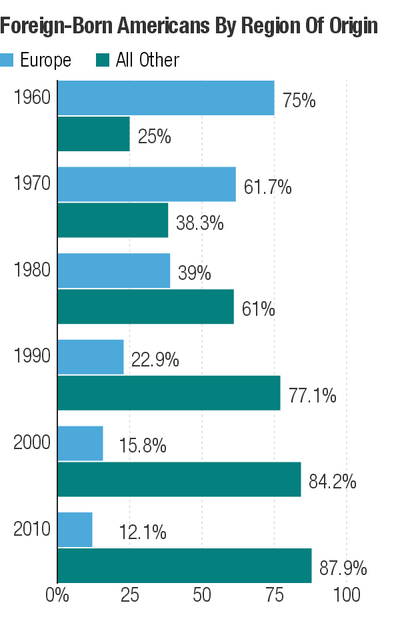
foreign-born-americans-by-region-of-origin_chartbuilder_custom-9770b1e7f27dbfa1e4906f473e578e59d20408e8-s400-c85.png

Foreign-born Americans by region of origin.

U.S. Census Bureau. Credit L. Carol Ritchie/PR
Fifty years after its passage, it is clear the law definitively altered the complexion of the U.S. population. In 1965, the immigrant share of the population was at an all-time low. Eighty-five percent of the population was white, and 7 out of 8 immigrants were coming from Europe. By 2010, the share of the U.S. population born overseas had tripled, and 9 out of 10 immigrants were coming from outside Europe.

The law was enacted at the height of the civil rights movement, and although it was motivated by the desire to eliminate discrimination, it was largely overshadowed at the time by the 1964 Civil Rights Act and the 1965 Voting Rights Act. Even its supporters saw its passage as largely a symbolic victory. "The bill that we sign today is not a revolutionary bill," Johnson said at the Statue of Liberty. "It does not affect the lives of millions."

The fact that its consequences were unanticipated is due largely to the law's rather curious legislative history. The original version of the bill, introduced in the Senate by Philip Hart (D-Mich.) and in the House by Emanuel Celler (D-N.Y.), gave immigration preference to people whose skills and training would be "especially advantageous" to the United States.

"A nation that was built by the immigrants of all lands can ask those who seek admission, 'What can you do for our country?' "Johnson said in his 1964 State of the Union address. "But we should not be asking, 'In what country were you born?' "

During the debate over the bill, however, conservatives said it was entirely appropriate to select immigrants on the basis of their national origin. The United States, they argued, was fundamentally an Anglo-Saxon European nation and should stay that way.

Sen. Sam Ervin (D-N.C.) said he objected to the idea of giving people from Ethiopia the same right to immigrate to the United States as people from England, France, Germany, or Holland. "With all due respect to Ethiopia," Ervin said, "I don't know of any contributions that Ethiopia has made to the making of America."

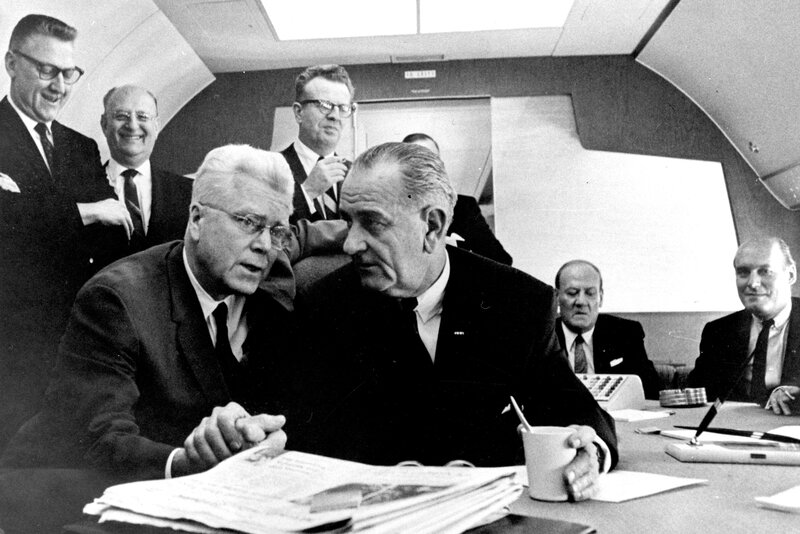
The conservatives had an ally in Rep. Michael Feighan (D-Ohio), the famously ornery chairman of the House Immigration subcommittee. Feighan refused even to hold hearings on the immigration reform bill and relented only after the president gave him the famous "Johnson treatment" when he took Feighan to Ohio with him on Air Force One.

gjelten8_slide-9536835f9c4b7b24512279288bd12bf889cd2c35-s800-c85.jpg

President Lyndon B. Johnson giving Rep. Michael Feighan the famous "Johnson treatment" — using his imposing physical presence to persuade — aboard Air Force One during a presidential trip to Cleveland in 1964. LBJ put heavy pressure on Feighan to support the new immigration legislation.

Princeton University Library/Simon & Schuster
In the end, Feighan agreed to support the reform proposal, but he insisted on a key change. Rather than giving preference to those immigrants whose skills were "especially advantageous" to the United States, Feighan insisted on prioritizing those immigrants who already had relatives in the United States, with a new preference category for adult brothers and sisters of naturalized U.S. citizens.

In justifying the change, Feighan told his conservative allies that a family unification preference would favor those nationalities already represented in the U.S. population, meaning Europeans. Among the conservative groups persuaded by Feighan's argument was the American Legion, which came out in support of the immigration reform after originally opposing it.

In an article praising Feighan's legislative prowess, two Legion representatives said he had "devised a naturally operating national-origin system." A family unification preference, they argued, would preserve America's European character.

"Nobody is quite so apt to be of the same national origins of our present citizens as are members of their immediate families," they wrote. Supporters of the move to eliminate national origin quotas feared they had been outmaneuvered.

But the scheme backfired. What Feighan and his allies did not recognize was that the motivation of Europeans to move to the United States was diminishing, while the urge to migrate was growing in Asia, Africa and other non-European countries.

"You had a huge pent-up feeling of wanting to come to the New World," says Muzaffar Chisti, a senior lawyer at the Migration Policy Institute.

Some people from those areas were able to immigrate by getting student visas or employer sponsorships or through marriage to a legal resident, and as they gained a foothold in the United States, they invited other family members to join them.

By 2010, family unification provisions were accounting for about three-quarters of all U.S. immigration, and they were largely benefiting people from those parts of the world that Feighan and his allies considered less desirable.

Though it did so inadvertently, the 1965 Immigration Act fulfilled a promise the country's founders had made but which had been almost forgotten over the next 200 years. "The bosom of America is open to receive not only the Opulent and Respectable Stranger," George Washington famously declared, "but the oppressed and persecuted of all Nations and Religions, whom we shall welcome to a participation of all our rights and privileges, if by decency and propriety of conduct they appear to merit the enjoyment."

Chisti, himself an immigrant from India, says the 1965 Immigration Act sent a message to the rest of the world "that America is not just a place for certain privileged nationalities to come. We are truly the first universal nation," Chisti says. "That may have been the promise of the founding fathers, but it took a long time to realize that. And the '65 Act was critical in making that happen."

But on its 50th anniversary, not everyone is celebrating the law that made America more diverse. In this election season, some commentators have intensified their complaints about immigration. Not only are there too many foreigners, some say; they're not white enough.

"The 1965 Act [changed the kind of people who could come] through a series of complicated rules to bring in people from cultures as different from ours as possible and as poor as possible," said conservative author Ann Coulter in a recent interview on C-SPAN's Book TV.

Coulter suggests that liberals may have engineered the post-1965 immigration influx in order to attract new voters for the Democratic Party. But while immigrants do tend to vote Democratic, the "rules" that brought them here are largely the product of a scheme devised originally to keep "different" cultures out.

As the 1965 Immigration Act demonstrates, laws sometimes have unintended consequences.
 
Top