Vonte3000
Chance 3 :wow: :blessed:

Throughout the late 19th century, and well into the 1950′s, Africans and in some cases Native Americans, were kept as exhibits in zoos. Far from a relic from an unenlightened past, remnants of such exhibits have continued in Europe as late as the 2000′s.
Throughout the early 20th century, Germany held what was termed a, “Peoples Show,” or Völkerschau. Africans were brought in as carnival or zoo exhibits for passers-by to gawk at.
Only decades before, in the late 1800′s, Europe had been filled with, “human zoos,” in cities like Paris, Hamburg, Antwerp, Barcelona, London, Milan, and Warsaw. New York too saw these popular exhibits continue
 into the 20th century. There was an average of 200,000 to 300,000 visitors who attended each exhibition in each city.
Carl Hagenbeck of Germany ran exhibits of what he called, “purely natural,” populations, usually East Asian Islanders, but in 1876, he also sent a collaborator to the Sudan to bring back, “wild beasts and Nubians.” The traveling Nubian exhibit was a huge success in cities like Paris, London, and Berlin.
The World’s Fair, in 1889 was visited by 28 million people, who lined up to see 400 indigenous people as the major attraction. The 1900 World’s Fair followed suit, as did the Colonial Exhibitions in Marseilles (1906 and 1922) and in Paris (1907 and 1931) which displayed naked or semi-naked humans in cages. Paris saw 34 million people attend their exhibition in six months alone.
Just four years shy of the 20th century, the Cincinnati Zoo kept one hundred Sioux Native Americans in a mock village at the zoo for three months.
In 1906, the amateur anthropologist Madison Grant
, who was the head of the New York Zoological Society, put a Congolese pygmy Ota Benga, on display at the Bronx Zoo in New York City. The display was in the primate exhibit, and Ota was often made to carry around chimpanzees and other apes. Eugenicist and zoo director William Hornaday labeled Ota, “The Missing Link.” The public flocked to see the display.Benga shot targets with a bow and arrow, wove twine, and wrestled with an orangutan. Although, according to the New York Times, “few expressed audible
objection to the sight of a human being in a cage with monkeys as companions,” controversy erupted as black clergymen in the city took great offense. “Our race, we think, is depressed enough, without exhibiting one of us with the apes,” said the Reverend James H. Gordon, superintendent of the Howard Colored Orphan Asylum in Brooklyn. “We think we are worthy of being considered human beings, with souls.”http://politicalblindspot.com/throu...tive-americans-were-kept-in-zoos-as-exhibits/
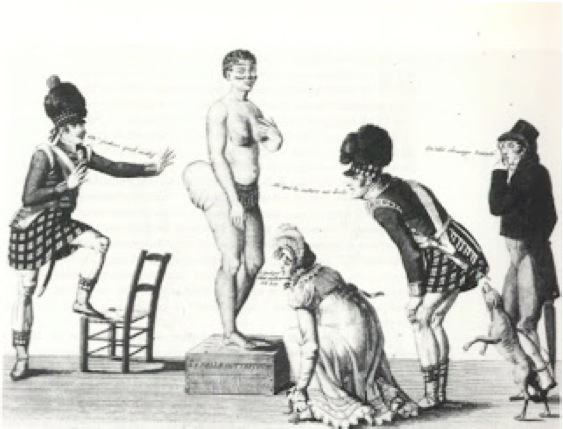
A 20 year-old girl from South Africa known as Sarah “Saartjie” Baartman would be emblematic of the dark era that gave rise to the popularity of human zoos. She was recruited by an exotic animal-dealer on location in Cape Town and traveled to London in 1810 to take part
in an exhibition. The young woman went willingly under the pretense that she would find wealth and fame. Exhibitors were looking for certain qualities in their ‘exotic’ recruits that either coincided with the European beauty ideal or offered unexpected novelty. Sarah had a genetic characteristic known as steatopygia; a protuberant buttocks and elongated labia.She found herself being exhibited in cages at sideshow attractions dressed in tight-fitting clothing that violated any cultural
norms of decency at the time. A few years later she came to Paris where racial anthropologists poked and prodded and made their theories. Sarah eventually turned to prostitution to support herself and drank heavily. She had been in Europe for only four years.When she died in poverty, Sarah’s skeleton, sexual organs and brain were put on display at the Museum of Mankind in Paris where they remained until 1974. In 2002, President Nelson Mandela formally requested the repatriation of her remains. Nearly two hundred years after she had stood on deck and watched her world disappear behind her, Sarah Baartman finally went home, where the air smelled of buchu and mint, and the veld called out her name.
http://www.popularresistance.org/deep-racism-the-forgotten-history-of-human-zoos/
This was just in the 1950's too and I"m only just now finding out about it


 ,
,