

Do yourselves a favor and read the whole article here: http://jezebel.com/from-miasma-to-ebola-the-history-of-racist-moral-panic-1645711030

On October 1st, the New York Times published a photograph of a four-year-old girl in Sierra Leone. In the photograph, the anonymous little girl lies on a floor covered with urine and vomit, one arm tucked underneath her head, the other wrapped around her small stomach. Her eyes are glassy, returning the photographer's gaze. The photograph is tightly focused on her figure, but in the background the viewer can make out crude vials to catch bodily fluids and an out-of-focus corpse awaiting disposal.
The photograph, by Samuel Aranda, accompanied a story headlined "A Hospital From Hell, in a City Swamped by Ebola." Within it, the Times reporter verbally re-paints this hellish landscape where four-year-olds lie "on the floor in urine, motionless, bleeding from her mouth, her eyes open." Where she will probably die amidst "pools of patients' bodily fluids," "foul-smelling hospital wards," "pools of infectious waste," all overseen by an undertrained medical staff "wearing merely bluejeans" and "not wearing gloves."
EXPAND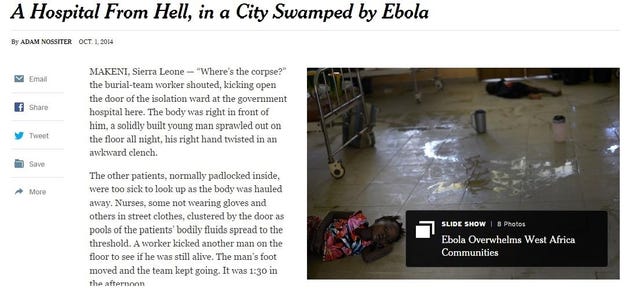
Aranda's photograph is in stark contrast to the images of white Ebola patients that have emerged from the United States and Spain. In these images the patient, and their doctors, are almost completely hidden; wrapped in hazmat suits and shrouded from public view, their identities are protected. The suffering is invisible, as is the sense of stench produced by bodily fluids: these photographs are meant to reassure Westerners that sanitation will protect us, that contagion is contained.
Pernicious undertones lurk in these parallel representations of Ebola, metaphors that encode histories of nationalism and narratives of disease. African illness is represented as a suffering child, debased in its own disease-ridden waste; like the continent, it is infantile, dirty and primitive. Yet when the same disease is graphed onto the bodies of Americans and Europeans, it morphs into a heroic narrative: one of bold doctors and priests struck down, of experimental serums, of hazmat suits and the mastery of modern technology over contaminating, foreign disease. These parallel representations work on a series of simple, historic dualisms: black and white, good and evil, clean and unclean.
The Western medical discourse on Africa has never been particularly subtle: the continent is often depicted as an undivided repository of degeneration. Comparing the representations of disease in Africa and in the West, you can hear the whispers of an underlying moral panic: a sense that Africa, and its bodies, are uncontainable. The discussion around Ebola has already evoked—almost entirely from Tea Party Republicans—the explicit idea that American borders are too porous and that all manners of perceived primitiveness might infect the West.
And indeed, with the history of American and European panic over regulating foreign disease comes a history of regulating the perception of filth from beyond our borders, a history of policing non-white bodies that have signified some unclean toxicity.


