Dusty Bake Activate
Fukk your corny debates
Matt Taibbi Interviews Bernie Sanders: Where We Go From Here
Matt Taibbi
10 hours ago
More News
Bernie Sanders' Political RevolutionJane Sanders: Why Bernie Voters Shouldn't Get Over ItAll Stories
It feels like a bomb went off in Washington. In less than a year, the leaders of both major parties have been crushed, fundamentally reshaping a political culture that for generations had seemed unalterable. The new order has belligerent outsider Donald Trump heading to the White House, ostensibly backed in Congress by a tamed and repentant majority of establishment Republicans. Hillary Clinton's devastating loss, meanwhile, has left the minority Democrats in disarray. A pitched battle for the soul of the opposition party has already been enjoined behind the scenes.

Bernie Sanders Fights On: The Rolling Stone Interview
A defiant candidate on what he's trying to achieve
Vermont Sen. Bernie Sanders, who won overwhelming youth support and 13 million votes during primary season, now sits on one side of that battle, in a position of enormous influence. The party has named him "outreach chair," and Minnesota congressman and Sanders political ally Keith Ellison is the favorite to be named head of the Democratic National Committee. This is a huge change from earlier this year, when the Sanders campaign was completely on the outs with the DNC, but many see Sanders' brand of politics as the Democrats' best shot at returning to prominence.
Sanders' rise is a remarkable story, obscured by the catastrophe of Trump's win. When I first visited with Sanders for Rolling Stone, 11 years ago, for a tour of the ins and outs of congressional procedure, he was a little-known Independent in the House from a tiny agrarian state, an eccentric toiler pushing arcane and unsexy amendments through Congress, usually on behalf of the working poor: expanded access to heating oil in the winter, more regional community health centers, prohibitions against regressive "cash-balance pension plans," etc.
His colleagues gently described Sanders as a hardworking quack, the root of his quackery apparently being that he was too earnest and never off-message, even in private. He had fans among Republicans (some called him an "honest liberal") and many detractors among Democrats, who often grew weary of his lectures about the perils of over-reliance on donations from big business and Wall Street.
In other words, Sanders was a political loner, making his recent journey to the top of the Democratic Party even more remarkable. He has been put in this position not by internal patronage but by voters who are using him to demand that Democrats change their priorities.
At his Washington office a week after the election, I sat down with Sanders and his wife, Jane, just after the release of his new book, Our Revolution: A Future to Believe In. When he offered to get me a copy, I told him I'd already read the e-book, at which he frowned. "Does that have the pictures?" he asked. He was relieved when I told him it did, including black-and-whites from his youth in Brooklyn.
Sanders' experiences growing up in the hardscrabble Flatbush neighborhood still seem central to the way he looks at the world. All the adults in his neighborhood voted Democratic. The loss of the support of those kinds of people still eats at Sanders, like a childhood wrong not yet corrected. Thus the opportunity he has now to push the Democrats back in that direction is something he doesn't take lightly. He's spent his whole life getting to this point.
The senator and his staffers were obviously sorting through a variety of emotions, and it was hard not to wonder what might have been. But Sanders admonished himself once or twice not to look back. "It's not worth speculating about," he said.
Instead, Sanders laid out the dilemma facing the Democratic Party. The Democrats must find their way back to a connection with ordinary people, and this will require a complete change in the way they do business. He's convinced that the huge expenditure of time and mental effort the Democrats put in to raise more than $1 billion for the Clinton campaign in the past year ended up having enormous invisible costs. "Our future is not raising money from wealthy people, but mobilizing millions of working people and young people and people of color," he says.
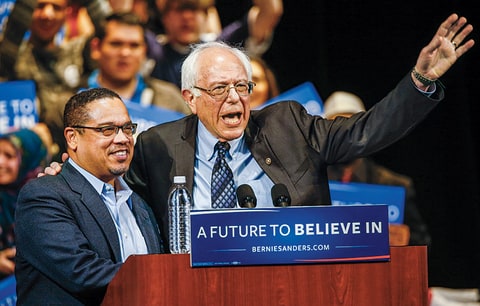
With Rep. Keith Ellison, a front-runner to become the next chair of the DNC. Tannen Maury/Redux
On other issues, he was more careful. The senator's sweet spot as a politician has always been talking about the problems of the working poor: the economic struggles, the anomalous-across-the-industrialized-world story of a decline in life expectancy among rural Americans. But those same voters just lost any sympathy many Democrats might have had by electing the race-baiting lunatic Trump. Exactly how much courting of such a population is permissible? Is trying to recapture voters who've made a racist choice in itself racist?
Sanders believes it is a mistake to dismiss the Trump movement as a monolithic expression of racism and xenophobia. Trump's populist appeals, sincere or not, carried the day, and Democrats need to answer them. Trump pledged not to cut Medicare or Social Security, promised to support re-importation of prescription drugs from other countries, and said he'd reinstate the Glass-Steagall Act. Sanders insists he and his staff are going to try to hold him to all of these promises. How they'll manage that is only a guess, but as ranking member of the Senate Budget Committee, Sanders could easily force the Republicans into votes on all of these issues by introducing amendments during the budget resolution process, which begins in January. "Were those 100 percent lies that [Trump] was telling people in order to gain support?" he asks. "We'll find out soon enough."
Sanders seems anxious to communicate a sense of urgency to young people. No more being content with think-tank-generated 14-point plans that become 87-point plans in bipartisan negotiation, and end up scheduled to take effect in 2040. People want change right now. To survive Trump and turn the tide, Sanders says, he needs help. "You don't have to run for president," he says. "Just get people involved."
After the election, you called the anger Trump connected with "justified." When did you first recognize that sense of discontent and alienation was big enough to have the impact it did this past year?
I've seen it for years. I've seen a media, which has basically ignored the declining middle class, that doesn't talk about poverty at all, and has no sense of what is going on in the minds of millions of ordinary Americans. They live in a bubble, talk about their world, worry about who's going to be running 18 years from now for office. Meanwhile, people can't feed their kids. That's something I knew.
Talking about those issues, seeing that they resonated, that did not surprise me. How quickly they resonated did surprise me. How weak the Democratic establishment was, and how removed they were from the needs of ordinary people, that also surprised me.
President Obama talked after the election about winning Iowa by going into counties even if the demographics didn't "dictate" success there. This seemed to be a criticism that the party had decided to ignore big parts of the country.
I talked about that in the book. That's exactly what we did. We had 101 rallies in that small state. That's grassroots democracy. You speak to three-quarters of the people who end up voting for you. In New Hampshire, we had just a zillion meetings – far more people came out to our meetings. If you had the time to do that around the country, the world becomes different. The assessment has got to be that not only did we lose the White House to the least-popular candidate in perhaps the history of America, certainly in modern history, but we've lost the Senate, we've lost the House, we've lost two-thirds of the governors' chairs in this country. We've lost 900 seats in state legislatures throughout the country in the last eight years. Maybe it might be time to reassess?
Is there any way to read that except as a massive repudiation of Democrats?
No. I can't see how any objective person can. It speaks to what I just mentioned; we cannot spend our entire life – I didn't, but others do – raising money from wealthy people, listening to their needs. We've got to be out in union halls, we've got to be out in veterans' halls, and we've got to be talking to working people, and we've got to stand up and fight for them.
This is how screwed up we are now. When you have a Republican Party that wants to give huge tax breaks to billionaires, when many of their members want to cut Social Security, Medicare and Medicaid, when they don't believe in climate change, when they've been fierce advocates of unfettered free trade – I'm talking about pre-Trump – why would any working person, when they want to cut programs for working people, support them?
I think we know the answer. We know what the Karl Roves of the world have been successful in doing. They're playing off working-class people against the gay community, or African-Americans, or Latinos. But that only works when you have not laid the foundation by making it clear to those workers that you are on their side on economic issues.