

88m3
Fast Money & Foreign Objects
Moscow fairytale comics to help migrants 'behave'
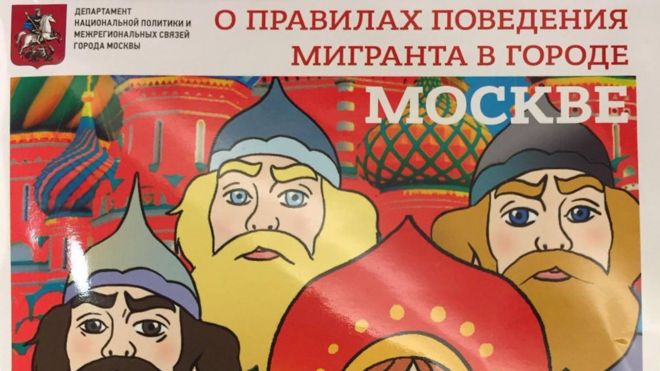 Image copyrightMOSCOW'S NATIONAL POLICY DEPARTMENT
Image captionRussia's famous three warriors (bogatyri) are meant to represent Moscow's law enforcement agencies
Moscow city authorities have begun using comics with characters from Russian fairytales to explain to migrants how they should behave.
They say a 100-page guide is needed to "maintain a positive image" of the city and could help reduce "tensions" between Muscovites and migrants.
But critics have suggested that foreign migrants and ethnic Russians may be viewed as antagonists in the manual.
Russian nationalists and migrants have repeatedly clashed in Moscow recently.
Thousands of people - many of them from ex-Soviet republics in Central Asia and the Caucasus, and Russia's North Caucasus - arrive in Moscow every year, attracted by the capital's job opportunities and relatively high salaries.
A significant number of them work in the Russian capital illegally.
Test your Russian
The new guide in Russian seeks to explain the "dos" and "don'ts" to migrants.
They are urged not to cause trouble, by ogling women, or eating or talking loudly on the streets.
They are also warned that police may routinely stop them to check their documents.
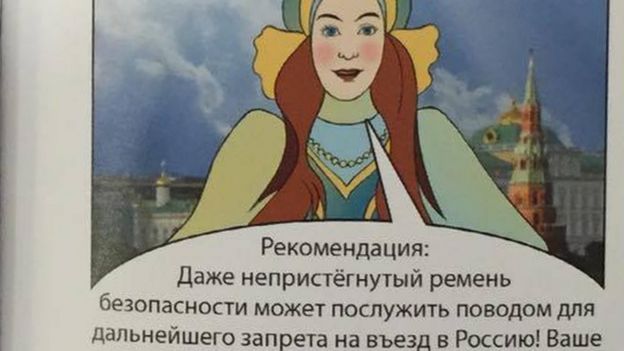 Image copyrightMOSCOW'S NATIONAL POLICY DEPARTMENT
Image captionVasilisa the Wise warns that "even an unfastened seatbelt could be a reason for an entry ban" to Russia
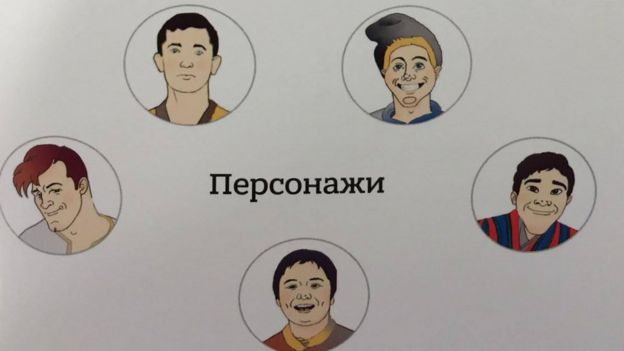 Image copyrightMOSCOW'S NATIONAL POLICY DEPARTMENT
Image captionMigrant characters had been initially identified as representatives of different nationalities, but the idea was later dropped
In the manual, Russia's famous "three warriors" (bogatyri) are meant to represent the city's law enforcement agencies, while Prince Yuri Dolgoruky (a historical character) is used for tours around Moscow.
Meanwhile, Vasilisa the Wise and Snegurochka (The Snow Maiden) test the reader on Russia's language and history.
A special section of the book explains the importance of following Moscow's strict residency and employment rules, stressing that migrants could otherwise be deported or banned from entry.
The manual was written primarily for illegal migrants, Alexander Kalinin, who heads the group Support for Working Migrants in Moscow, told BBC Russian.
"We want to raise their level of law awareness," he added.
Migrant characters had initially been identified as representatives of different nationalities, but the book's authors later decided to drop this idea so as "not to offend anyone", said Mr Kalinin.
While welcoming the new book, critics point out that migrants are "ethnicised" and Moscow is presented as a Slavic city with its warriors.
"The old conflict between Russian heroes and hordes [non-Slavic invaders] is being revived," Yevgeny Varshaver, a migration and ethnicity expert at the Russian Presidential Academy of National Economy and Public Administration, told BBC Russian.
He also suggested that the language used in the book would be "difficult" to understand for some migrants who were not native Russian speakers.
Moscow fairytale comics to help migrants 'behave' - BBC News

- 16 January 2017
- From the sectionEurope
Image captionRussia's famous three warriors (bogatyri) are meant to represent Moscow's law enforcement agencies
Moscow city authorities have begun using comics with characters from Russian fairytales to explain to migrants how they should behave.
They say a 100-page guide is needed to "maintain a positive image" of the city and could help reduce "tensions" between Muscovites and migrants.
But critics have suggested that foreign migrants and ethnic Russians may be viewed as antagonists in the manual.
Russian nationalists and migrants have repeatedly clashed in Moscow recently.
Thousands of people - many of them from ex-Soviet republics in Central Asia and the Caucasus, and Russia's North Caucasus - arrive in Moscow every year, attracted by the capital's job opportunities and relatively high salaries.
A significant number of them work in the Russian capital illegally.
Test your Russian
The new guide in Russian seeks to explain the "dos" and "don'ts" to migrants.
They are urged not to cause trouble, by ogling women, or eating or talking loudly on the streets.
They are also warned that police may routinely stop them to check their documents.
Image captionVasilisa the Wise warns that "even an unfastened seatbelt could be a reason for an entry ban" to Russia
Image captionMigrant characters had been initially identified as representatives of different nationalities, but the idea was later dropped
In the manual, Russia's famous "three warriors" (bogatyri) are meant to represent the city's law enforcement agencies, while Prince Yuri Dolgoruky (a historical character) is used for tours around Moscow.
Meanwhile, Vasilisa the Wise and Snegurochka (The Snow Maiden) test the reader on Russia's language and history.
A special section of the book explains the importance of following Moscow's strict residency and employment rules, stressing that migrants could otherwise be deported or banned from entry.
The manual was written primarily for illegal migrants, Alexander Kalinin, who heads the group Support for Working Migrants in Moscow, told BBC Russian.
"We want to raise their level of law awareness," he added.
Migrant characters had initially been identified as representatives of different nationalities, but the book's authors later decided to drop this idea so as "not to offend anyone", said Mr Kalinin.
While welcoming the new book, critics point out that migrants are "ethnicised" and Moscow is presented as a Slavic city with its warriors.
"The old conflict between Russian heroes and hordes [non-Slavic invaders] is being revived," Yevgeny Varshaver, a migration and ethnicity expert at the Russian Presidential Academy of National Economy and Public Administration, told BBC Russian.
He also suggested that the language used in the book would be "difficult" to understand for some migrants who were not native Russian speakers.
Moscow fairytale comics to help migrants 'behave' - BBC News