Im Kemet Rocky & I like penis
googling gay porn :ahh:
First off , im going to go into the classifications in modern anthropology and how particularly old studies were bias against black people claiming any sort of civilization. the racial classifications such as negroid,cuacasoid,mongoloid,etc. are debunked, as they have realized certain groups or as a matter of fact; general populations regardless of area develope different phenotypes within the group (mainly africa).

now that thats out of the way, there has been this assumption from mainy eurocentrist; that there were indeed blond and red headed straight haired egyptians(thuya,yuya, and ramses III). now as for the color of hair, is directly due to the embalming process. if you look close at the hair color, its not even a actual hair color; its literally impossoble for that specific colors. its almost golden with a hint of green and the red head was typically auburn with a shiny film. also, both are rumered to have died in there mid 50s. you ofcourse would have been aging which means you would have grey hair forming, so perfect strands of awkward gold blond and red hair is impossible. now as far as egyptians having straight hair is possible, east africans are known for having indegenous straight-curly hair or less kinky hair than west and southern africans.

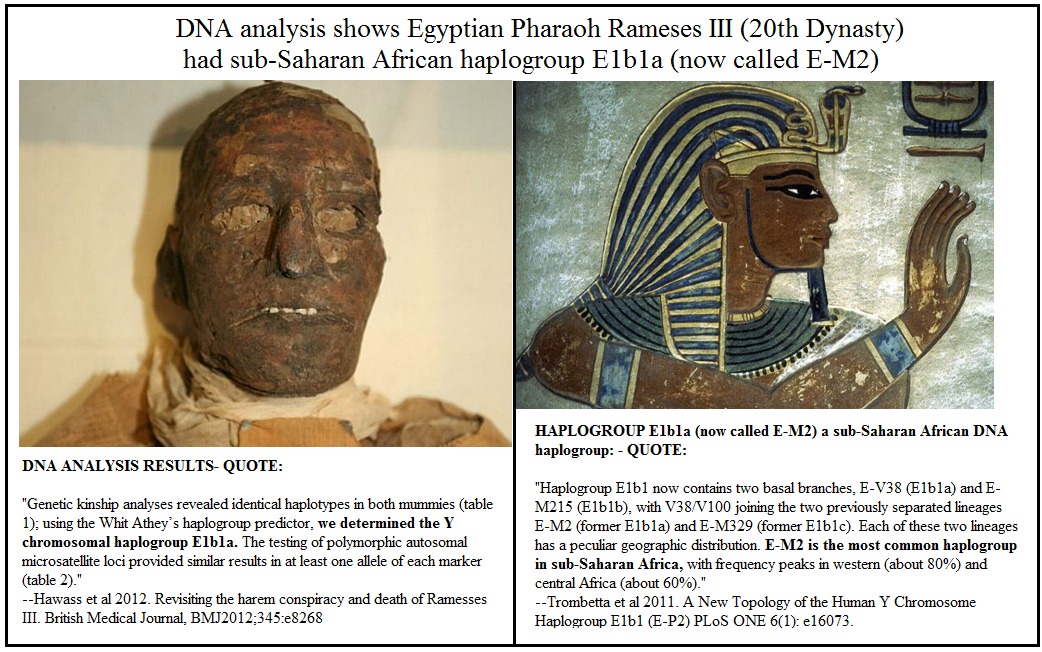
dna tests, so far only what i assume to be cherry picked dna tests have been done on a few pharoahs. the private lab dna tribes as released there dna tests on the amarma mummies in 2012 but mainstream anthropology or history have not yet recognized or just plain ignored the test results, so far : ramses III has had a prominant marker of E1b1a which is a african marker that has origins in east africa.also has a subclade that mainy comprises of west and central africans. which is not suprising since populations migrate time and time again.

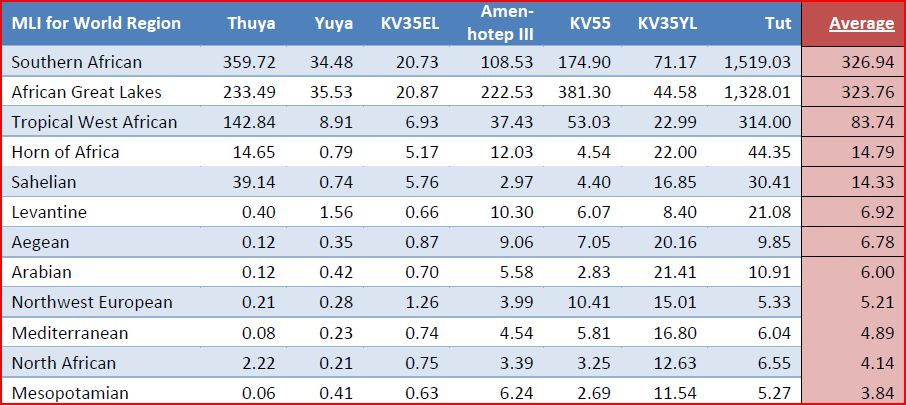
ancient Egyptians have a African origin, this 2014 study confirms it completely.
the nubians are genetically and culturally the closest to egyptians. its believed that egyptians descend from nubians but that is a theory. swill provide more studies later, but for now..
Estimates of genetic diversity in major geographic regions are frequently made by pooling all individuals into regional aggregates. This method can potentially bias results if there are differences in population substructure within regions, since increased variation among local populations could inflate regional diversity. A preferred method of estimating regional diversity is to compute the mean diversity within local populations. Both methods are applied to a global sample of craniometric data consisting of 57 measurements taken on 1734 crania from 18 local populations in six geographic regions: sub-Saharan Africa, Europe, East Asia, Australasia, Polynesia, and the Americas. Each region is represented by three local populations. "Both methods for estimating regional diversity show sub-Saharan Africa to have the highest levels of phenotypic variation, consistent with many genetic studies." Polynesia and the Americas both show high levels of regional diversity when regional aggregates are used, but the lowest mean local population diversity. Regional estimates of F(ST) made using quantitative genetic methods show that both Polynesia and the Americas also have the highest levels of differentiation among local populations, which inflates regional diversity. Regional differences in F(ST) are directly related to the geographic dispersion of samples within each region; higher F(ST) values occur when the local populations are geographically dispersed. These results show that geographic sampling can affect results, and suggest caution in making inferences regarding regional diversity when population substructure is ignored.
now that thats out of the way, there has been this assumption from mainy eurocentrist; that there were indeed blond and red headed straight haired egyptians(thuya,yuya, and ramses III). now as for the color of hair, is directly due to the embalming process. if you look close at the hair color, its not even a actual hair color; its literally impossoble for that specific colors. its almost golden with a hint of green and the red head was typically auburn with a shiny film. also, both are rumered to have died in there mid 50s. you ofcourse would have been aging which means you would have grey hair forming, so perfect strands of awkward gold blond and red hair is impossible. now as far as egyptians having straight hair is possible, east africans are known for having indegenous straight-curly hair or less kinky hair than west and southern africans.
dMummification actices and dyeing of hair
Hair studies of mummies note that color is often influenced by environmental factors at burial sites. Brothwell and Spearman (ref in Fletcher's works-1963) point out that reddish-brown ancient color hair is usually the result of partial oxidation of the melanin pigment. Other causes of hair color "blonding" involve bleaching, caused by the alkaline in the mummification process. Color also varies due to the Egyptian practice of dyeing hair with henna. Other samples show individuals lightening the hair using vegetable colorants. Thus variations in hair color among mummies do not necessarily suggest the presence of blond or red-haired Europeans or Near Easterners flitting about Egypt before being mummified, but the influence of environmental factors.
d
Hair for wigs often obtained through trade not mass waves of "Caucasoid" migrants.
The use of wigs made of varying hair also complicates attempts at 'racial' analysis. Fletcher (2002) shows that many Egyptian wigs have been found with what is defined as straighter 'cynotrichous' hair. This however is hardly a marker of massive European or Near Eastern presence or admixture. Fletcher notes that the Egyptians often eschewed their own personal hair, shaving carefully and using wigs widely. The hair for these wigs was often obtained through trade. Indeed, "hair itself being a valuable commodity ranked alongside gold and incense in account lists from the town of Kahun." Egyptian trading links with other regions is well known, and a prized commodity like straighter 'cynotrichous' hair could have been easily obtained via the Sahara, Levant, the Maghreb, Mediterranean contacts, or even the hair of Asiatic war captives or casulaties from Egypt's numerous conflicts.
-------------------------------------------------------------
Red-headed Ramses- routine for genetic variability in Africa not "whiteness"
Rameses came along comparatively late in Egyptian history, when outsiders toEgypt like the Hyskos were increasing in the region. Detailed microscopic analysis during the 1980s (Balout 1985) identified some of the hair of Egyptian Pharoah Rameses II as being a yellowish-red. Such a finding should not be surprising given the wide range of physical variability in Africa, the most genetically diverse region on earth, out of which flowed other population groups. Indeed, blondism and various other hair shades are not unknown in East Africa or Nubia, particularly in children, nor are such hair color variants uncommon in dark-haired or dark skinned populations like the Australians. (Hrdy 1978) Given the range of genetic variability in Africa, a red-haired Rameses is hardly unusual. Rameses' reign, in the 19th Dynasty, came over 1,500 years after the Egyptian state had been established, and after the Hyskos interlude. Such latecomers to Egypt, like the Hyskos, Assyrians, Greeks, Romans, Arabs etc would add their own genetic strands to the nation's mix. Whatever the blend of genes that occurred with Rameses, his hair offers little supposed "proof" of a "white" or "Nordic" Egypt. If anything, X-rays of several royal mummies by mainstream scientists show that the Egyptians pharoahs and other royals had several uncomfortable 'Negroid' leanings. (http://www.geocities.com/nilevalleypeoples/xraymummies1.htm)
-------------------------------------------------------------
Red hair can be readily produced by dark-skinned populations- just check out Australia and pheomelanin
The finding of Rameses "red" hair also deserves further scrutiny. The analysis found evidence of dyeing to make the hair yellowish-red, but some elements were untouched by the dye. These elements of yellowish-red hair in Balout's study, were established on the basis of the presence of pheomelanin, a red-brown polymeric pigment in the skin and hair of humans. However, pheomelanin can also be found in persons with dark brown or even black hair as well, which gives it a reddish hue. Most natural melanins contain sulfur, which is typically associated with pheomelanin. In scientific tests of melanin, black hair contained as much as 5% sulfur, 3% lower than the 8.8% found in Irish red hair, but exceeding the 2.3% found in Scandinavian blond hair. (Jolles, et al. 1996) Thus the yellowish-red hair discovered on Rameses is well within the range of human variation for dark haired people, whatever the exact gene combination that led to the condition.
As noted above, such variation began with ancient African populations. Most red hair is found in northern and western Europe, especially in the British Isles, and even then it appears in minor frequencies in Europe- some 4% of the population. It is unlikely such populations had any major contact or influence in the ancient Nile Valley. The analysis on Rameses also did not show classic "European" red hair but hair of a light red to yellowish tinge. Black haired or dark-skinned populations are quite capable of producing such yellowish-red color variants on their own, as can be seen in today's east and northeast Africa (see child's photo above). Nor is such color variation unusual to Africa. Native dark-skinned populations in Australia, routinely produce people witn blond or reddish hair. .
The analysis also found Rameses' hair to be cymotrich or wavy, again a characteristic quite within the range of overall African or Nile valley physical and genetic diversity. A "pure" Nordic type of straight hair was thus not established for Rameses. Hence the notion of white Europeans or red-headed Caucasoids from other areas flowing into ancient Egypt to add hair variation is dubious. Inflows occurred during the Greek and Roman eras but reddish or brown hair is within the range of African variation. Genetic studies (Tishkoff 2009, 2000) show Africans have the highest diversity in the world. Skeletal/cranial studies confirm the pattern. Relethford (2001) shows that ".. methods for estimating regional diversity show sub-Saharan Africa to have the highest levels of phenotypic variation, consistent with many genetic studies." (Relethford, John "Global Analysis of Regional Differences in Craniometric Diversity and Population Substructure". Human Biology - Volume 73, Number 5, October 2001, pp. 629-636) Hanihara 2003 notes that [significant] "..intraregional diversity are present in Subsaharan Africans.." While ancient Egypt had gene flow in various eras, hair variations easily fall under this pattern of built-in, indigenous diversity, as well as the above noted cultural practice of using wigs with hair from different places obtained through trade.
-----------------------
Notes: Formation and Structure of Human Hair: Biology and Structure, By Pierre Jollès, Helmut Zahn, H. Höcker, Birkhäuser, 1996, pp. 200-225
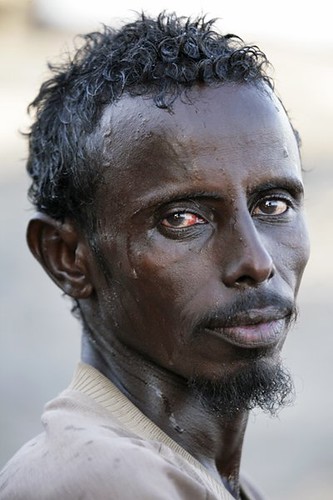
dna tests, so far only what i assume to be cherry picked dna tests have been done on a few pharoahs. the private lab dna tribes as released there dna tests on the amarma mummies in 2012 but mainstream anthropology or history have not yet recognized or just plain ignored the test results, so far : ramses III has had a prominant marker of E1b1a which is a african marker that has origins in east africa.also has a subclade that mainy comprises of west and central africans. which is not suprising since populations migrate time and time again.
Revisiting the harem conspiracy and death of Ramesses III: anthropological, forensic, radiological, and genetic study . Dec 2013.
Genetic kinship analyses revealed identical haplotypes in both mummies (table 1⇓); using the Whit Athey’s haplogroup predictor, we determined the Y chromosomal haplogroup E1b1a. The testing of polymorphic autosomal microsatellite loci provided similar results in at least one allele of each marker (table 2⇓). Although the mummy of Ramesses III’s wife Tiy was not available for testing, the identical Y chromosomal DNA and autosomal half allele sharing of the two male mummies strongly suggest a father-son relationship
ancient Egyptians have a African origin, this 2014 study confirms it completely.
the nubians are genetically and culturally the closest to egyptians. its believed that egyptians descend from nubians but that is a theory. swill provide more studies later, but for now..
Last edited by a moderator: