

newworldafro
DeeperThanRapBiggerThanHH
Platform Cooperativism vs. the Sharing Economy
The backlash against unethical labor practices in the “collaborative sharing economy” has been overplayed. Recently, The Washington Post, New York Times and others started to rail against online labor brokerages like Taskrabbit, Handy, and Uber because of an utter lack of concern for their workers. At the recent Digital Labor conference, my colleague McKenzie Wark proposed that the modes of production that we appear to be entering are not quite capitalism as classically described. “This is not capitalism,” he said, “this is something worse.” [1]
But just for one moment imagine that the algorithmic heart of any of these citadels of anti-unionism could be cloned and brought back to life under a different ownership model, with fair working conditions, as a humane alternative to the free market model.
Take, for example, Uber’s app, with all its geolocation and ride ordering capabilities. Why do its owners and investors have to be the main benefactors of such platform-based labor brokerage? Developers, in collaboration with local, worker-owner cooperatives could design such a self-contained program for mobile phones. Despite its meteoric rise, $300 million in VC-backing (and its $18 billion evaluation bubble), as well as massive international reach, there is nothing inevitable about Uber’s long-term success. There’s no magic when it comes to developing such a piece of software; it’s not rocket science. Of course, technology is only one part of the equation and instead of letting techno-determinism run its course, I’d rather point to the long history of worker-owned cooperatives, EP Thompson and Robert Owen.
Just forget about all the trending lifestyles;
the giant automaton could get a new set of operators soon.
There isn’t just one, inevitable future of work. Let us apply the power of our technological imagination to practice forms of cooperation and collaboration. Worker–owned cooperatives could design their own apps-based platforms, fostering truly peer-to-peer ways of providing services and things, and speak truth to the new platform capitalists.
I have been part of cooperatives all my life; I lived in communes, I experienced first hand how they can put people at the center of the equation. But you’d be mistaken if you think that I have an idealized view of everything cooperative. To start with, millennials might stress their individual careers over an allegiance to any given co-op, and then there is the problem of competition with global corporations that are rolling in money. And while Silicon Valley’s turbo capitalists are zipping ahead, social movements as well as regulators are often slow. For hackers, “long tail workers,” and labor activists, now is the time to step up their efforts before the network effect chisels brands like Uber into stone.
I will start with a few comments about work in the sharing economy and then advance an intensely practical argument about what I call platform cooperativism.
Business gurus suggest that there is a logical step from the sharing of content through social media to the rental of goods, space, and the provision of transport through de facto labor companies like Feastly, Carpooling, Handy,Kozaza, EatWith, Kitchensurfing, TaskRabbit, and Uber. Consumers, raised with an appreciation of low prices above all else, welcome many of these market incumbents.
And, of course, all of these developments play out against the background of deliberate shockwaves of austerity that followed the 2008 financial crash. The sharing economy is portrayed as harbinger for the post work society and path to ecologically sustainable capitalism, Google will conquer death itself, and this brave new “disruptive” economy will rid us of Jurassic forms of labor, which might well include what David Graeber refers to as “bullshyt jobs.”[2]
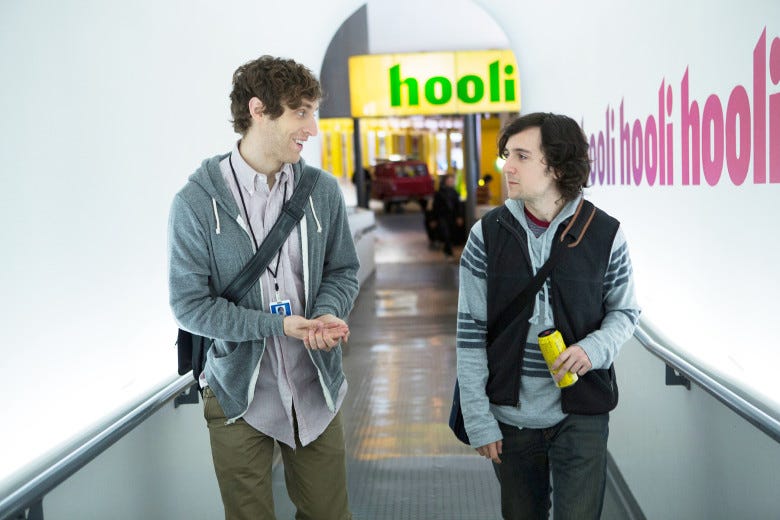
With HBO's New 'Silicon Valley' Show, We Have Attained Peak Geekdom
But by now, only few people still fall for the solidarity theater of the “disruptive sharing economy,” its deceptive “peer” rhetoric when referring to individual workers and consumers, as well as its constant talk of changing the world (HBO’s Silicon Valley anyone?). They figured it out by now. People understand that it is the modus operandi of the “community managers” of the sharing economy to conflate multimillion-dollar commercial entities like Uber with non-market, peer-to-peer projects like Wikipedia or FoldIt. (I elaborate on this dynamic on Public Seminar.)
Also the mystifying association of the sharing economy with Occupy or the Arab Spring lost its pull for anybody who has been paying attention. Just like in the pharmaceutical industry, these “community managers” of key companies in the sharing economy are frequently young, likable women. Let’s say you come across the fact that TaskRabbit and TopCoder explicitly bar their workers from contacting each other, than you might strongly feel that that this is completely unacceptable. But while such practice may seem disagreeable, critics often hesitate to confront the before-mentioned reps about such abuses.
If you are taking a closer look at templates of 21st century work that are currently put in place, you will notice a trajectory of workers taking on many gigs at once. Sascha Lobo [3] and Martin Kenney[4] recently introduced the term platform capitalism, which I’d define in reference to subcontracting and rental economies with big payouts going to small groups of people. Occupations that cannot be off-shored, the pet walkers or home cleaners, are now subsumed under platform capitalism.
Even if you hesitate to categorize emerging unregulated platforms like Handyas innovative, it is hard to deny that baby boomers are losing sectors of the economy like transportation, food, and various other services, to millennials who fiercely rush to control demand, supply, and profit by adding a thick icing of business onto apps-based user interactions.
Companies like Uber and airbnb are enjoying their Andy Warhol moment, their $15 billion of fame, in the absence of any physical infrastructure of their own. They didn’t build that— they are running on your car, apartment, labor, and importantly, time. They are logistics companies where all participants pay up the middleman: the finanzialization of the everyday 3.0. According to NYU business professor Arun Sundrarajan, personal and professional services are now blended, creating a continuum of commercial activity while at the same time raising serious issues about labor protections against discrimination, for example.
Today, nothing remains outside of labor.
The narrative of the sharing economy is just so huggable: neighbors can sell the fruit from the trees in their gardens, you can rent an apartment in Rome, a tree house or yurt in Redwood Forest. In Berkeley, you can pay your neighbor to cook you a wholesome dinner[5], and now you can even listen to your own Spotify account in an Uber taxi. It is just all so convenient.
The sharing economy is presented as the ultimate anti-Turkle. Where Sherry Turkle, author of Alone Together, claims that technology leads to social deskilling, here comes the sharing economy, positioning itself with the claim that it leads people out of that social isolation. Just think of the old lady renting out her room on airbnb. “People come for the consumption and stay for the sociality,” as Sundrarajan put it [6].
If you agree to drive your car for Uber much of the time, the company will co-finance the purchase of a new car so that you can afford that Lexus after all. But much in contrast to that, one of the slogans of the sharing economy is “access, not possession.” Allegedly, millennials don’t have an interest in worldly possessions, they just want to access stuff when they need it. ZipCar plays into that model of thinking. It’s all about the just-in-time delivery of things. You could think of it as a streaming service: you don’t own the file, you merely stream it. You are paying for what you are using now and the next time you want it, you are paying for it again. We are streaming our own lives.
The sharing economy is said to bring an end to “markets for lemons.” No longer will we have to buy used cars that later turn out to be poorly serviced. This is the end of the road for the shady used car salesman, the incompetent plumber, or wanting electrician. Now, “real-life profiles” on LinkedIn and Facebook, connected to these emerging platforms, introduce novel checks and balances. That is, at least, how the argumentation in favor of these reputation systems, and against governmental regulation, runs its course. Sundrarajan is suggesting that these reputation systems are largely capable of self-regulating this market, much in contradiction to arguments by Canadian technologist and blogger Tom Slee who argues that these systems don’t deliver an adequate measurement for reputation. Who needs the government if reputation systems can isolate the bad airbnb host or abusive Uber driver? On the other hand, however, it is important to remind ourselves that governmental regulation still matters when it comes to securing wage floors for workers and preventing monopolies.
There is no question about it; legacy taxi companies have seen better days. Ride ordering apps are making transportation easier and also a bit more accountable as passengers can give dreadful drivers devastating reviews. Some taxi drivers report that they appreciate not having to commit to a company like Uber, full-time. They enjoy the flexible hours that they cannot get with legacy taxi companies. Ecological concerns about single driver occupancy are also real when thinking about these labor companies.
It’s a no-brainer, the medallion system could use an update and at far over$800,000 for a single medallion in New York City, the system is completely impenetrable for taxi associations trying to build a small fleet of their own. The medallion cartel prevents such worker-owned organizations from taking hold. With innovative ride rental software, organizing the taxi business is slightly more conducive for the various types of worker cooperatives. Entities like Uber, Ola, Quick Cabs, TaxiForSure, or Lyft are quite vulnerable because their technology can be duplicated. But of course, when you see how regulation is steered by costly PR campaigns in big cities, when you see how ever-increasing brand awareness tilts the network effect in favor of Uber and airbnb, when you notice the co-financing for new cars offered for Uber drivers, and when you understand that insurance for passengers is costing an arm and a leg, then you remind yourself of the old saying: money talks.

