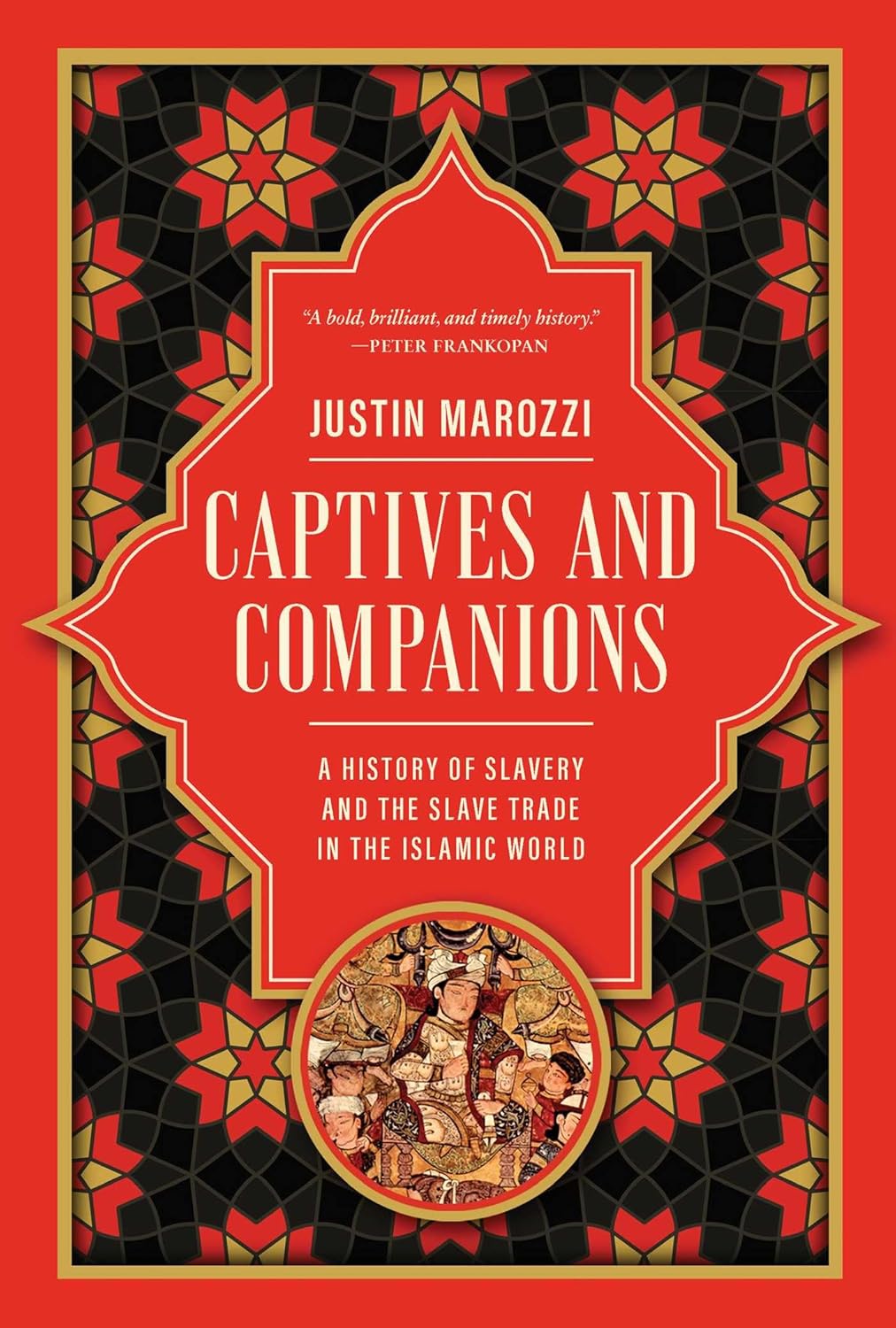
Prof Gerald Horne is writing a book about slavery anti-Blackness in the Arab Islamic world; New Justin Marozzi book Captives and Companions out now!

☑︎#VoteDemocrat

The Original
WOAT
Supporter
Joined
Dec 9, 2012
Messages
337,464
Reputation
-34,919
Daps
640,916
Reppin
The Deep State

The Islamic world is appallingly silent on its history of slavery
Summarize
Justin Marozzi 15 November 2025 3:00pm GMT
Suleyman the Magnificent, sultan of the Ottoman Empire in the sixteenth century. The Empire enslaved millions of people
Suleyman the Magnificent, sultan of the Ottoman Empire in the sixteenth century. The Empire enslaved millions of people Credit: Pictures From History/Universal Images Group via Getty Images
In his new book, The Big Payback, the British comedian Sir Lenny Henry has called on the UK Government to pay £18tn in reparations for slavery to black British people.
Having spent the past five years researching a history of slavery and the slave trade in the Islamic world, what struck me especially about Sir Lenny’s intervention (apart from the figure of £18tn, which is equivalent to between six and seven times the size of the UK’s economy), was the continued dominance of the transatlantic trade in public discourse about slavery.
While the West has engaged in critical discussions over this egregious phenomenon for many years, the same cannot be said for swathes of the Middle East: a region in which slavery and the accompanying trade endured without pause from the seventh to the 20th centuries.

As the Sudanese-British journalist Zeinab Badawi has argued in An African History of Africa, while Arab societies benefited enormously from enslaved African labour for more than a millennium, there has been little, if any, meaningful examination of the subject in Arab states, and no public debate on reparations. “The silence must be broken,” she writes.

Under pressure from African and Caribbean states, together with organisations like the National Coalition of Blacks for Reparations in America, the debate continues in the West, but no such discourse is underway in the Muslim world.
The reality is that there is barely any public discussion in Arab countries, Turkey or Iran, of the historical practice of slavery, let alone the issue of reparations.

The inability or unwillingness to reckon with the legacy of slavery is not a marginal issue. The Atlantic trade accounted for between 11–14 million enslaved Africans, the corresponding trade with the geographical heart of the Muslim world, centred on North Africa and the Middle East, was probably responsible for 12–15 million, possibly as many as 17 million if India is included. That is without Malaysia and Indonesia.

Such reckoning as does exist remains in its infancy. In 2015, when Qatar was under pressure for its treatment of migrant workers ahead of the 2022 World Cup, it turned Bin Jelmood House, once a holding area for enslaved East Africans waiting to be sold, into a museum memorialising slavery.

The museum says it explores the role Islam played in providing guidance for the humane treatment of the enslaved and the ultimate abolition of slavery‬‬‬‬‬‬‬‬‬. “The story in Qatar begins in enslavement but ends in shared freedom and shared prosperity,”‬‬‬‬‬‬ it declares. This gloss fails to address the appalling reality of slavery and its legacy.

In the West, governments and institutions often follow the lead of academics and activists. Although it is no longer true that the study of the history of slavery in Ottoman society and the wider Muslim world is characterised by “a deafening silence”, as the historian Ehud Toledano argued a generation ago, it is fair to say that, with some honourable exceptions among a courageous new generation of scholars, in both the West and the Islamic world itself, it remains little more than a murmur.

A recent study of the life of Fezzeh Khanom, an enslaved African woman in 19th-century Iran, to give one example, begins with the words: “The history of slavery in Iran has yet to be written.”

As the Moroccan-born historian Maha Marouan has written: “Talking about slavery in Morocco is taboo.” The subject is not even included in educational curricula. “It is also difficult to talk about slavery because we are a Muslim nation who enslaved other Muslim nations – a practice that is strictly prohibited in Islam.”

In Istanbul I interviewed a young Turkish historian who described how a professor brushed her off when she sought his advice on a doctoral thesis on Ottoman war captives. “Our ancestors treated their slaves very well,” he told her. “Don’t waste your time with this.”

Earlier this summer in Oman, once a powerful slave-trading empire, I talked to a man in his 70s who demonstrated a similar sense of denial. “Everyone criticises the Arabs for taking African slaves,” he said. “What should we have done? Everyone was doing it. That was business. Without it we would have starved.”

In some quarters, merely discussing the history of slavery in the Islamic world, never mind broaching reparations, brings about immediate accusations of Islamophobia. The historian Dahlia Gubara argues that histories of slavery and the slave trade in the Middle East constitute a “liberal incitement to racial discourse”. It is an academic way of saying “nothing to see here”.
This month, I have been giving a lecture series on “Slavery and Islam” in Oxford, hosted by the Pharos Foundation, a research institution and educational charity.

After my introduction to the historical, legal and theological underpinnings of slavery in the Islamic world, I was disappointed but not surprised to hear that one student had complained to the university. While academic freedom was very important, he wrote, it would be “potentially harmful to students” if the lectures continued.

In a stronger reaction I was accused of Islamophobia and likened to the “compromised academics” of 1930s Germany who enabled the genocide of the Jews.
I mention this reaction from a small, but vocal, minority in the context of the ongoing conversations in the West about reparations. Such discussions will continue, and governments such as our own and those of the US, Holland, Belgium, France, Spain, Portugal and others will face strong external pressures to apologise and pay up.

Yet any meaningful and historically worthwhile international debate on reparations must necessarily include Arab states and Turkey. As a 2003 conference in Johannesburg on the “Arab-led Slavery of Africans” noted, there was a “collective amnesia about Arab enslavement of Africans,” despite it representing the largest and longest “removal of any indigenous people in the history of humanity”. Tidiane N’Diaye, the Franco-Senegalese anthropologist, calls it a “veiled genocide”.

In Daring to be Free, a powerful new history of black resistance in the Atlantic world, the Oxford historian Sudhir Hazareesingh ends his reflections on reparations with the words of Frederick Douglass, the African-American abolitionist: “power concedes nothing without a demand.” That may be true in the West. In the more autocratic Middle East, however, the conversation has yet to even begin.
 

☑︎#VoteDemocrat

The Original
WOAT
Supporter
Joined
Dec 9, 2012
Messages
337,464
Reputation
-34,919
Daps
640,916
Reppin
The Deep State

Taking on the history of slavery in the Muslim world | Francis Ghiles | AW
Summarize
In all pre-capitalist societies slavery was an economic necessity, Ancient Egyptians, Romans, Greeks and Chinese could not have fed their societies, supported vast cities and large military establishments without recourse to slavery, which became only expendable after the industrial revolution.

In more recent centuries, the UK’s Royal Navy relied on informal slavery until the 19th century. Stalin’s Russia and Hitler’s Germany enslaved millions of people.

The author of this book has more to say about the Arab and Saharan worlds than about Central Asia, India and Indonesia but that in no way detracts from its interest.

Justin Marozzi has travelled widely across the countries he describes. He vividly illustrates the scale and horror of a practice which spanned 13 centuries of Islamic rule from caliphates to Ottoman Empire but was concentrated, for the most part over three centuries when it comes to Europe’s practice of slavery, the Atlantic slave trade. The horrors of the latter are well known in the West and continue to influence modern Western politics. In sharp contrast, modern-day parts of the Muslim world have downplayed the history of the practice for too long. The subject remains sensitive and is likely to drive your Arab and Muslim interlocutors into a defensive mode when raised. Some even view the issue as an argument that is weaponised against the Arab Muslim world by its enemies. The subject remains taboo in school books and is rarely mentioned in political debates. An exception might be in Tunisia where the 1848 ban on slavery by Ahmed Bey before any other Muslim nation, is celebrated each year.

Nonetheless, the Arab and Muslim world still need to soberly confront the issue while putting it in its historical context.

Marozzi estimates that as many African men were enslaved by Muslims for centuries as by Europeans/Americans; exact numbers are impossible to establish but an estimated 12 and 17 million people are concerned.

There has been an emergence of a practice akin to slavery in Libya where modern day human traffickers offer men for a few hundred dollars apiece, illegal immigrants from sub-Saharan Africa, in cases that have been well documented by Western media.

Slavery practised on south Sudanese black men and women by the Muslim north of that country explain in part why that country was partitioned. In Darfur and in Mali the practice of slavery helps to fuel civil wars where the cruel behaviour of many of the actors has nothing to envy practices of the past.

Marozzi is an historian and a journalist whose previous books include Islamic Cities: Fifteen Cities which Define a Civilization (2019) and Baghdad: City of Peace, City of Blood (2014). The sheer number of themes and time span makes Captives and Companions somewhat uneven and at times difficult to read but this study is essential reading because its help put into a modern context a phenomenon which is often viewed as of purely historical interest. Hence the author’s decision to give voice to former older slaves, from the Ottoman empire, and Mauritanians who only recently escaped slavery, a voice in the opening and closing of his book. One of the last eunuchs of Ottoman days, speaking in 1938, had never forgotten the screams of his mother and brother when they were killed in front of him by slave-traders, before he was castrated and sold for the price of a set of crockery.

Slavery in the lands of Islam has been ubiquitous if only because slaves there could often rise to great power and accumulate huge wealth. Slave soldiers such as the Janissaries and the Mamluks played an essential part in the history of Egypt and the Ottoman empire. Eunuchs could become grand viziers in Istanbul as they had in Baghdad centuries before. The sons of slave women for their part often became caliphs and sultans. Women could rise to dizzying heights, the best known being Roxelana, the Slav born mistress and then all powerful wife of the most famous of Ottoman sultans, Suleyman the Magnificent.

Many were courtesans famous for their wit and beauty. Millions however toiled in miserable conditions in private households across the land.

The author reminds us of what was arguably the most spectacular and bloody slave revolt of history, the revolt of the Zanj. They were black Africans, who tilled the land in the marshes of lower Iraq. In 869 they rose against their masters in Baghdad, a revolt that lasted for fourteen years. They repeatedly humiliated the Abbassid caliphate, extraordinary scenes of death and torture were recorded. In 871 the Zanj stormed “Basra, the brilliant.” Marozzi writes that “you could sense the entire Arab and Persian world shudder in the rage-filled prose and apocalyptic poetry of Masudi, Tabari, Ibn al Rumi and others when they recounted the Zanj revolt. But then these were the same men who subscribed to the Curse of Ham theory of black enslavement and who routinely denigrated black Africans in their writings.”

The author mentions manifestations of racism in writings of 14th century Ibn Khadoun and the prince of Persian poets Ferdowsi.

Arab poets of African descent were known pejoratively as Aghribat al Arab, the Crows or Ravens of the Arabs.

The list is endless of distinguished Persian and Arab intellectual figures who, during the first centuries of Islam, poured scorn on black people.

But racist disdain for black people equally permeated Western literature for centuries as well.

The legacy of raiding, enslaving and trafficking north from Bilad al Sudan has left its mark.

Racist attitudes towards black people proved remarkably resilient within the Islamic world prompting the emergence in recent years of many anti-racism NGO’s.

Marozzi is excellent on the different forms slavery took during the six centuries the Ottoman empire lasted. He reminds his readers that while thousands of western books speak of the Barbary states and the European slaves/prisoners who languished in the jails most notably of Algiers but they omit to mention the tens of thousands of Algerians, Tunisians and Moroccans who spent years in French, Spanish and British jails. He quotes the pioneering work of Nabil Matar who has written extensively on relations between Tudor and Stuart England and the Barbary States in the 16th and 17th centuries. Europeans remain woefully ignorant of their recent history with the lands of Islam and this influences modern day international relations.

Minor mistakes in the book could be corrected notably when the author mentions from Algerian official sources that the country’s war of liberation against France chalked up 1.5 million native victims. Historians agree on an overall figure of 500,000 dead, including 13,000 Frenchmen. This in no way detracts from the author’s emotional intelligence and a combination of erudition and empathy in these times of binary nonsense about Islam versus the West, makes Captives and Companions
 

☑︎#VoteDemocrat

The Original
WOAT
Supporter
Joined
Dec 9, 2012
Messages
337,464
Reputation
-34,919
Daps
640,916
Reppin
The Deep State


‘Captives and Companions’ Review: Centuries of Servitude
Summarize
The history of slavery under Islam involved multiple forms of bondage that stretched across continents and generations.

Oct. 10, 2025 at 10:46 am
Sultan Selim III (1761-1808) receiving officials of the Ottoman empire at Topkapi Palace, Istanbul.
As a youngish man in the late 1990s Mr. Marozzi crossed the north African desert on camelback. Later he tried to build civil society in war-torn Iraq and Libya and was briefly kidnapped by Tuareg militiamen. In 2011 he overheard a Libyan revolutionary call out to a black-skinned brother-in-arms, “hey, slave! Go and get me a coffee!” and was spurred to begin an inquiry into slavery—its history, prejudices and afterlife—in the Islamic world.

Slavery thrived there, Mr. Marozzi tells us, a millennium longer than the trans-Atlantic version did, and probably enslaved more people (17 million, according to one study, as opposed to the 12 million to 15 million who were sold into the Atlantic trade). It was finally abolished under Western pressure and after decades of resistance, foot dragging and delay; in the case of Saudi Arabia, it was legal until 1962. Even now it remains glaringly visible in the roughly one million people that Temedt, an antislavery organization, estimates are living as hereditary slaves in Mali, toiling in the fields, performing menial tasks and, in the case of women, Mr. Marozzi tells us, being “routinely raped.” So why is this story so little known?

Until recently the reluctance of modern Muslim societies to delve into an unflattering episode of their past, along with Western historians’ unswerving focus on slavery in the Americas, had generated, in the words of Middle Eastern scholars quoted by Mr. Marozzi, a “deafening silence” and a “collective amnesia” on the subject. Drawing on the work of a new generation of Turkish and north-African historians who have challenged “the default setting of denial,” Mr. Marozzi tells the story in all its richness, variety and horror, from the slave concubines who used sex and poetry to bedazzle the caliphs of ninth-century Baghdad to the slave-seizing free-for-all that the western Mediterranean became in the 16th and 17th centuries—the age of the “Barbary corsairs.”

Most significant of all, Mr. Marozzi re-examines the comforting orthodoxy that slavery in the Islamic world was inherently benign, with kindly slave-owners the norm, manumission common after only a few years and Islam’s much-vaunted color-blindness foreclosing the racism that was intrinsic to the same institution in the American South. The result is a monumental revisionist work that will alter views on slavery inside and outside the Islamic world.

From the Mamluk slave-soldiers, recruited from Kipchak tribes in what is now southern Russia and Ukraine, to Hurrem, the powerful wife of the Ottoman sultan Suleyman the Magnificent, who started her career as a lot in the Istanbul slave mart, the trope of the upwardly mobile slave has more than a grain of truth. Crucially, however, there is much ambiguity stemming from Islam’s origins.

That Muhammad himself had numerous slaves, and that the Quran enjoins compassion toward slaves—ideally with a view to their emancipation—made it impossible even for the Islamic reformers of the 19th century, who regarded slavery as a stain on their civilization, to maintain, as Christian abolitionists did, that the ownership of one person by another was by definition offensive to God. Nor was the tendency to justify slavery on racial grounds any less widespread among elite Muslims than it became among plantation owners in the American South. It is disconcerting to read the opinion of the medieval thinker Ibn Khaldun, for instance—whose theories about the rise and fall of civilizations are cited even now—that African nations were, as Mr. Marozzi quotes, “submissive to slavery, because [black people] have little [that is essentially] human and have attributes that are quite similar to those of dumb animals.”

Mr. Marozzi writes about the myriad routes (“capillaries rather than arteries”) along which enslaved sub-Saharan Africans were driven northward as far as the Mediterranean and onto ships that would transport them to Istanbul and other markets. Over the course of several hundred years the desert equivalent of the notorious Middle Passage of the Atlantic trade witnessed an exodus both vast and lethal—some 1,600 slaves in a single caravan, we are told, died of thirst in 1849 somewhere between Lake Chad and Murzuq.

Nor does Mr. Marozzi shrink from other painful topics. Prohibited by Muhammad but perpetuated by Islamic rulers—who believed their harem women needed supervision by men who would not threaten them sexually—the castration of slaves was farmed out to Christian monks. So high was the mortality rate from this unspeakable procedure that in 1868 the French explorer Count Raoul du Bisson estimated that 35,000 African boys were losing their lives annually in Sudan for a harvest of 3,800 eunuchs.

Islamic slavery thrived beyond the Islamic world, its chief exponents sometimes converts of dubious sincerity who would pray to the Virgin Mary for a change of wind if Allah failed them, or go on drunken sprees while ashore. “Don’t let the Turks ravish us again!” ran the headline in Iceland’s most popular newspaper when Turkey played Iceland at soccer in 1995—despite the fact that the razzia it was alluding to, back in 1627, had been led by “a rich, intelligent and opportunistic Dutch renegade called Jan Janszoon,” whose Muslim name was Murad Reis.

This absorbing book abounds in such ironies. Thus the British, who had been such enthusiastic slavers, went on to force Muslim rulers to end their own version of the practice. Of the 52 “Barbary corsairs” who were captured by the Dutch in November 1614, only four were north African Muslims, the remaining 48 being “fortune-seeking sailors from England and the Netherlands.”
 

☑︎#VoteDemocrat

The Original
WOAT
Supporter
Joined
Dec 9, 2012
Messages
337,464
Reputation
-34,919
Daps
640,916
Reppin
The Deep State


71IInLdhikL._SL1500_.jpg
 
  • Dap
Reactions: QBN

☑︎#VoteDemocrat

The Original
WOAT
Supporter
Joined
Dec 9, 2012
Messages
337,464
Reputation
-34,919
Daps
640,916
Reppin
The Deep State


“Captives and Companions: A History of Slavery and the Slave Trade in the Islamic World” by Justin Marozzi
Summarize
Rosie Milne 26 August 2025 Non-Fiction7 February 2020

A fluent Arabic speaker, Justin Marozzi has spent much of his career as a journalist and author trying to understand the Middle East through an historical lens. His earlier books include Islamic Empires, a history of Islamic civilisation told through some of its greatest cities, and Baghdad: City of Peace, City of Blood, which won the 2015 Royal Society of Literature’s Ondaatje Prize.

His new book, Captives and Companions: A History of Slavery and the Slave Trade in the Islamic World is indeed a history of slavery and the slave trade in (much of) the Islamic world—apart from passing references, it excludes India and southeast Asia. It stretches from the earliest days of Islam in 7th century Mecca and Medina to interviews with former slaves in present day Mali and Mauritania.

Wherever possible, Marozzi highlights the voices of the enslaved themselves.

Marozzi acknowledges that slavery has been almost universal, but he asks, in effect, what kind of slavery and which slave trades westerners now choose to discuss. His answers are: plantation slavery and the Atlantic slave trade. The world once contained, he sets out to explain to the general reader in the West, far more slave trades than the one they know from books and films; that in Turkey, Africa and the Middle East in particular various forms of slavery were an accepted part of life from ancient (pre-Islamic) times, until as late as 1981, when Mauritania became the last country to outlaw not only slave trading, but also the institution of slavery.

Marozzi marshals a great deal of information to produce an account which is always readable, clear, informative, and interesting. Wherever possible, he highlights the voices of the enslaved themselves, their first-person experiences and memories, notwithstanding these are generally mediated by “European and American travellers, explorers, diplomats, officials, abolitionists, journalists, editors and publishers.” Testimony is often gut-wrenching: accounts of children being snatched from parents during the terror of a slave raid; forced marches across the Sahara in which untold numbers died; women being assessed like animals in slave markets; the horror of castration.

The variety, and paradoxes, of slavery in the Islamic world are thoroughly explored. Slave soldiers, whether Mamluk, in Egypt, or Janissary, in Turkey, could become rich and powerful, as could eunuchs serving in Ottoman harems; enslaved concubines could move to the centres of political hierarchies, and become the mothers of future rulers.

Where did these slave soldiers, eunuchs and concubines come from? Yes, multitudes were black Africans, trafficked north across the Sahara, but vast numbers were white, particularly from Eastern Europe, the Balkans and the Caucasus, with some raids as far away from Islamic lands as Britain and Iceland.

Marozzi quotes Sudanese scholar Yusuf Fadl Hasan: “Slavery is slavery and cannot be beautified by cosmetics.”

Marozzi is well aware that any history by a westerner of anything contentious in the non-western world, particularly when it links the contested idea or practice to a particular religion, can run up against culturally-based objections:

The heat of nineteenth-century debates between mostly Western opponents and mostly Muslim defenders of slavery is echoed in some scholarly clashes today. The historian Dahlia Gubara, for example, argues that the very histories of slavery and the slave trade in the Middle East are so problematic that they constitute a ‘liberal incitement to racial discourse’. A key problem with such an adversarial approach is that it can easily slide into ‘nothing to see here’ denial. Some academics, meanwhile, argue that critical discussions in this field are guilty of ‘otherizing’ Arabs, Muslims and Africans.

Marozzi evidently feels otherwise and that is essential to understand slavery in the Islamic world, not least because:

its sheer scale shows that this was no fringe affair. In terms of the numbers of people enslaved it was on a par with the slave trade to the Americas. Second, it was not a short-lived business that fizzled out after a brief flourish long ago. It lasted almost 1,400 years, far longer than the Atlantic trade. And finally, it is necessary to examine it because it continues – and even flourishes – in parts of the Muslim world today, openly in some places, behind closed doors and through private messages on smartphone apps in others.

Nor was slavery in the Islamic world in some sense more benign than elsewhere. He quotes Sudanese scholar Yusuf Fadl Hasan: “Slavery is slavery and cannot be beautified by cosmetics.”

Marozzi stresses that the persistence of slavery in parts of the contemporary Islamic world cannot and should not be overlooked. Captives and Companions starts with Marozzi in Bamako, in 2020, and finishes with him in Nouakchott, in 2024. He makes it clear that despite its formal illegality, hereditary chattel slavery persists today in both Mali and in Mauritania, and that in both countries local organisations and brave activists are working to free slaves, and to bring slavery to an end. Marozzi’s interviews with three freed slaves, Hamey in Bamako, and brother and sister Habi Rabah, and Bilal, in Nouakchott, are amongst the most moving passages in the book, and deserve to be widely read.

Rosie Milne is the author of the novels How to Change Your Life, Holding the Baby, Olivia & Sophia and Circumstance.


☑︎#VoteDemocrat

The Original
WOAT
Supporter
Joined
Dec 9, 2012
Messages
337,464
Reputation
-34,919
Daps
640,916
Reppin
The Deep State

The hidden history of slavery in the Islamic world
Summarize
February 22 2025, 12.00am GMT
Memorial sculpture of enslaved people at the Old Slave Market in Stone Town, Zanzibar.
A memorial sculpture to slaves by the Swedish artist Clara Sornas in Zanzibar, Tanzania
ALAMY
Q: What sitcom saved a man from death row after footage from filming confirmed his alibi?

Test your knowledge
Beshir Agha was born in Abyssinia in 1655, seized by slave traders, castrated as a boy and sold for 30 piastres. When he died in 1746 he left a fortune of 30 million piastres, 800 jewel-studded watches and 160 horses. When he was a slave to the Ottoman governor of Egypt, he received an education. He was clearly gifted; he soon found a berth at the Topkapi Palace, the main residence of the Ottoman sultan. There he proved an adept functionary, particularly good at organising lavish entertainments, and a skilful palace politician, rising through the ranks to serve as chief harem eunuch to two sultans.

Beshir is one of the many fascinating characters in Captives and Companions, Justin Marozzi’s history of slavery in the Islamic world. Marozzi starts his account in the 7th century, during the life of Muhammad. Marozzi quotes one of the most famous Quranic pronouncements on slavery, one that treats inequality between master and slave as a fact of life: “Allah has favoured some of you over others in provision.” Allah had evidently favoured the Prophet Muhammad, whose tastes were ecumenical — his 70 slaves included Copts, Syrians, Persians and Ethiopians.

Book cover: Captives and Companions, A History of Slavery and the Slave Trade in the Islamic World, by Justin Marozzi. Illustration of a historical battle scene.
The sexual exploitation of female slaves by their male owners is permissible too, counsels the Quran. This furnished the Ottoman sultans with an alibi for their harem of enslaved concubines — and in our time armed Islamic State with a sanction for the rape and enslavement of Yazidi women in northern Iraq. As Marozzi rightly argues in this history of slavery in the Islamic world, it is disingenuous to deny the Islamic State its Islamic character, as Barack Obama once attempted. These are not secular fanatics but Muslim fundamentalists. For centuries Quranic justifications were invoked to defend slavery as a cultural tradition — as if it were no more troubling than morris dancing.
Small wonder, then, that Muslim nations were among the last to abolish it — Saudi Arabia in 1962, Oman in 1970, Mauritania in 1981. But the practice persists. In Saudi Arabia, according to the Global Slavery Index, there are 740,000 people living in modern slavery. Marozzi opens his book in the Kayes region of western Mali, where hereditary slavery persists, as does the right of masters to rape the wives and daughters of their slaves.

Despite its long history and continued presence, however, slavery in the Islamic world remains woefully underresearched. Western parochialism bears some blame; James Walvin’s A Short History of Slavery, for example, devotes 201 of its 235 pages to the Atlantic trade. But so does western timidity. The historian Bernard Lewis once lamented that, thanks to contemporary sensibilities, it had become “professionally hazardous” for bright young things to probe slavery in Muslim societies.

• Read more of the latest religion news, views and analysis.
Thankfully Marozzi is unencumbered by such PC pretensions. He is careful with words, preferring “the slave trade in the Islamic world” to “Muslim slavery” — as we do not, after all, call the Atlantic trade “Christian slavery”. Likewise, he never deserts perspective. While discussing the million or so European Christian captives taken by Barbary corsairs, he reminds us that Christendom enslaved twice as many Muslims in the early modern period. If the Arabs enslaved 17 million souls between AD650 and 1905, Marozzi says that we would do well to remember that nearly as many — perhaps 14 million — Africans were claimed by the Atlantic trade in a much shorter period.

18th-century illustration of concubines bathing in the Topkapi Palace harem.
Concubines in a Bath, 18th-century miniature by Fazil Enderuni

ALAMY

Captives and Companions, then, is an unsentimental unveiling of a subject that has long been enshrouded in scholarly purdah. To be sure, Marozzi breaks no new ground in these pages, drawing heavily on recent work by North African, Turkish and a handful of western scholars. Yet the result is an elegant and ambitious synthesis, serving up a scintillating compendium of potted lives.

We meet Bilal ibn Rabah, the Ethiopian slave who in AD610 “had his head turned” by the self-styled Prophet Muhammad, rejecting the old gods to become one of his first followers. For this Bilal was tortured by his master, Umayya ibn Khalaf — who met his end at the Battle of Badr in AD624, cut down by his former slave after the prophet’s fledgling army routed the Quraysh tribe. Muhammad then appointed Bilal the voice of Islam; as the first muezzin (the caller to prayer), his voice — a resonant baritone — was the one the earliest Muslims heard five times daily, beckoning them to prayer.

• The 21 best history books of the past year to read next
That was Islam in its radical infancy. Later Arabs, Marozzi shows, shed Muhammad’s colour-blindness and took up trafficking darker-skinned Africans. Racism ran deep. Even an intelligent fellow like the 10th-century historian Masudi could be dismayingly provincial and downright racist in his descriptions of black Africans. The Zanj, as they were called, had ten qualities, he wrote: “Kinky hair, thin eyebrows, broad noses, thick lips, sharp teeth, malodorous skin, dark pupils, clefty hands and feet, elongated penises, and excessive merriment.” Chafing under the Arab yoke, they struck back in AD869, launching what may have been history’s largest slave revolt. For 14 years they flattened cities, torching mosques and enslaving their former slaveholders. Something like a million lives were lost before the Zanj Rebellion was quelled.

If male slaves could pose a physical threat, female slaves were another kind of risk. The Nestorian physician Ibn Butlan, writing in the 11th century, offered cautionary counsel: resist lustful impulse purchases “for the tumescent has no judgment, since he decides at first glance, and there is magic in the first glance”. The concubine Arib beguiled no fewer than eight caliphs over seven decades. Al-Amin, clearly a paedophile, adored her when she was still in her early teens, and Mutamid, surely a gerontophile, loved her in her seventies. Even into her nineties she was propositioned, although she demurred: “Ah, my sons, the lust is present, but the limbs are helpless.”

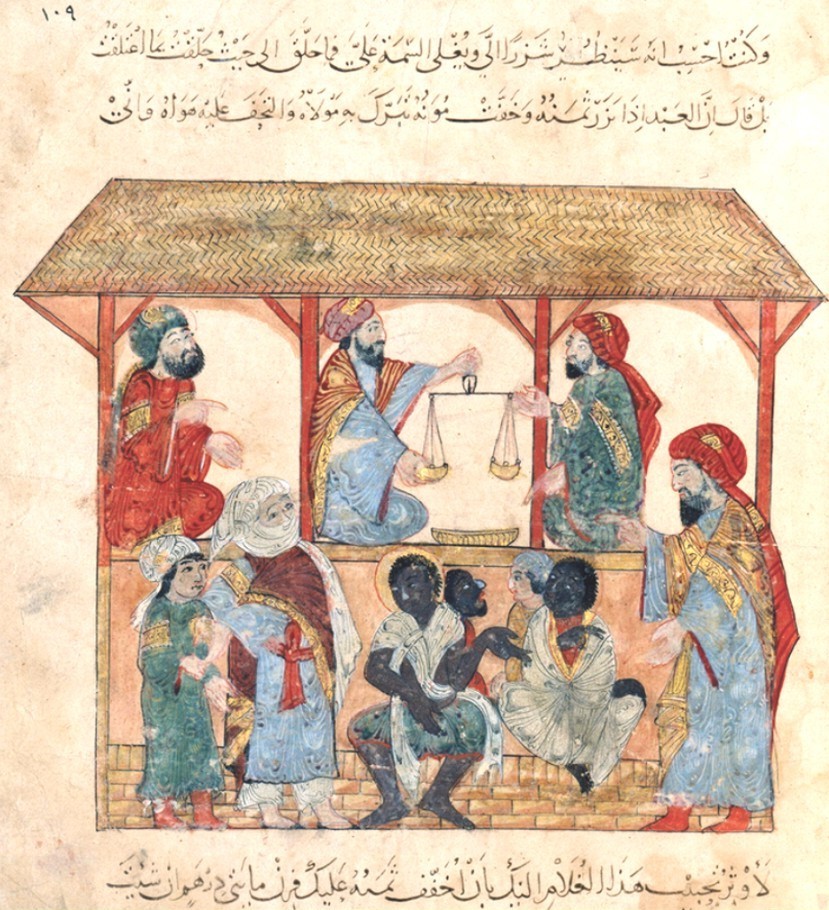
Illustration of a 13th-century slave market in Zabid, Yemen.
A 13th-century slave market in Zabid, Yemen

Less threatening were enslaved eunuchs. Although the Quran forbade castration, the enterprising Abbasids found a workaround since their ever-expanding harems needed a steady supply of unthreatening men. Infidels in sub-Saharan Africa did the dirty work of sourcing and exporting eunuchs. It was a gruesome business. Even as late as in the 19th century, nine in ten boys put under the knife died. Western visitors were horrified by the presence of eunuchs in the holy places, although Marozzi might have noted that Christianity, too, had its eunuchs — the Sistine Chapel’s last castrato wasn’t retired until 1903.

Gliding through the ages, dropping a metaphor here and a maxim there, Marozzi’s prose recalls an older tradition of history writing — the effortless fluidity of a John Julius Norwich or Jan Morris. Reading him, one thinks of Tintoretto: vast canvases, mannered style, high drama, narrative drive. But it has its drawbacks. Marozzi, whose previous books include The Arab Conquests and Islamic Empires, delights in the zany and lurid. He loves his lobbed heads and unruly libidos, his swivel-eyed slavers and concupiscent concubines.
Consider the tale of Thomas Pellow, “an eleven-year-old Cornish lad” who, in 1715, ignored his parents’ warnings and set sail from Falmouth in search of adventure. “If only he had listened to them,” Marozzi sighs. Snatched by Moroccan corsairs off Cape Finisterre, Pellow landed in Meknes, where beatings and bastinadings — feet flayed while strung upside down — quickly dulled his taste for colourful exploits. To save his skin he “turned Turk”, although he later insisted it was all for show: “I always abominated them and their accursed principle of Mahometism.”

• Read more book reviews and interviews — and see what’s top of the Sunday Times Bestsellers List
As slaves go, he did well. He climbed the ranks, led a 30,000-man slave raid into Guinea and did as he was told, “stripping the poor negroes of all they had, killing many of them, and bringing off their children into the bargain”. Then came the compulsory marriage in order to sire more slaves for his master: eight African women were paraded before him, but Pellow, bigoted fellow that he was, turned them down, “not at all liking their colour”. He demanded a wife “of my colour” and was duly granted one, although by now he was hardly a pasty Cornishman. When he escaped he was briefly mistaken for a “Moor”. Back in London, he felt alienated from his homeland — until he ended up at dinner at the Moroccan ambassador’s, who offered him “my favourite dish”: a big bowl of couscous.

Captives and Companions: A History of Slavery and the Slave Trade in the Islamic World by Justin Marozzi (Allen Lane £35 pp560). To order a copy go to timesbookshop.co.uk. Free UK standard P&P on orders over £25. Special discount available for Times+ members

 
Top