The Best of Christian Compassion, the Worst of Religious Power
The Best of Christian Compassion, the Worst of Religious Power
On the religious roots of war and the Christian response.

David French
Mar 13
539
(Photo by Mikhail Svetlov/Getty Images.)
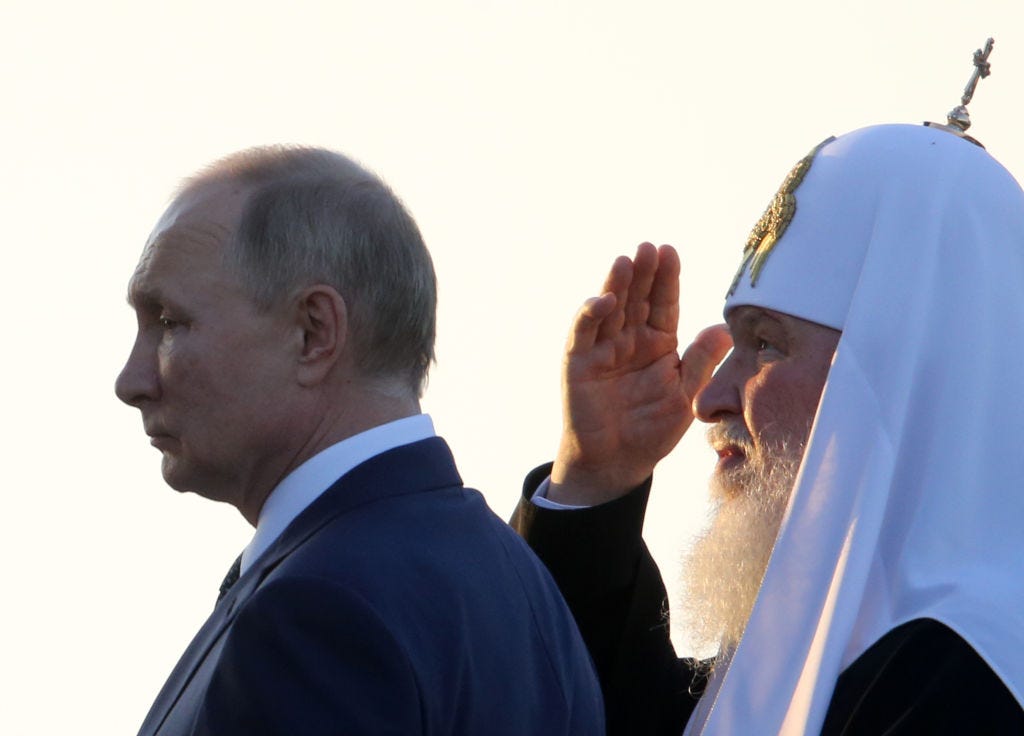
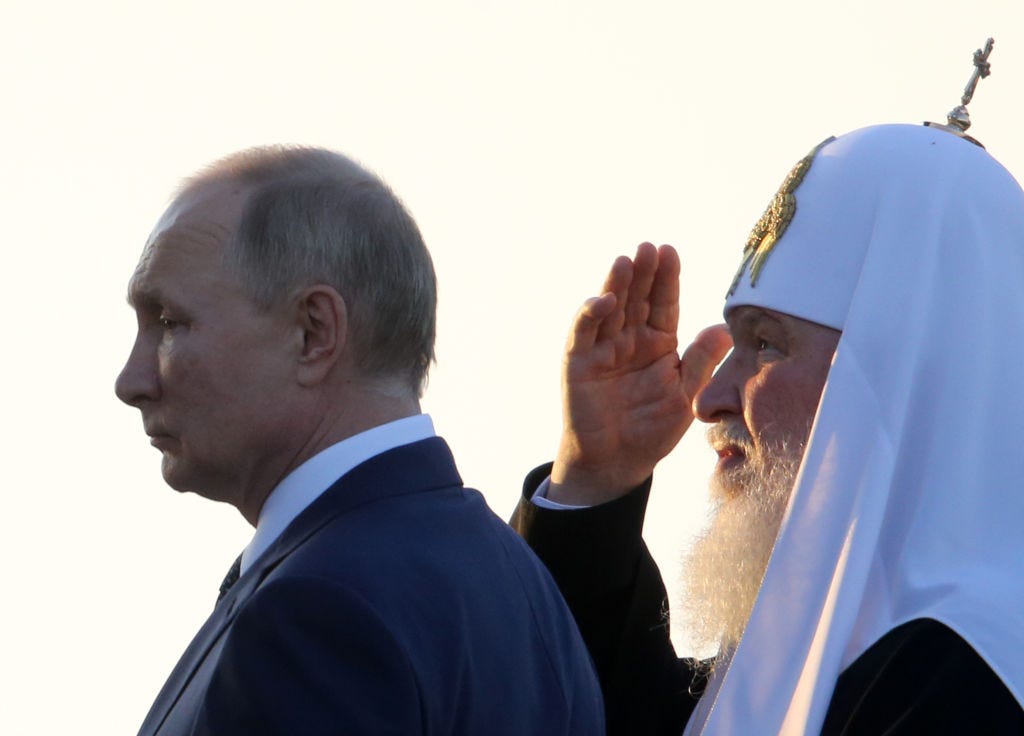
As you watch the horror unfolding in Ukraine, you are watching two immensely important, competing religious events unfold in real time
. First, Russia’s invasion is laced with religious elements. In many ways, it’s a religious war, representing religion at its worst. Second, as we watch the Ukrainian and international church race to Ukraine’s aide, we’re seeing Christianity at its best.
In one stark moment, we are seeing the extremes of what Christians can do, for evil and for good. Let’s start by describing the evil.
There are times when you read an essay so illuminating and informative that you think about it for years. That happened to me in December 2014, several months after the Russian invasion of Crimea.
The essay was by former National Security Agency analyst John Schindler, and it was called “Putin’s Orthodox Jihad.” An Orthodox Christian himself, Schindler provided an analysis of Putin’s Russia I’d seen nowhere else.
The essay is long and complex, but at the risk of oversimplifying the argument,
Schindler described an ideological “fusion” between the Russian Orthodox Church (ROC) and the FSB, Russia’s intelligence service. This fusion culminated “in the 2002 dedication of an Orthodox church at the Lubyanka, the FSB—and former KGB’s—notorious Moscow headquarters.”
This ideological fusion, Schindler argued, was at the heart of Putin’s emerging ideology. In essence
, Putin didn’t just seek Russian greatness out of a sense of secular national chauvinism, but out of religious mission, and that mission was rooted in the ROC.
Moreover, the church provided the core of the Russian moral argument against the west. Again, here was Schindler:
ROC agitprop, which has Kremlin endorsement, depicts a West that is declining down to its death at the hands of decadence and sin, mired in confused unbelief, bored and failing to even reproduce itself. Patriarch Kirill, head of the church, recently explained that the “main threat” to Russia is “the loss of faith” in the Western style, while ROC spokesmen constantly denounce feminism and the LGBT movement as Satanic creations of the West that aim to destroy faith, family, and nation.
Indeed, Russia even adopted a term called
“spiritual security,” which “gives the ROC a mission in defending Russia from negative Western spiritual influences, in partnership with Moscow’s intelligence agencies.”
Since Schindler’s piece—little-noticed at the time—the evidence of Putin’s religious motivations has grown overwhelming.
As Giles Fraser argued in the British website
Unherd, “Putin regards his spiritual destiny as the rebuilding of Christendom, based in Moscow.”
But what does this have to do with Ukraine? It turns out that Kiev is of central importance in Russian Orthodoxy. It’s the
birthplace of the ROC, the church’s “Jerusalem” according to the Russian Orthodox Patriarch Kirill:
Ukraine is not on the periphery of our church. We call Kiev ‘the mother of all Russian cities.' For us Kiev is what Jerusalem is for many. Russian Orthodoxy began there, so under no circumstances can we abandon this historical and spiritual relationship. The whole unity of our Local Church is based on these spiritual ties.
Now, let’s add one final ingredient.
In 2019 large numbers of Ukrainian parishes separated from the Ukrainian Orthodox Church, which was formerly under the ROC, to join a new Orthodox Church of Ukraine. In a February report describing the religious dimensions of the war, Schindler noted that “the schism rendered Moscow white-hot with rage. The ROC viewed this as a direct attack on its ‘canonical territory’ and on world Orthodoxy itself.”
To make this as simple as possible,
Putin has fused Russian identity with the ROC, sees his nation and his church as a bulwark against western decadence, and is now not just attempting to seize his church’s “Jerusalem” but potentially forcibly reuniting his church after a schism it rejects. There are nationalist, historical, and strategic reasons for Putin’s move against Ukraine, but the religious elements are real, and important.
The religious dimension of this conflict is yet another reason why the Cold War analogies are incorrect.
As I’ve said before, Putin isn’t trying to recreate the Soviet Union. The
better analogy is to the deeply religious Russian Empire that existed before the Russian Civil War.
This is the church at its worst, when it weds itself to state power and wields the sword to advance God’s kingdom on earth
. We are watching the deep darkness of malevolent Christendom, a religious movement that will slaughter innocents to fight “decadence” and bomb hospitals to combat “sin.” When you see Putin’s armies advance, you can think,
this is why our nation rejects established religion.
But when great evil arises, great good answers. And in this case, the great good is also in the church. Yes, it’s represented by individual Christian Ukrainian soldiers laying down their lives in defense of their nation and their homes, but it’s also represented by a very different kind of institutional Christian response.
I’m thinking, for example, of the
report that the average Baptist World Alliance Church in Ukraine is “feeding and sheltering 100 people.” I’m thinking of Samaritan’s Purse
setting up an emergency field hospital outside of Lviv, Ukraine. I’m thinking of churches
like First Baptist Church of Robertsdale, Alabama, sending a team to Moldova to help Ukrainian refugees.
I’m also thinking of my colleague Harvest Prude’s
moving story about the bonds between Christians in the United States and Christians in Ukraine:
“It’s personal for us in the Southern Baptist world,” Brent Leatherwood, acting president of the Southern Baptist Convention’s Ethics and Religious Liberty Commission, told The Dispatch. “Most folks don’t realize it, but Ukraine has the second largest population of Baptists in Europe.” In churches across America, Leatherwood said, pastors are utilizing prayer guides and partnering with Send Relief and other organizations helping on the ground.
I have friends who’ve spent time in Ukraine. Our churches are praying for Ukraine. They’re sending people and goods to Ukraine, flooding Eastern Europe with tangible support for a people who are suffering from terrible harm.
In this circumstance, national borders and national identities matter far less than the Christian brotherhood with Ukrainian churches and the shared humanity of Ukrainian refugees.
This is Christianity at its best. It’s not pacifistic. Its members are resisting tyranny with the force of arms. But its focus isn’t on conquest, but rather compassion. A religious war is being met with a religious response, and that religious response represents the true face of the faith that Putin purports to defend.


 @88m3 @ADevilYouKhow @wire28 @dtownreppin214 @Leasy @Neo The Resurrected ONE
@dza @wire28 @BigMoneyGrip @Dameon Farrow @re'up @Blackfyre @NY's #1 Draft Pick @Skyfall @2Quik4UHoes
@88m3 @ADevilYouKhow @wire28 @dtownreppin214 @Leasy @Neo The Resurrected ONE
@dza @wire28 @BigMoneyGrip @Dameon Farrow @re'up @Blackfyre @NY's #1 Draft Pick @Skyfall @2Quik4UHoes