
apnews.com
Russia's northernmost base projects its power across Arctic
By KOSTYA MANENKOV and VLADIMIR ISACHENKOV
7-9 minutes
NAGURSKOYE, Russia (AP) — During the Cold War, Russia’s Nagurskoye airbase was little more than a runway, a weather station and a communications outpost in the Franz Josef Land archipelago.
It was a remote and desolate home mostly for polar bears, where temperatures plunge in winter to minus-42 Celsius (43 degrees below zero Fahrenheit) and the snow only disappears from August to mid-September.
Now, Russia’s northernmost military base is bristling with missiles and radar and its extended runway can handle all types of aircraft, including nuclear-capable strategic bombers, projecting Moscow’s power and influence across the Arctic amid intensifying international competition for the region’s vast resources.
The shamrock-shaped facility — three large pods extending from a central atrium — is called the “Arctic Trefoil” and is painted in the white-red-and-blue of the national flag, brightening the otherwise stark vantage point on the 5,600-kilometer (3,470-mile) Northern Sea Route along Russia’s Arctic coast. Other buildings on the Island, which is called Alexandra Land, are used for radar and communications, a weather station, oil storage, hangars and construction facilities.
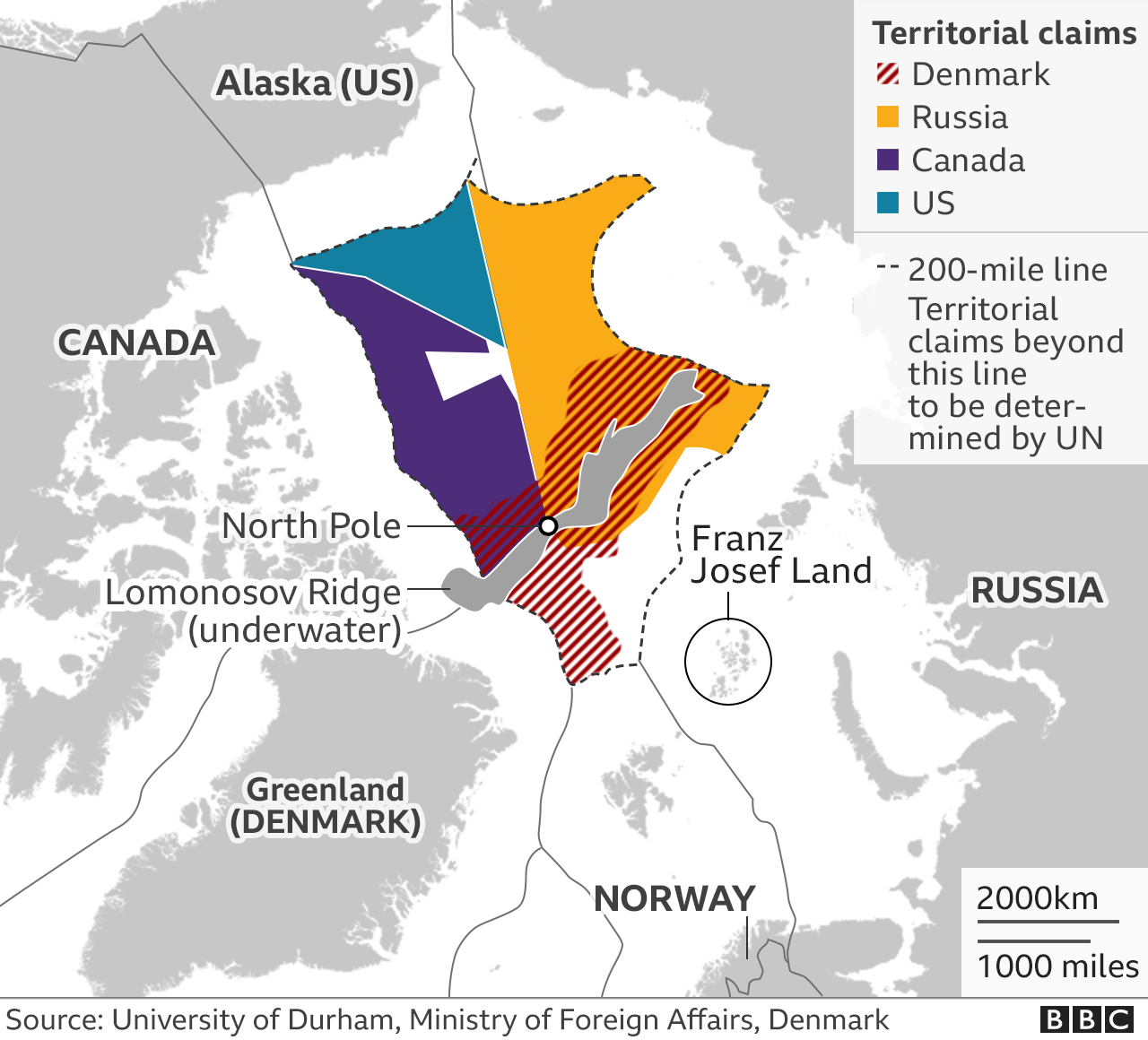
Russia has sought to assert its influence over wide areas of the Arctic in competition with the United States, Canada, Denmark and Norway as shrinking polar ice from the warming planet offers new opportunities for resources and shipping routes. China also has shown an increasing interest in the region, believed to hold up to one-fourth of the Earth’s undiscovered oil and gas.
Russian President Vladimir Putin has cited estimates that put the value of Arctic mineral riches at $30 trillion.
Tensions between Russia and the West will likely loom large over Thursday’s meeting of the Arctic nations’ foreign ministers in Reykjavik, Iceland, where Moscow is set to take a rotating chairmanship in the Arctic Council.
“We have concerns about some of the recent military activities in the Arctic,” U.S. Secretary of State Antony Blinken said Tuesday after arriving in Iceland for talks with foreign ministers of the eight members of the Arctic Council. “That increases the dangers of accidents and miscalculations and undermines the shared goal of a peaceful and sustainable future for the region. So we have to be vigilant about that.”
The Russian base, which sits about 1,000 kilometers (600 miles) south of the geographic North Pole, was built using new construction technologies as part of Kremlin efforts to bolster the military amid spiraling tensions with the West following Russia’s 2014 annexation of Ukraine’s Crimean Peninsula.
The following year, Russia submitted a revised bid for vast territories in the Arctic to the United Nations, claiming 1.2 million square kilometers (over 463,000 square miles) of Arctic sea shelf, extending more than 350 nautical miles (650 kilometers) from shore.
While the U.N. pondered that claim and those from other nations, Russia has said it sees the Northern Sea Route as its “historically developed national transport corridor,” requiring authorization from Moscow for foreign vessels to navigate along it. The U.S. has dismissed Russia’s claims of jurisdiction on parts of the route as illegitimate.
Moscow has declared its intention to introduce procedures for foreign ships and assign Russian pilots for guidance along the route, which runs from Norway to Alaska.
As part of that effort, Russia has rebuilt and expanded facilities across the polar region, deploying surveillance and defensive assets. A base in the similar trefoil shape and patriotic colors to the one in Nagurskoye is on Kotelny Island, between the Laptev Sea and the East Siberian Sea on eastern end of the shipping route, also with missiles and radar.
Adm. Alexander Moiseyev, chief of Russia’s Northern Fleet, said last week that Moscow has the right to set navigation rules along the shipping lane.
“Practically the entire Northern Sea Route goes through Russia’s territorial waters or the country’s economic zone,” Moiseyev told reporters aboard the Peter the Great missile cruiser. “The complex ice conditions make it necessary to organize safe shipping, so Russia insists on a special regime of its use.”
NATO is increasingly worried about the growing Russian military footprint in the Arctic, and Washington sent B-1 bombers to Norway this year.
“Increased Russian presence, more Russian bases in the High North, has also triggered the need for more NATO presence, and we have increased our presence there with more naval capabilities, presence in the air, and not least, the importance of protecting transatlantic undersea cables transmitting a lot of data,” NATO Secretary-General Jens Stoltenberg said.
Moiseyev fretted about the U.S. military assets in Norway, saying it has led to an “increase of the conflict potential in the Arctic.”
The Russian Foreign Ministry last week fumed at a U.S. nuclear submarine calling at a Norwegian port, saying it reflected what it described as “Oslo’s course for the militarization of the Arctic.”
On the sidelines of this week’s Arctic Council meeting, Russian Foreign Minister Sergey Lavrov is set to hold talks with Blinken -- an encounter intended to lay the groundwork for Putin’s meeting with U.S. President Joe Biden planned for next month.
Blinken has pointed out that with the Arctic warming at twice the rate of the rest of the global average, Russia has moved to increase its presence in the region.
“Russia is exploiting this change to try to exert control over new spaces,” he said last month. “It is modernizing its bases in the Arctic and building new ones.”
Blinken has rejected Russian calls to resume a military component of the Arctic Council. He also took Lavrov to task for comments earlier this week in which the Russian diplomat dismissed such criticism because the Arctic “is our territory, our land.”
“We have to proceed all of us, including Russia, based on the rules, based on norms, based on the commitments that we’ve each made and also avoid statements that undercut those,” Blinken said.
Since Putin visited the Nagurskoye base in 2017, it has been strengthened and expanded. It now houses a dedicated tactical group that operates electronic surveillance, air defense assets and a battery of Bastion anti-ship missile systems.
A runway has been extended to accommodate all types of aircraft, including Tu-95 nuclear-capable strategic bombers, said Maj.-Gen. Igor Churkin, who oversees air force operations at the base.
“The modernization of Arctic airfields significantly increases the potential of the Northern Fleet’s aviation to control the airspace in the area of the Northern Sea Route and allows to ensure its security,” he said.
In March, the Russian military conducted drills at Nagurskoye with ground troops and a pair of MiG-31 fighters flying over the North Pole. The exercise also saw three nuclear submarines smash through the Arctic ice next to one another in a carefully planned show of force.
On Monday, Lavrov rebuffed Western criticism of Russia’s Arctic expansion and bristled at what he described as Norway’s push for a stronger NATO presence there.
“We hear whining about Russia expanding its military activities in the Arctic,” Lavrov said. “But everyone knows that it’s our territory, our land. We bear responsibility for the Arctic coast to be safe, and everything our country does there is fully legitimate.”
—-
Isachenkov reported from Moscow.
bbc.com
Russia flexes muscles in challenge for Arctic control
By Sarah Rainsford
5-7 minutes
By Sarah Rainsford
BBC News, Franz Josef Land
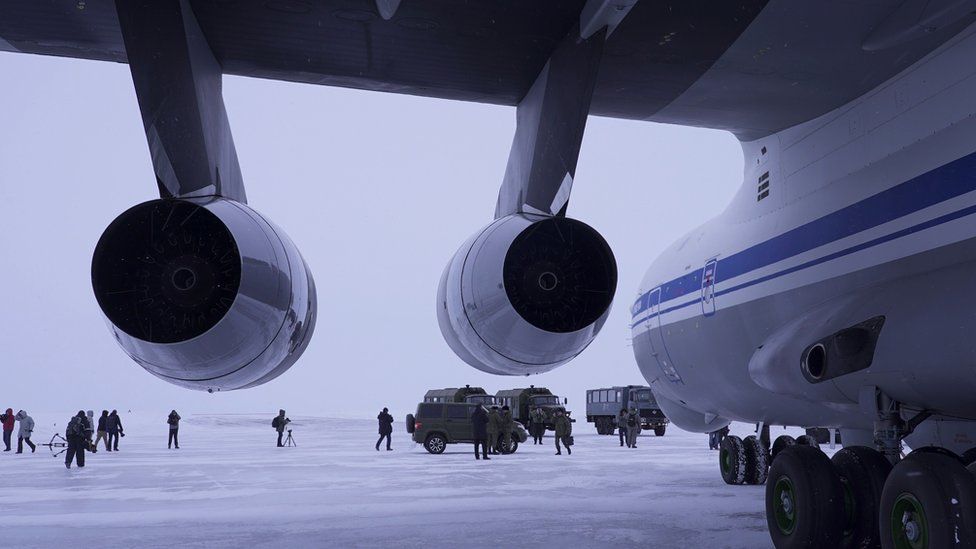
image captionThe airfield on Alexandra Island is over two hours' flight from Murmansk in Russia's north-west
The Russian military cargo plane flew us almost to the top of the world, to an archipelago once best known for its rare bird species and its walruses.
Now Franz Josef Land is home to a Russian military base and the source of added tension in relations with the West.
The US has once again accused Moscow of "militarising" the Arctic and the head of Russia's Northern Fleet has told the BBC that Nato and US military activity in the region is "definitely" provocative and on a scale not seen since World War Two.
Making the Arctic a priority for Russia
We were among the first foreign journalists taken to visit the facility on Alexandra Island, over two hours' flight from Murmansk up over the Arctic.
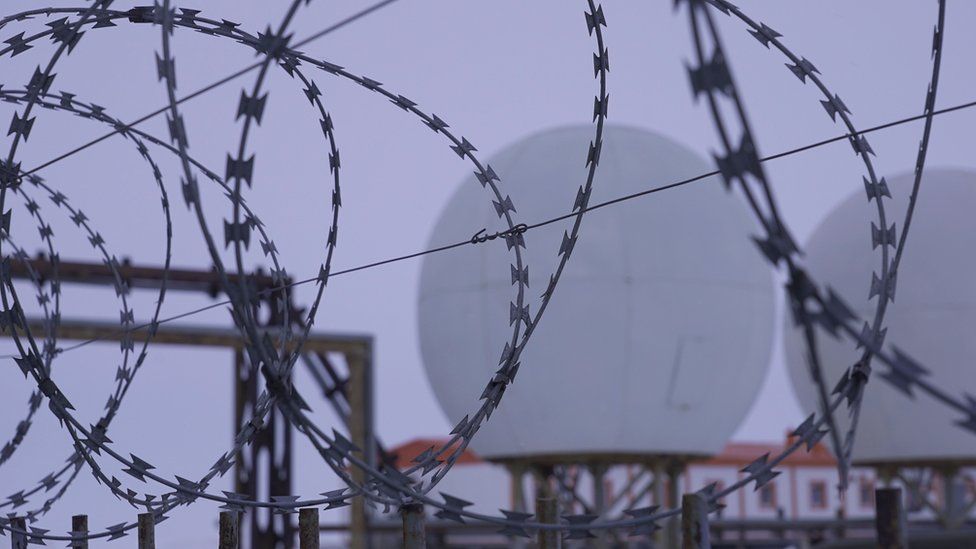
image captionTemperatures on the island drop to minus 50C during the winter
The airfield has been upgraded to allow all kinds of planes to land all year round, though emerging on to the tarmac was like stepping on an ice rink.
Less than 960km (600 miles) below the North Pole, conditions are extreme, with deep snowdrifts and blizzards even in mid-May. For a while, rattling along in a military truck, I could make out nothing but white through the window.
In deepest winter the temperature drops to minus 50 degrees C and the soldiers occasionally have to head out in their vehicles to disperse the polar bears who amble right up to the base.
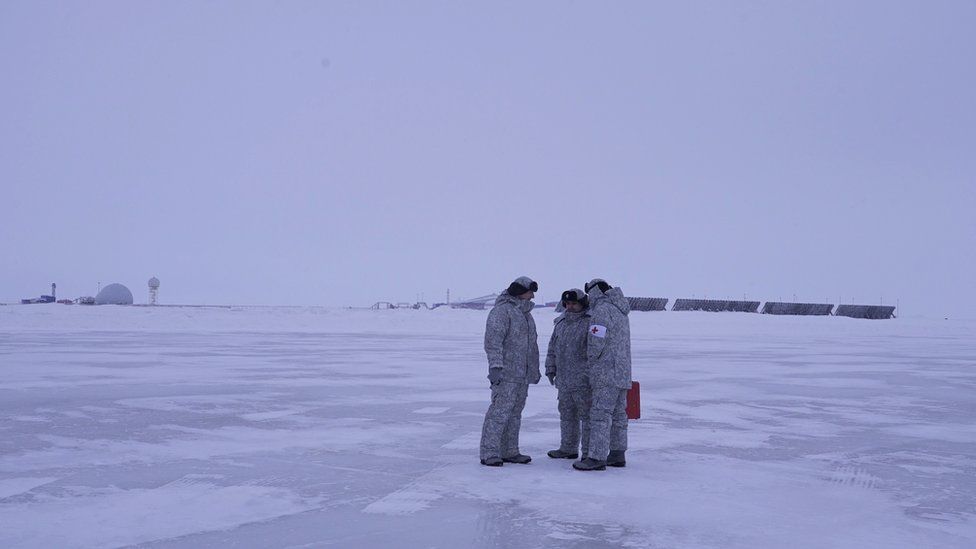
Even so, Russia has made boosting its presence in this region a priority.
'Like a space station'
Even the structure of the base is meant to make a statement: it's painted in the colours of the Russian flag, bright against the blank canvas all around.
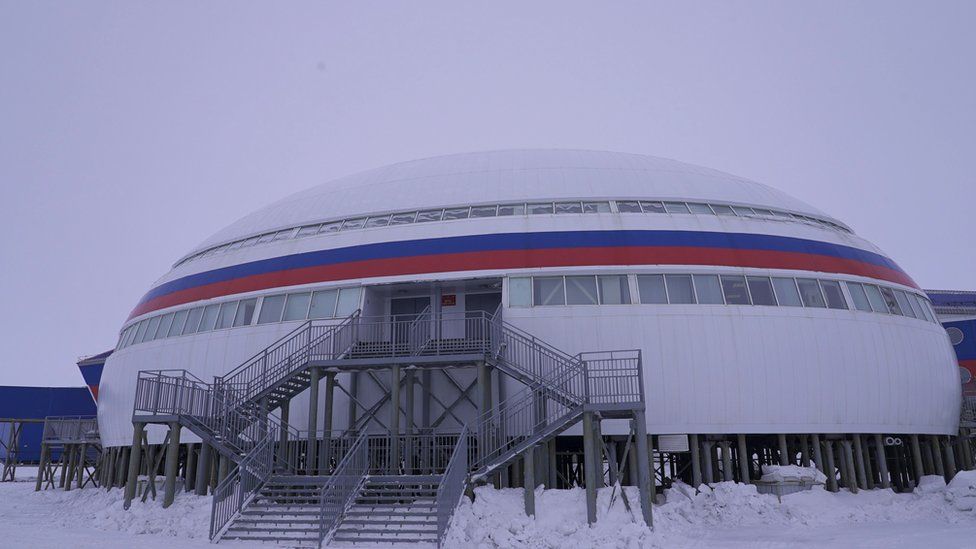
Known as Arctic Trefoil for its three-leaved shape, the base is the second of its kind in the Arctic - this one is meant for 150 soldiers.
Ahead of a tour, the commander in charge said it was so high-tech and ecologically efficient it was "like a space station, just in the Arctic emptiness instead of in orbit".
But the main show is outside, where Bastion missile launchers raise and lower their firing mechanisms as a soldier in white camouflage stands guard, gun across his chest.
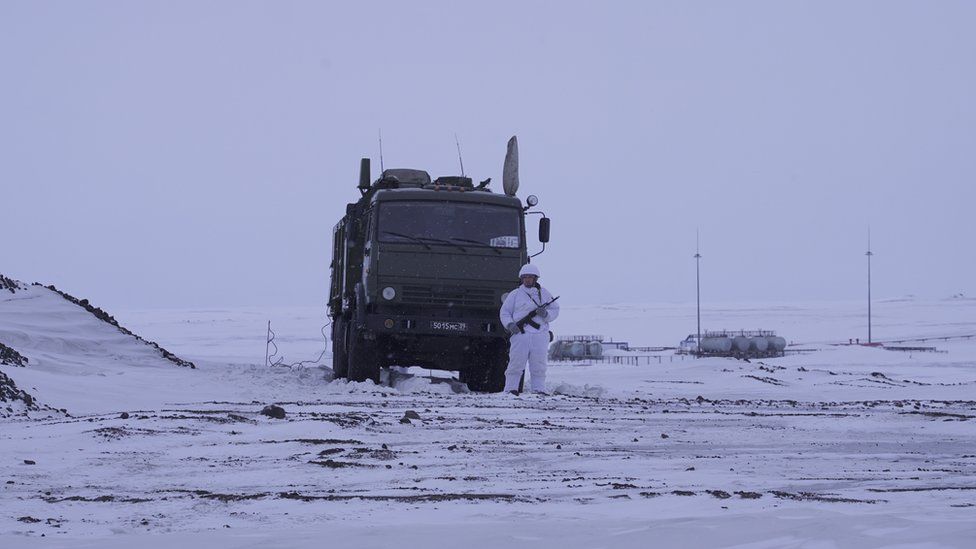
image captionRussia's Bastion missile launchers are guarded outside the base
The missile systems are "to destroy enemy ships," another soldier said. They are "effective", he informed us.
The Northern Fleet put on a far greater show of strength earlier this year when three nuclear submarines smashed through the ice simultaneously, a manoeuvre never seen before. On the same Arctic exercises, two fighter jets flew over the North Pole, refuelling in mid-air.
Such posturing is making the United States and Nato wary as Russia's military presence in the region expands to a level not seen since the Cold War.
Nato's spokeswoman confirmed that the alliance had stepped up its patrols and exercises, in response, she said, to a "more challenging security environment".
Blaming Nato for build-up
But Russia doesn't see things that way.
Before we were flown to the archipelago, we were bussed to a battlecruiser moored in the closed military town of Severomorsk. At 252 metres long, the nuclear-powered Peter the Great is the giant grey flagship of the Northern Fleet.
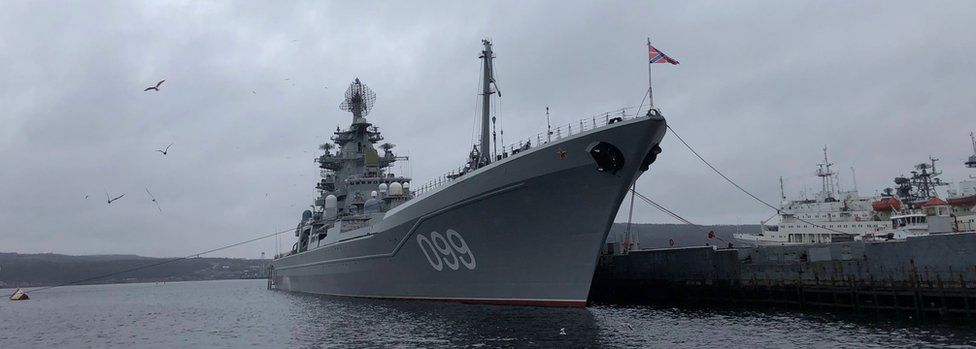
On board, the Fleet's commander, Adm Alexander Moiseyev, addressed us in front of a portrait of Peter I, the Tsar who founded Russia's navy and turned the country towards the West.
But he accused Nato forces and the US of military actions in the Arctic that increased the risk of conflict.
"There haven't been so many of their forces here for years. Decades. Not since World War Two," Adm Moiseyev countered, when I put it to him that Nato blamed Russia for the surge in tension. "We see such activity as provocative so close to the Russian border where we have very important assets. By that, I mean nuclear forces."

As for the Russian build-up, the troops are returning to a region Russia abandoned in the 1990s when the Soviet Union fell apart.
"We're just recreating the capacity to protect our borders, not to threaten anyone," argues Lev Voronkov, an Arctic expert from MGIMO university. "After the USSR collapsed, even border posts in that region were left unmanned."
That won't be an option for much longer. As the polar ice melts, removing a protective natural curtain, Russia's long northern frontier will become vulnerable.
Land of opportunity
As the Bastion missile launchers danced for the cameras on Alexandra Island, I spotted a Russian ice-breaker cutting through the frozen landscape in the distance. A smaller cargo ship followed in its wake and an iceberg loomed behind both of them.
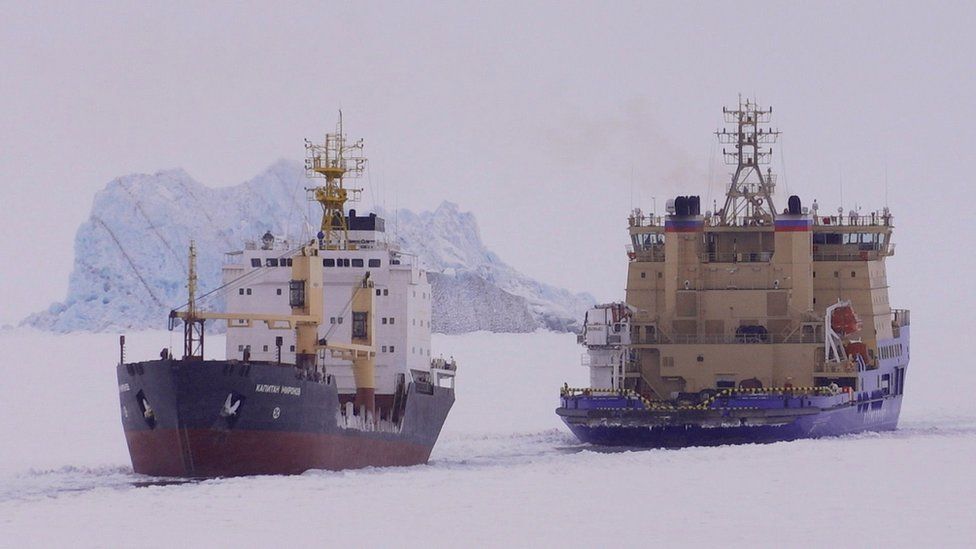
The vessels were crawling along the northern shipping route that skirts the archipelago and that Russia hopes to develop and control as global warming makes it easier to navigate. Trade would include exports of the large oil and gas reserves beneath the sea here.
Admiral Moiseyev calls his troops the "main instrument" for protecting those economic interests, as well as Russia's borders.
As competition begins to heat up, our visit to Franz Josef Land was a chance for Russia to flex some muscle and send a message: that its ambitions for the Arctic are great and growing and they are interests it's ready to defend.
media captionThe US has deployed long-range bombers to Norway for the first time, in a move seen as a message to Russia