

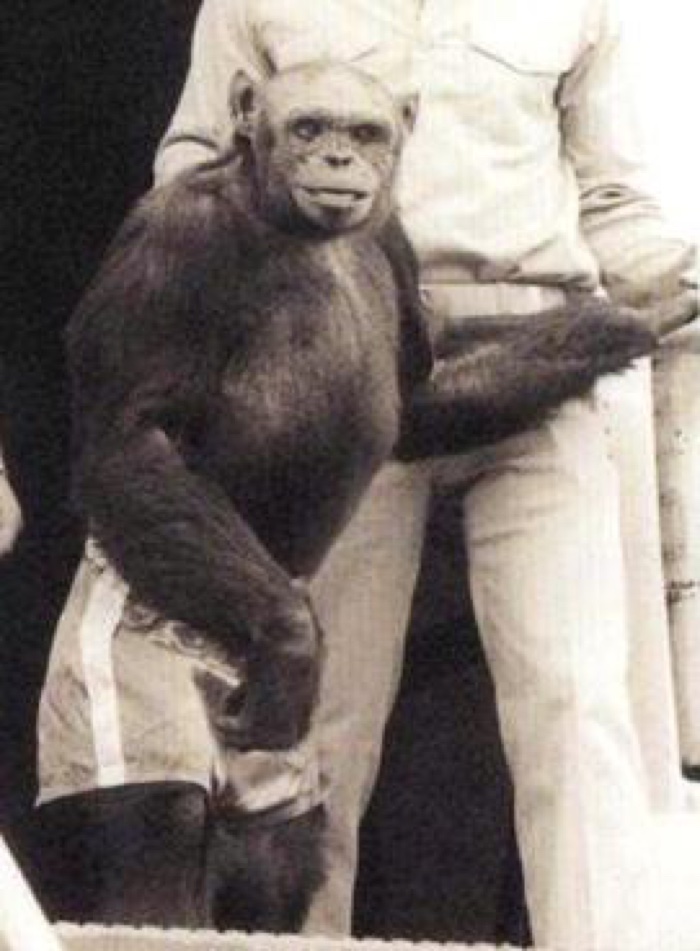
A prominent US scientist has claimed researchers in Florida succeeded in breeding a human-chimp hybrid called a 'humanzee' in controversial, long-rumoured 1920s research.
Evolutionary psychologist Gordon G. Gallup, Jr., who achieved renown for his pioneering mirror self-recognition experiments with animals in the 1970s, says a former university professor told him the hybrid creature was born at an animal research laboratory where he once worked.
"One of the most interesting cases involved an attempt which was made back in the 1920s in what was the first primate research centre established in the US in Orange Park, Florida," Gallup told The Sun.
"They inseminated a female chimpanzee with human semen from an undisclosed donor and claimed not only that pregnancy occurred but the pregnancy went full term and resulted in a live birth."
But is it true? While it's impossible to disprove Gallup's claims, there are a lot of uncertainties around the story, which is making us pretty doubtful.
First up, the timeline. The institution Gallup says carried out the experiment is these days called the Yerkes National Primate Research Centre – but it was established in 1930, not in the 1920s.
Its founder, psychologist and primatologist Robert Yerkes, was a divisive figure in the scientific community, given his stated support for eugenics research, but he was also fascinated by animal behaviour, especially that of primates.
Before it was called the Yerkes National Primate Research Centre, Yerkes' lab went by other names during the 1920s, including the Yale Laboratories of Primate Biology, and the Anthropoid Breeding and Experiment Station in Orange Park, Florida, which presumably is the facility Gallup is referring to.
While Gallup doesn't identify which university professor told him about the humanzee, it's not the first time this mystery confidante has been mentioned.
Scientist Claims US Lab Engineered 'Humanzee' Human-Chimp Hybrid 100 Years Ago


