TODAY Spain has it's general election. Here is how polling looks:
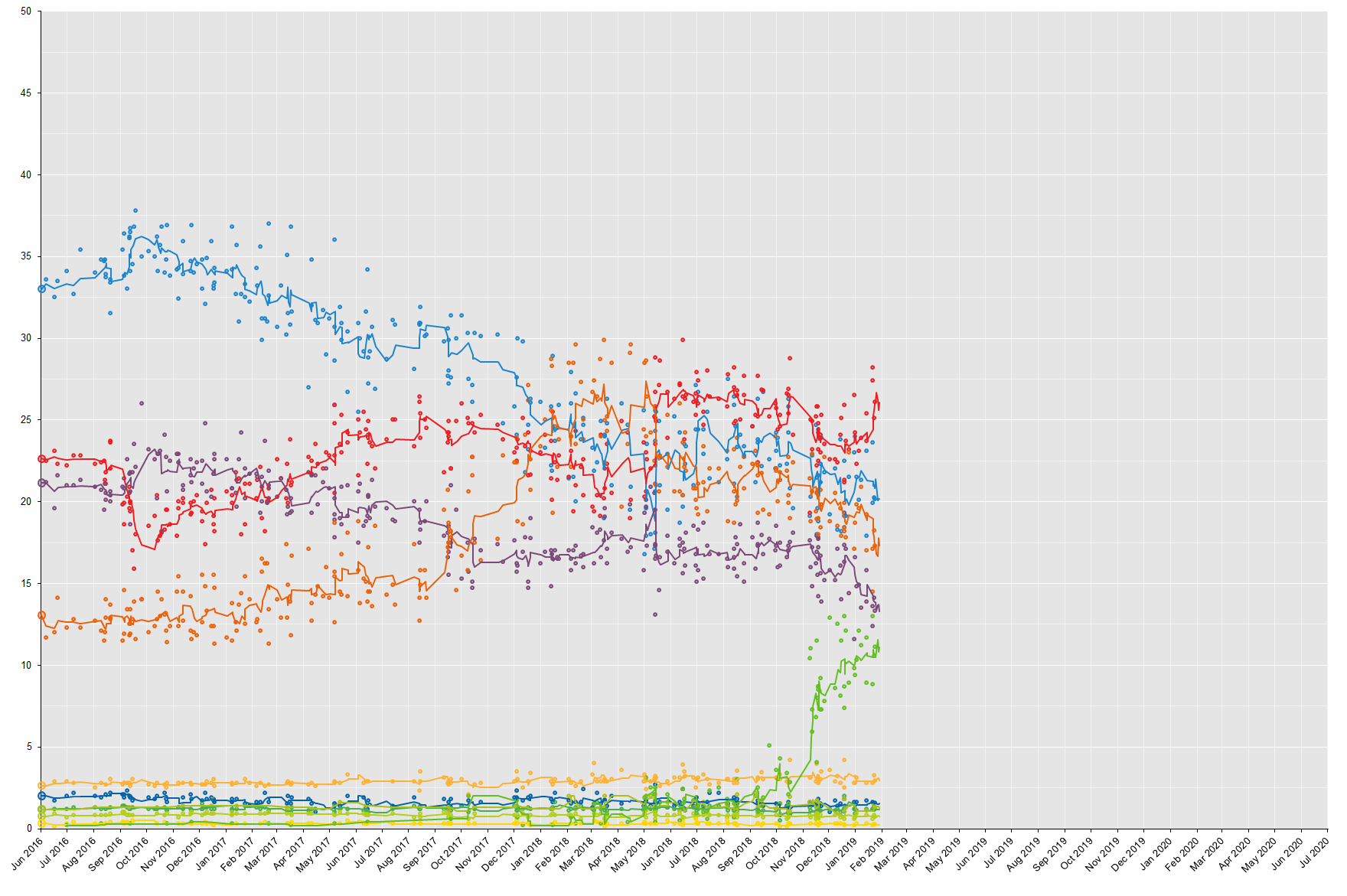
If you're not familiar with the parties ideology:
PP - Establishment Center Right
Podemos & allies - Anti Establishment Left Wing
PSOE - Establishment Center Left
C's - Anti Establishment Fiscally Conservative/Socially Liberal
IU-UPeC - Catalonian Separatist/Left Wing
DL-CDC - Catalonian Separatist/Center to Center Right
PNV - Basque Nationalist Party/Center Right
6 things to watch in the Spanish elections
It’s the second vote in 6 months. With 28 percent of Spaniards undecided, a third is possible, too.

By
DIEGO TORRES
6/26/16, 6:00 AM CET
Updated 6/26/16, 4:05 PM CET
MADRID — For the first time in its short democratic history, Spain holds repeat elections on Sunday, six months after voters shook up the two-party system, depriving the winning incumbent Mariano Rajoy of a governing majority.
The four top-placed parties couldn’t break the deadlock and Spaniards now have to head to the ballots again. Rajoy, the acting prime minister from the conservative Popular Party, hopes he can win a second mandate by luring back defectors from Albert Rivera’s centrist Ciudadanos and getting those on the fence out to vote.
The PP’s traditional Socialist rivals, the PSOE, face being relegated to third place by an anti-austerity alliance led by upstart leftists Podemos.
Voting begins at 9 a.m and closes at 8 p.m., and one hour later in the Canary Islands. With 28 percent of Spaniards undecided, anything could happen — even a third round of elections.
Here are six things to watch:
1) Combined Left
The main change prompted by the six-month impasse is the alliance between Podemos and communist United Left. ‘Unidos Podemos’ (United We Can) includes other regional and social allies to total 16 participants. Under a province-based electoral system which rewards strong concentrations of voters, this factor has the potential to alter the status quo. Had both parties run together in December, their 24.33 percent share of the vote would have yielded 85 seats in Congress, instead of the 71 they got separately. That would have given the combined PSOE and leftist forces 173 deputies in Congress — very close to the absolute majority of 176 seats.

Leader and candidate of left wing alliance party Unidos Podemos ‘United We Can’ Pablo Iglesias | Pablo Blazquez Dominguez/Getty Images
Most polls predict Podemos and its partners overtaking the PSOE in terms of percentage of votes and challenging it closely in terms of seats in Congress as well: So the combined left-of-center bloc could even muster an absolute majority.
Unidos Podemos, therefore, goes into Sunday’s vote in better shape than it was in December. Its success or failure depends on its ability to keep votes it gained six month ago. The PSOE, the PP and Ciudadanos, on the other hand, are riding against the wind to reach the same result and keep their seats in the Congress.
2) Left-Right balance
In December’s vote, the right-of-center PP/Ciudadanos bloc won 163 seats vs 161 for the combined leftist bloc, with the rest of the seats allocated to regional parties such as the Basques and Catalans. Historical animosity — the legacy of the 1936-1939 Civil War won by Francisco Franco — makes it hard to cross the Left-Right divide, although the PSOE’s Pedro Sánchez tried to break the impasse with an agreement with Ciudadanos. Podemos, however, managed to portray it as a betrayal of Socialist voters.
There should be little difficulty forming a ruling coalition between the PP and Ciudadanos, if they get the numbers; on the Left, though, coalition-building could still prove difficult. Kiko Llaneras, who has compiled and analyzed polls for the online paper El Español, gives the right-of-centre bloc a 28 percent chance of reaching 170 seats and the left-of-center 45 percent, with a 27 percent likelihood of ending up with a similar stalemate as December.
3) ‘Sorpasso’
What matters on Sunday is not only who comes first — almost guaranteed to be Rajoy’s PP — but also who ends up second. Both Podemos and the PSOE aspire to the silver medal, in their battle for the hegemony of the Spanish Left. The goal laid out by Podemos’ Pablo Iglesias is to force the Socialists to choose between submitting to his authority or committing hara-kiri.
So far, the radical movement founded in 2014 has outmaneuvered the PSOE at every turn. The Socalist old guard, like former prime minister Felipe González, doesn’t trust Podemos and would prefer to facilitate some sort of understanding with the PP, which might require Rajoy’s resignation to make it digestible for Socialist voters. This would also be the preferred choice of the most powerful figure right now in the PSOE, Andalusia’s regional leader Susana Díaz.
However, a large chunk of Socialists, including some regional PSOE figures like Valencia’s Ximo Puig, who governs with the support of Podemos, would rather make a deal with Unidos Podemos even if it means making Iglesias prime minister.
4) Potential resignations
Spanish politics isn’t prone to resignations at big moments, with the exception of former PSOE leader Joaquín Almunia who quit on election night after losing to the PP’s José María Aznar. That being said, nothing is to be ruled out on Sunday and the PSOE’s Sánchez looks like the weakest link, who could find it difficult to resist pressure to quit if his party comes in third.

Leader of Spanish Socialist Party (PSOE) and party candidate Pedro Sanchez | Cristina Quicler/AFP via Getty Images
Rajoy doesn’t have a future if he can’t secure a new mandate, but he might prefer to remain party leader until a PP congress settles on a successor, in whose appointment he would want to have a say.
5) Center vs. extremes
Rajoy has tried to polarize the campaign by playing on fears of the far left to squeeze Ciudadanos and the PSOE in the middle ground. Podemos was complicit in this strategy, saying there were only two possible outcomes: rule by the PP or Podemos.
Ciudadanos and the PSOE, respecting an apparently non-aggression pact in the center, fought back with different tactics: Rivera struck out at the PP for corruption and Podemos for its links to leftists in Venezuela and Greece; Sánchez wooed leftists who had defected to Podemos by accusing Iglesias of preferring to keep Rajoy in power rather than support a government led by the PSOE.
Regional results in Catalonia will also be closely watched for clues to a confidence vote that pro-independence regional president Carles Puigdemont faces in September. In Andalusia, people will pay attention to regional results in the last remaining PSOE stronghold. If Susana Díaz wins and keeps Podemos in check, she’ll be a stronger contender for the Socialist leadership.
6) Brexit, scandals and age
Candidates have tried to spin the Brexit debate to their own advantage, with Rajoy warning that now is not the time for any more uncertainty in Europe, and Sánchez compared the U.K. vote to the binding referendum on independence that Podemos proposes for Catalonia. Rivera said “fear” had won in Britain and he was worried it would win in Spain as well; Iglesias argued that if the EU was fairer and more equitable, nobody would want to leave.
Unlike in Britain, where older and less educated voters opted for change, in Spain they back the traditional two-party system and the status quo. This is one of the reasons why Rajoy’s PP isn’t taking more of a hit from corruption scandals affecting the party, as well as a ministerial resignation over the Panama Papers and leaks of a plot to discredit Catalan separatists.
The PP remains the top choice for voters over 65-years-old but comes fourth among young people. The PP loyalists are unlikely to change their minds on Sunday, but it may be hard for the conservatives to win back disenchanted supporters who fled to Ciudadanos in December.
6 things to watch in the Spanish elections
If you're not familiar with the parties ideology:
PP - Establishment Center Right
Podemos & allies - Anti Establishment Left Wing
PSOE - Establishment Center Left
C's - Anti Establishment Fiscally Conservative/Socially Liberal
IU-UPeC - Catalonian Separatist/Left Wing
DL-CDC - Catalonian Separatist/Center to Center Right
PNV - Basque Nationalist Party/Center Right
6 things to watch in the Spanish elections
It’s the second vote in 6 months. With 28 percent of Spaniards undecided, a third is possible, too.
By
DIEGO TORRES
6/26/16, 6:00 AM CET
Updated 6/26/16, 4:05 PM CET
MADRID — For the first time in its short democratic history, Spain holds repeat elections on Sunday, six months after voters shook up the two-party system, depriving the winning incumbent Mariano Rajoy of a governing majority.
The four top-placed parties couldn’t break the deadlock and Spaniards now have to head to the ballots again. Rajoy, the acting prime minister from the conservative Popular Party, hopes he can win a second mandate by luring back defectors from Albert Rivera’s centrist Ciudadanos and getting those on the fence out to vote.
The PP’s traditional Socialist rivals, the PSOE, face being relegated to third place by an anti-austerity alliance led by upstart leftists Podemos.
Voting begins at 9 a.m and closes at 8 p.m., and one hour later in the Canary Islands. With 28 percent of Spaniards undecided, anything could happen — even a third round of elections.
Here are six things to watch:
1) Combined Left
The main change prompted by the six-month impasse is the alliance between Podemos and communist United Left. ‘Unidos Podemos’ (United We Can) includes other regional and social allies to total 16 participants. Under a province-based electoral system which rewards strong concentrations of voters, this factor has the potential to alter the status quo. Had both parties run together in December, their 24.33 percent share of the vote would have yielded 85 seats in Congress, instead of the 71 they got separately. That would have given the combined PSOE and leftist forces 173 deputies in Congress — very close to the absolute majority of 176 seats.
Leader and candidate of left wing alliance party Unidos Podemos ‘United We Can’ Pablo Iglesias | Pablo Blazquez Dominguez/Getty Images
Most polls predict Podemos and its partners overtaking the PSOE in terms of percentage of votes and challenging it closely in terms of seats in Congress as well: So the combined left-of-center bloc could even muster an absolute majority.
Unidos Podemos, therefore, goes into Sunday’s vote in better shape than it was in December. Its success or failure depends on its ability to keep votes it gained six month ago. The PSOE, the PP and Ciudadanos, on the other hand, are riding against the wind to reach the same result and keep their seats in the Congress.
2) Left-Right balance
In December’s vote, the right-of-center PP/Ciudadanos bloc won 163 seats vs 161 for the combined leftist bloc, with the rest of the seats allocated to regional parties such as the Basques and Catalans. Historical animosity — the legacy of the 1936-1939 Civil War won by Francisco Franco — makes it hard to cross the Left-Right divide, although the PSOE’s Pedro Sánchez tried to break the impasse with an agreement with Ciudadanos. Podemos, however, managed to portray it as a betrayal of Socialist voters.
There should be little difficulty forming a ruling coalition between the PP and Ciudadanos, if they get the numbers; on the Left, though, coalition-building could still prove difficult. Kiko Llaneras, who has compiled and analyzed polls for the online paper El Español, gives the right-of-centre bloc a 28 percent chance of reaching 170 seats and the left-of-center 45 percent, with a 27 percent likelihood of ending up with a similar stalemate as December.
3) ‘Sorpasso’
What matters on Sunday is not only who comes first — almost guaranteed to be Rajoy’s PP — but also who ends up second. Both Podemos and the PSOE aspire to the silver medal, in their battle for the hegemony of the Spanish Left. The goal laid out by Podemos’ Pablo Iglesias is to force the Socialists to choose between submitting to his authority or committing hara-kiri.
So far, the radical movement founded in 2014 has outmaneuvered the PSOE at every turn. The Socalist old guard, like former prime minister Felipe González, doesn’t trust Podemos and would prefer to facilitate some sort of understanding with the PP, which might require Rajoy’s resignation to make it digestible for Socialist voters. This would also be the preferred choice of the most powerful figure right now in the PSOE, Andalusia’s regional leader Susana Díaz.
However, a large chunk of Socialists, including some regional PSOE figures like Valencia’s Ximo Puig, who governs with the support of Podemos, would rather make a deal with Unidos Podemos even if it means making Iglesias prime minister.
4) Potential resignations
Spanish politics isn’t prone to resignations at big moments, with the exception of former PSOE leader Joaquín Almunia who quit on election night after losing to the PP’s José María Aznar. That being said, nothing is to be ruled out on Sunday and the PSOE’s Sánchez looks like the weakest link, who could find it difficult to resist pressure to quit if his party comes in third.
Leader of Spanish Socialist Party (PSOE) and party candidate Pedro Sanchez | Cristina Quicler/AFP via Getty Images
Rajoy doesn’t have a future if he can’t secure a new mandate, but he might prefer to remain party leader until a PP congress settles on a successor, in whose appointment he would want to have a say.
5) Center vs. extremes
Rajoy has tried to polarize the campaign by playing on fears of the far left to squeeze Ciudadanos and the PSOE in the middle ground. Podemos was complicit in this strategy, saying there were only two possible outcomes: rule by the PP or Podemos.
Ciudadanos and the PSOE, respecting an apparently non-aggression pact in the center, fought back with different tactics: Rivera struck out at the PP for corruption and Podemos for its links to leftists in Venezuela and Greece; Sánchez wooed leftists who had defected to Podemos by accusing Iglesias of preferring to keep Rajoy in power rather than support a government led by the PSOE.
Regional results in Catalonia will also be closely watched for clues to a confidence vote that pro-independence regional president Carles Puigdemont faces in September. In Andalusia, people will pay attention to regional results in the last remaining PSOE stronghold. If Susana Díaz wins and keeps Podemos in check, she’ll be a stronger contender for the Socialist leadership.
6) Brexit, scandals and age
Candidates have tried to spin the Brexit debate to their own advantage, with Rajoy warning that now is not the time for any more uncertainty in Europe, and Sánchez compared the U.K. vote to the binding referendum on independence that Podemos proposes for Catalonia. Rivera said “fear” had won in Britain and he was worried it would win in Spain as well; Iglesias argued that if the EU was fairer and more equitable, nobody would want to leave.
Unlike in Britain, where older and less educated voters opted for change, in Spain they back the traditional two-party system and the status quo. This is one of the reasons why Rajoy’s PP isn’t taking more of a hit from corruption scandals affecting the party, as well as a ministerial resignation over the Panama Papers and leaks of a plot to discredit Catalan separatists.
The PP remains the top choice for voters over 65-years-old but comes fourth among young people. The PP loyalists are unlikely to change their minds on Sunday, but it may be hard for the conservatives to win back disenchanted supporters who fled to Ciudadanos in December.
6 things to watch in the Spanish elections
Last edited: