

Doobie Doo
Veteran
Supreme Court rules against Navajo Nation in Colorado River water rights case
By JESSICA GRESKO32 minutes ago
1 of 4
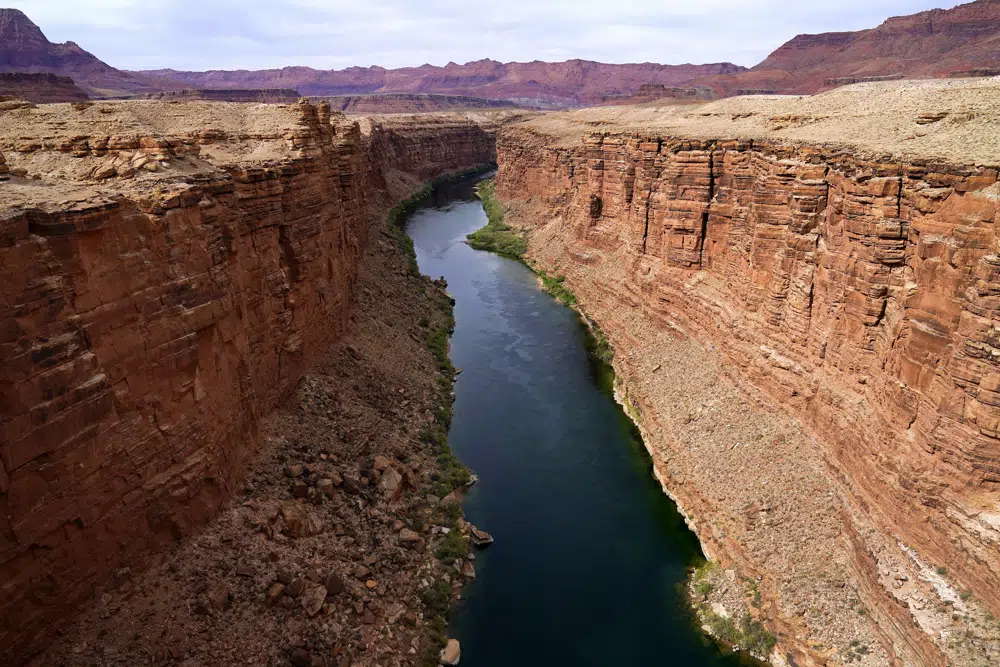
FILE - The Colorado River in the upper River Basin is pictured in Lees Ferry, Ariz., on May 29, 2021. (AP Photo/Ross D. Franklin, File)
WASHINGTON (AP) — The Supreme Court ruled against the Navajo Nation on Thursday in a dispute involving water from the drought-stricken Colorado River.
States that draw water from the river — Arizona, Nevada and Colorado — and water districts in California that are also involved in the case had urged the court to decide for them, which the justices did in a 5-4 ruling. Colorado had argued that siding with the Navajo Nation would undermine existing agreements and disrupt the management of the river.
The Biden administration had said that if the court were to come down in favor of the Navajo Nation, the federal government could face lawsuits from many other tribes.
Lawyers for the Navajo Nation had characterized the tribe’s request as modest, saying they simply were seeking an assessment of the tribe’s water needs and a plan to meet them.
The facts of the case go back to treaties that the tribe and the federal government signed in 1849 and 1868. The second treaty established the reservation as the tribe’s “permanent home” — a promise the Navajo Nation says includes a sufficient supply of water. In 2003 the tribe sued the federal government, arguing it had failed to consider or protect the Navajo Nation’s water rights to the lower portion of the Colorado River.
Writing for a majority made up of conservative justices, Justice Brett Kavanaugh explained that “the Navajos contend that the treaty requires the United States to take affirmative steps to secure water for the Navajos — for example, by assessing the Tribe’s water needs, developing a plan to secure the needed water, and potentially building pipelines, pumps, wells, or other water infrastructure.”
But, Kavanaugh said, “In light of the treaty’s text and history, we conclude that the treaty does not require the United States to take those affirmative steps.”
Kavanaugh acknowledged that water issues are difficult ones.
“Allocating water in the arid regions of the American West is often a zero-sum situation,” he wrote. It is important, he said, for courts to leave “to Congress and the President the responsibility to enact appropriations laws and to otherwise update federal law as they see fit in light of the competing contemporary needs for water.”
A federal trial court initially dismissed the lawsuit, but an appeals court allowed it to go forward. The Supreme Court’s decision reverses that ruling from the appeals court.
In a dissent, Justice Neil Gorsuch wrote that he would have allowed the case to go forward and he characterized the Navajo’s position as a “simple ask.”
“Where do the Navajo go from here?” he wrote. “To date, their efforts to find out what water rights the United States holds for them have produced an experience familiar to any American who has spent time at the Department of Motor Vehicles. The Navajo have waited patiently for someone, anyone, to help them, only to be told (repeatedly) that they have been standing in the wrong line and must try another.”
Gorsuch said one “silver lining” of the case may be that his colleagues in the majority recognized that the tribe may still be able to “assert the interests they claim in water rights litigation, including by seeking to intervene in cases that affect their claimed interests.”
Gorsuch, a conservative, was joined by the court’s three liberals: Justices Sonia Sotomayor, Elena Kagan and Ketanji Brown Jackson.
During arguments in the case in March, Justice Samuel Alito pointed out that the Navajo Nation’s original reservation was hundreds of miles away from the section of the Colorado River it now seeks water from.
Today, the Colorado River flows along what is now the northwestern border of the tribe’s reservation, which extends into New Mexico, Utah and Arizona. Two of the river’s tributaries, the San Juan River and the Little Colorado River, also pass alongside and through the reservation. Still, one-third of the some 175,000 people who live on the reservation, the largest in the country, do not have running water in their homes.
The government argued that it has helped the tribe secure water from the Colorado River’s tributaries and provided money for infrastructure, including pipelines, pumping plants and water treatment facilities. But it said no law or treaty required the government to assess and address the tribe’s general water needs. The states involved in the case argued that the Navajo Nation was attempting to make an end run around a Supreme Court decree that divvied up water in the Colorado River’s Lower Basin.
Supreme Court rules against Navajo Nation in Colorado River water rights case
The Supreme Court has ruled against the Navajo Nation in a dispute involving water from the drought-stricken Colorado River. States that draw water from the river — Arizona, Nevada and Colorado — and water districts in California had urged the court to decide for them, and that's what the...
 apnews.com




 don’t even ask me how


