(continued)
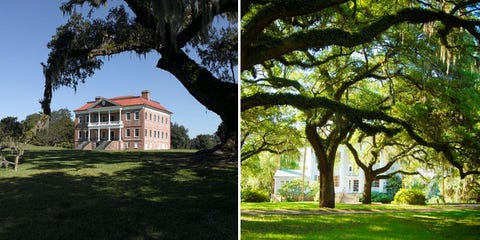
All of Charleston's historic plantations—left, the Palladian 18th-century Drayton Hall, and, right, mid-19th-century McLeod Plantation Historic Site—take great care to tell the stories of the enslaved who worked and built them. “We don’t focus on pretty things at McLeod but on people,” says David Bennett, of Charleston County Parks.
I ask Bernard Powers, emeritus professor of history at the College of Charleston and member of IAAM’s board of directors, about plantation museums. “We have relationships with all of them: Drayton Hall, Middleton Place, Magnolia… They have moved in a positive direction. These are places where you now hear Black voices, where before there was silence.”
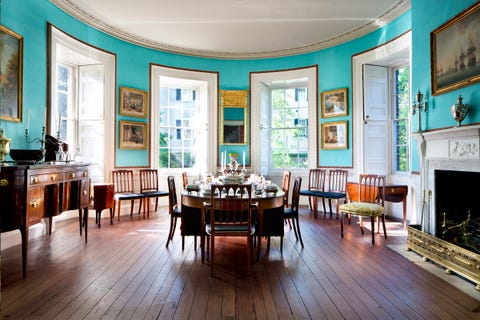
The dining room of the Nathaniel Russel House museum as it would have looked in 1808. Studies are underway on the kitchen house to learn the identities of the enslaved.
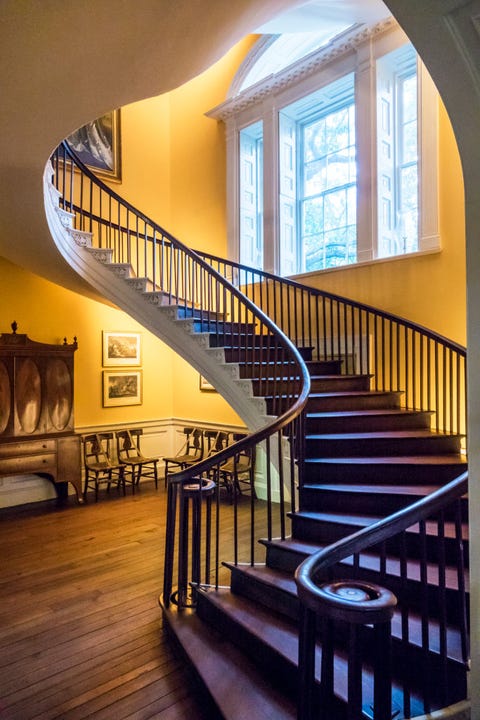
The showpiece staircase of the Nathaniel Russell House.
Honoring the contributions of the enslaved in a city that abounds with layers of historical mysteries can require avidity of purpose and judicious interpretation. The Nathaniel Russell House, built by a wealthy merchant and slave trader originally from Rhode Island and operated by the Historic Charleston Foundation, is the city’s most thoroughly restored antebellum house museum, its showpiece a grand cantilevered staircase. “It’s in what I call move-in state,” says the foundation’s director of museums, J. Grahame Long, “what it would have looked like in 1808.” But what has Long and his team most excited are some recent discoveries.
On a hunch, they began to search through debris preserved in the cracks in the original walls of the mansion’s adjoining kitchen house—its slave quarters. “A little piece of coral jewelry. Who wore that?” Long says. “Then a fragment from an 1830s Quaker reading primer. South Carolina’s Slave Codes, which proscribed reading and writing by the enslaved, among other activities, had severely tightened around then. We’d had Denmark Vesey’s narrowly thwarted slave rebellion in Charleston in 1822, Nat Turner’s in Virginia in 1831. There was a collective fear of the enslaved communicating, organizing. Someone—who?—was taking a big risk with the reading primer. I have the curator’s disease: I wanted to make an exhibit right away. But a close friend and adviser who is African-American said, ‘Hold your horses.’ I realized it’s not my story, a white guy’s, to tell. The Russells had 12 to 18 slaves on their property. So now we’ve started a venture to find out who they were, so that we can tell the story more accurately—not just the physical properties of the jewelry and the paper, but what they may have meant to those people.
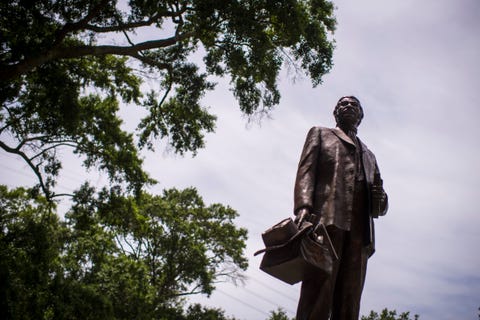
The statue of Denmark Vesey, who in 1822 plotted a massive slave uprising in Charleston and was executed, now stands in Hampton Park.
"We want to bring the human trauma back into the pretty architectural space," Long continues. "Visitors might look at this kitchen house and say, ‘Oh, slavery was not so bad. People have lived in worse.’ But what we need to get them to see is that Nathaniel Russell could walk in at any second and say, ‘You’re sold and your kids are staying here.’ ” It is worth noting that in 2014 Vesey, the would-be uprising leader, who bought his own freedom but was unable to obtain it for his first wife and their children, was rehabilitated from terrorist to freedom fighter, and his statue now stands in Charleston’s Hampton Park.
Mother Emanuel AME Church is one of the oldest Black churches in the South (Vesey was one of its founders). In June 2015 nine parishioners, including the Rev. Clementa Pinckney, a state senator, were massacred during Bible study by a white supremacist. It is one of Charleston’s many ironies that the church is on a street still named for John C. Calhoun, who famously called Southern slavery “a positive good” and whose monument was removed from the city’s Marion Square only in the wake of George Floyd’s murder.
Charleston’s historic Mother Emanuel AME Church.
The killings focused Charleston’s attention on the centuries of violence against Black people and the need for racial justice. The church’s current pastor, the Rev. Eric S.C. Manning, who has on the wall behind his desk a Gullah sweetgrass cross made using techniques brought from West Africa, is not sure how the struggle for racial equality is going. “There is still a lot of work to be done. I commend Mayor [John] Tecklenburg for the apology. He did not hide from the past. Fifteen years ago Charlestonians did not know what Gadsden’s Wharf was. Now everyone embraces that story. But there comes a time when conversations must cease and actions take root—we need economic opportunities, educational reforms, programs to help kids break the cycle. And I’m praying that one day we can get this street renamed.” Meanwhile, a $17 million memorial for the “Emanuel Nine,” designed by Michael Arad, architect of the 9/11 memorial in New York City, is close to breaking ground beside the church. There will be an area with “fellowship benches.” They will be a reminder, Manning says, “of how we must nevertheless continue to have constant conversations with our fellow men and women. And to forgive, as the families of these victims did, whatever atrocities were committed.”
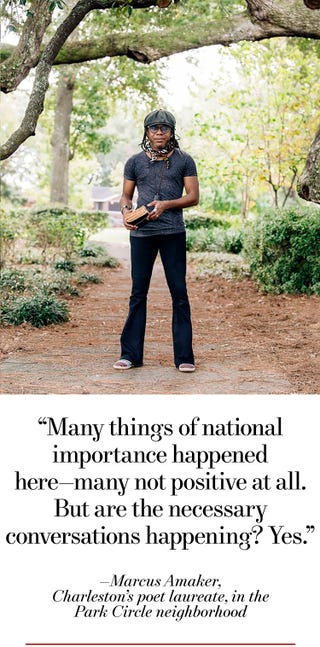
Marcus Amaker, who moved to Charleston in 2003 (a cum yah, not a bin yah, as a Gullah speaker would put it) and is the city’s first poet laureate, concurs. “Right now it seems to be in fashion to tell me that my life matters. But some of us in the Black community are wondering how long that’s going to last. And there are a lot of people in the city not benefiting at all from the attention we’re getting. But once you normalize conversations, a lot can happen. I’m an optimist. And Charleston, because of its history, should be leading the change. If anyone says this stuff is in the past, that we shouldn’t be talking about it, I say, ‘Think how recent it all is!’ The Emancipation Proclamation was 159 years ago, not 1,000. These wounds are fresh, the stories are fresh. We are all still unpacking so much. And having an outlet like the museum will be a positive thing.”
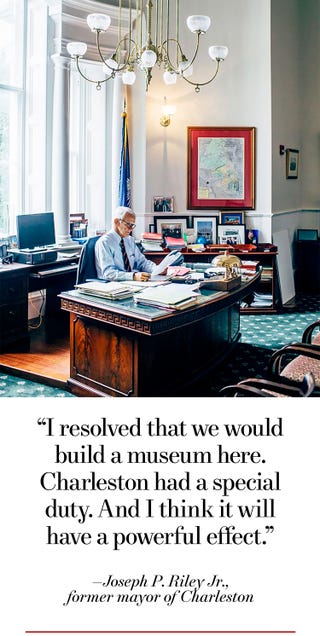
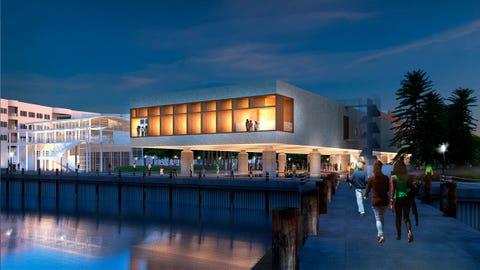
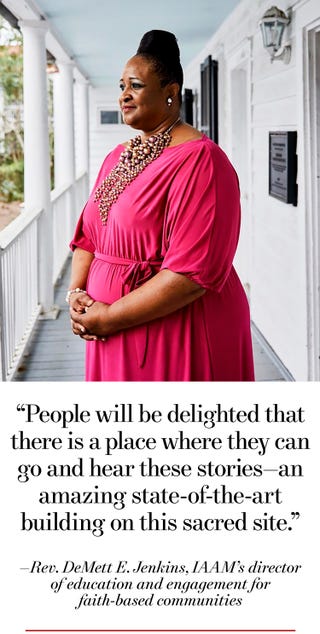
The International African American Museum is a starkly rectangular structure lifted up by 13-foot-tall pillars, 18 of them, above Gadsden’s Wharf—above what the Rev. DeMett E. Jenkins, who is showing me around, calls sacred ground. (Granddaughter of the celebrated South Carolina civil rights leader Esau Jenkins, she is IAAM’s Lilly director of education and engagement for faith-based communities.) Former mayor Joseph Riley, who had the idea for the museum back in 2000, calls it “a quiet building that honors the site,” echoing a description offered by the building’s architect, the late Henry Cobb of Pei Cobb Freed & Partners: “a purposefully unrhetorical work of architecture, quietly affirming the power of place.”
Its west and east walls will be banks of windows. The eastern gallery, facing the harbor, the Atlantic, and Africa, will aim to offer a complexity of perspectives on the diaspora created by the slave trade—on how the enslaved in the United States, the Caribbean, Canada, South America, and beyond, together with free Blacks, forged a life that influenced global history. (Already the museum has established partnerships with cultural institutions in Sierra Leone, Barbados, and the UK.) The westernmost gallery, facing Charleston, South Carolina, and the nation, will feature a family research center where genealogists will assist anyone who wishes to begin the journey of learning their ancestors’ names.
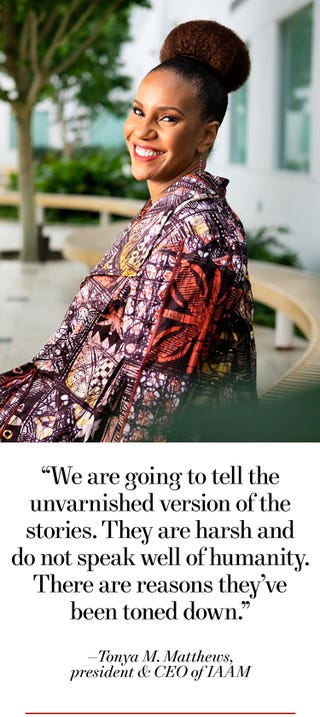
The museum will also have a gallery highlighting the intersection of South Carolinian and U.S. history, as they pertain to the slave trade. As CEO Tonya Matthews says, “Slave trading was a global industry, the first global industry of its kind. Much of that plays into why America matters to the world. Since the start of our existence we always have, and the story of enslaved Africans, and African-Americans, is part of why.”
The grounds of the museum will include a tidal pool where water will ebb and flow; on its bottom will be etched a ghostly cross section of a slave ship with prone figures of men, women, and children crowded as tightly as possible. There will be an African Ancestors Memorial Garden for reflection and meditation.
“Some of this will be extremely hard stuff,” Jenkins says. “It should be, because it was. But there will still be joy here—because we are all here because of the perseverance, resilience, and ability to survive of the enslaved. And that’s a lot to be thankful for.”









 #weallthesame


