
The New American Dilemma
Posted: 05/16/2014 10:16 pm EDT Updated: 05/19/2014 10:59 am EDT
Print Article


Source: Miles Corak, "Income Inequality, Equality of Opportunity, and Intergenerational Mobility," Journal of Economic Perspectives, Summer 2013.

Posted: 05/16/2014 10:16 pm EDT Updated: 05/19/2014 10:59 am EDT
Print Article
Some 70 years ago, the Swedish social scientist Gunnar Myrdal published an incisive monograph on a searing question facing the United States -- he named it "An American Dilemma." Myrdal and his associates were addressing the country's massive contradictions on matters of racial inequality, and concluded that the citizenry was riven by a legal, moral, constitutional commitment to equality, but still mired in Jim Crow laws and practices. Today, the country faces a new dilemma -- the rise of an unequal distribution of income and wealth so extreme that it undermines that most American of values: that talent and hard work, not accidents of birth, should determine how far someone can rise.
The basic facts about class division in America are well-known: the United States has the highest level of income inequality of any wealthy democratic country and faces the largest gap between the rich and the poor since the 1920s. But the question remains: how willing are Americans to do anything about it?
The apparent tolerance of Americans for high levels of inequality has been a staple of foreign observers since the nation's earliest decades. Writing in the 1830s, Alexis de Tocqueville noted (not without admiration) that "in no other country in the world is the love of property keener or more alert than in the United States, and nowhere does the majority display less inclination toward doctrines which in any way threaten the way property is owned."
Eight decades later, the German sociologist Werner Sombart wrote a book addressing the much-discussed question, Why is There No Socialism in the United States? In that classic 1906 study, Sombart cited many factors to explain Americans' aversion to ideologies of redistribution, but prominent among them was the greater opportunity for upward mobility in the United States: "The prospects of moving out of his class," wrote Sombart, "were undoubtedly greater for the worker in America than for his counterpart in old Europe."
But Sombart's image of America as the land of opportunity, whatever its truth in the past, is now a myth; as a number of recent studies have demonstrated, the United States now has one of the lowest rates of upward mobility among the wealthy democracies1. Moreover, America's extremely high levels of inequality undermine upward mobility; in a well-documented pattern that social scientists have come to refer to as "The Great Gatsby Curve," the higher the level of inequality, the lower the rate of mobility [See Figure 1].
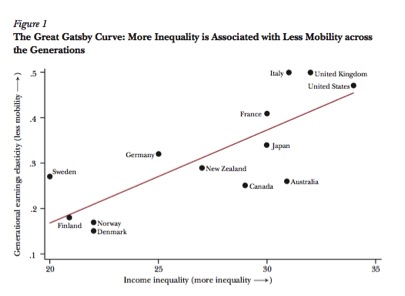
Source: Miles Corak, "Income Inequality, Equality of Opportunity, and Intergenerational Mobility," Journal of Economic Perspectives, Summer 2013.
There have been moments in our nation's history when Americans, challenged by difficult new conditions, came to support strong government policies to reduce inequality. The most transformative of these moments came during the Great Depression of the 1930s. Out of this crisis came a spate of government initiatives -- among them, the Social Security Act, the Wagner Act, the WPA, and the Fair Labor Standards Act -- that reduced inequality by strengthening labor unions, increasing taxes on the wealthy, establishing a federal minimum wage, and providing modest levels of economic security for the elderly and the unemployed.
Though the New Deal enjoyed broad popular support, there were signs -- even amidst an unprecedented economic catastrophe that had brought unemployment to 25 percent when Roosevelt took office -- of Americans' uneasiness with the expansion of government then taking place. In the mid-1930s, public attitudes toward the federal relief measures that had done so much to reduce unemployment (cutting it by 5 to 7 percent between 1934 and 1936) were sharply divided. By April 1937, a narrow majority of Americans -- 51 to 49 percent -- favored cuts in federal relief spending.
Three major community studies conducted in the 1930s -- in Muncie, Indiana ("Middletown"), New Haven, Connecticut and Akron, Ohio2 -- all found that even the harsh conditions of the Great Depression could not shake the commitment of the great majority of American workers, however sympathetic they may have been to the New Deal, to the "American way" of private enterprise and individual opportunity. The role of the American dream of advancement -- for one's self and one's children -- remained alive, if a bit shaken, even under conditions of mass unemployment. The description by Robert and Helen Lynd of the Middletown worker in 1935 is particularly revealing: "He is an individualist in an individualistic culture... and he is bent primarily on getting ahead under his own steam and ingenuity." Even in Akron, Ohio -- selected for study because it was the scene of a bitter sit-down strike in 1935 and 1936 at the city's massive rubber factories and was widely considered an epicenter of class conflict -- most workers sought compromise with their employers and decisively rejected radically egalitarian ideologies.
Beginning in 2008, Americans have faced the nation's most serious economic crisis since the Great Depression. There are, to be sure, some major differences; unemployment peaked in 2009 at one worker in 10 rather than one in four, and the nation's much higher standard of living as well as a stronger (if still porous) safety net have made it impossible to speak, as did FDR, of "one third of a nation ill-housed, ill-clad, and ill-nourished." Yet there are also some noteworthy similarities, including the arrival of economic crisis during a period of extraordinary -- and increasing -- income inequality. But perhaps the most striking similarity is the reluctance of the American people -- even more pronounced now than in the 1930s -- to wholeheartedly embrace policies that call for muscular government action.
The foundation of this reluctance is a deepening lack of trust in the federal government. From America's very founding, a deep-seated suspicion of centralized government power has shaped not only popular sentiment, but the very institutional arrangements enshrined on the Constitution. Nevertheless, when trust in government was high, as it was in the mid-1960s, the federal government could enact major policies to reduce poverty and economic insecurity. It was not a coincidence that some of the signature programs of the Great Society -- Medicare, Medicaid, the War on Poverty, and the expansion of Social Security -- were enacted at a time when three in four Americans believed that you could "trust the government in Washington to do what is right all or most of the time."
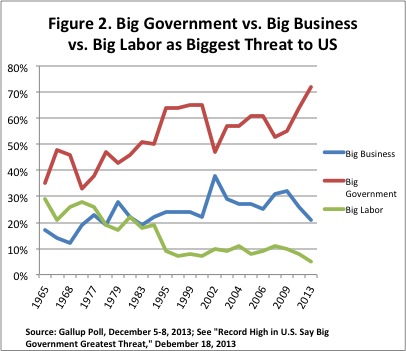
By 2010, trust in government had plummeted to an all-time low of 19 percent. But perhaps the most revealing figure compares the percentile of people viewing "big government" or "big business" as "the biggest threat to the country in the future." Even in 1965, Americans showed their perennial mistrust of "big government," choosing it as the biggest threat over business by a margin of two to one. Today, however, that margin is more than three to one (with "big labor" now a distant third) - -a gap that has grown even as the power of corporations has arguably reached unprecedented heights [see Figure 2].
Despite Americans' mistrust of government, they are not happy with concentrated economic power; according to a 2012 study, just 30 percent of the public is satisfied with the "size and power/influence of major corporations." Nor is it the case -- as some have claimed3-- that Americans don't care about inequality. On the contrary, Americans are quite unhappy with the distribution of income and wealth, with those dissatisfied outnumbering the satisfied by more than two to one (67 to 32 percent). And intense feelings are even more tilted against the status quo on inequality, with nearly four in 10 "very dissatisfied" and fewer than one in 10 who are "very satisfied."
An ingenious study by Michael Norton of Harvard Business School and Dan Ariely of Duke gives us a sense of the magnitude of the gap between how economic rewards are distributed in the United States today and how Americans believe they should be distributed. In the first part of their study, Norton and Ariely tested the public's response to three possible distributions of wealth: a perfectly egalitarian one, a relatively egalitarian one based on Sweden, and a third based on the actual distribution of wealth in the United States today. People were then asked to "imagine that if you joined this nation, you would be randomly assigned to a place in the distribution, so you could end up anywhere in this distribution, from the very richest to the very poorest." Remarkably, 92 percent chose the Swedish distribution. In the second phase of the study, respondents were asked to estimate the actual distribution of wealth in the United States. The results indicated that "Americans appear to drastically underestimate the current level of wealth inequality, suggesting that they may be simply unaware of the gap."
Although Americans would like in principle to live in a more equal society, they nonetheless have serious reservations about taking the concrete measures that would help produce a more egalitarian society. This is seen most clearly when one compares the United States to other wealthy democratic societies, all of which have more equal distributions of wealth and income. The most fundamental disagreements concern the proper role of government. On the basic question of whether it is the government's responsibility to reduce income differences, Americans were the only one of seven countries to report more people in disagreement than agreement. Everywhere else, there was strong agreement that reducing income differences was a government responsibility [see Figure 3]. On the questions of whether it is the government's responsibility to "provide a decent standard of living for the unemployed," Americans were again more likely than citizens of other countries to say that it was not a proper role for the government.






 Economic mobility is much lower in the US and Britain, the two countries with the highest inequality, than the rest of countries of that caliber. That is a fact. I have no idea what you're attempting to argue. Less than 30% of people will make it to an income bracket higher than the one in which they were born.

