

Jarryd Hayne: the Australian rugby star Seattle Seahawks may bring to the NFL
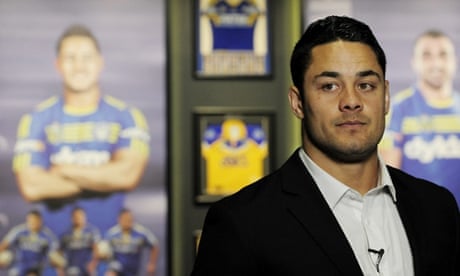
Jarryd Hayne, the rugby league player who wants to make the move to the NFL. Photograph: Brett Hemmings/Getty Images
When on form Hayne is the best rugby league player around but, as Pete Carroll said, it will be a ‘tremendous challenge’ to make the transition and adapt those skills to football
Who is Jarryd Hayne, the Australian rugby league player who’s just announced he’s quitting the sport to take a crack at the NFL? To answer the question, a clarification: there is not one Jarryd Hayne. There are two Jarryd Haynes. The first is the Hayne Train, or sometimes the Hayne Plane, a 6ft 2in, 220lb, 26-year-old superstar who, operating with runaway intelligence and strength from his spiritual home at the base of the Parramatta Eels’ backline, has spent much of the past half-decade cutting a ravishing, at times resplendently arrogant, trail through defence after defence in the National Rugby League.
The second hasn’t been handed a cutesy nickname but we might call him the Hayne Drain, a player so fixed on the imperative of the spectacular, so addicted to the extravagance of his own talent, that in games where he obviously doesn’t “feel it”, he withdraws into himself and usually ends up doing nothing at all.
It was in 2009 that Australian rugby league fans first became acquainted with the Hayne Plane, so-called because of his habit of celebrating tries with his arms stretched out like jet wings. It was Hayne’s annus mirabilis, the single-season equivalent of a straight flush, with the then-21-year-old putting together a chain of performances so incandescently brilliant that it seemed, for a moment, as if he’d expanded the horizon of what was previously thought possible on a rugby league field.
Rugby league is far less tactical and statistics-driven than American football; there’s less of an emphasis on set pieces and much greater scope for the expression of individual virtuosity in open, unstructured play. It’s a sport, in many respects, that is all about elevating the cult of individual genius over the collective plan; it’s a sport whose whole psychology is geared towards rewarding the unexpected. In 2009, dragging a middling Parramatta side from eighth in the table all the way to the grand final, Australian rugby league’s equivalent of the Superbowl, Hayne gave us the unexpected in spades: there were scything, length-of-the-field tries, chips over the top, no-look passes, stop-start shuffles of jinking impudence from 10 metres out, and numerous tectonic, body-slam moments in defence. Statistics show that Hayne ran the most of anyone in the NRL in 2009; if there was such a figure, they’d probably show that he was the game’s hardest player to tackle as well. For one year, Hayne was the best player that rugby league had ever seen.
Until he wasn’t. The Hayne Drain reared his head in the 2009 grand final: facing Melbourne and attempting to guide Parramatta to their first premiership since 1986, Hayne, whose contest against opposing full-back Billy Slater had been eagerly anticipated, spent 80 minutes shuffling about the field with all the urgency and interest of an animatronic ham. Melbourne duly waltzed away with the game (although they were later stripped of the title for salary cap breaches). Hayne was solid through 2010, without ever quite touching the heights of 2009, but a protracted slump at the start of 2011 saw Phil Gould, Australian rugby league punditry’s closest thing to Bill O’Reilly, accuse Hayne of only ever attempting to make things happen on a rugby league field when the odds of success were heavily in his favour. Hayne, it was said, did not have the courage to fail.
For a moment, Gould’s accusation looked like sticking. But recent years have seen a return to form, and in the season just concluded, Hayne recaptured the brilliance of his 2009 breakthrough; the Hayne Train was back. Like all the great players, Hayne has developed a gait and a style all his own: to watch him in full flight, centre of gravity low, torso pushed to the sky, head up, a kind of shrugged, king-of-the-mountain diffidence in every one of his movements, it’s not hard to convince yourself that somehow, 27 years ago, by a divine accident of biology, Michael Johnson and Diego Maradona – the legendary Argentina soccer player – produced a child together and settled on rugby league as the compromise sport for him to go into. Those are ludicrous comparisons, of course; but at his best, Hayne merits them.
To get a better sense for what makes him so special, it’s important to understand where he stands on the field. Traditionally the full-back, the position in which Hayne has spent the bulk of his career, is a master at running with ball in hand and little else. Receiving the ball deep in his team’s own half, the full-back will make easy yards in the face of the onrushing opposition; piercing the first line of defence is usually seen as a successful run, and in the best scenario, the full-back will break through for the deep-lying back’s fetish-object, the runaway try. The measure of Hayne’s talent is that he regularly scores runaway tries from deep in his own half, but is also capable of doing everything else as well: he has the strength of a forward, the stop-start change of pace of a more central back, and the close handling control and kicking vision of a playmaker. Good players can do some of these things, but very few can do all of them – and no one in rugby league today can do all of them as well as Hayne. He is, in short, the sport’s sole multi-instrument virtuoso.
Speed, commitment in defence, butter-soft hands, and a barging, twisting energy with the tryline in sight: as a rugby league player, Hayne has it all. But it’s the nature of rugby league to encourage players to indulge their desire to do everything. Rugby league is a maximalist sport: players look better the more they can achieve. Hayne, in sympathy, has made his name by being very good at very many things. But now he’s moving to a sport whose calculus of value is fundamentally minimalist – where the best players are those who are exceptional at one thing and one thing only.
For Hayne to achieve anything close to the success he’s had in rugby league will require a rewiring of basic instincts; he will have to teach himself to pull back from the urge to do it all. That’s a task that may prove, you sense, beyond even this most powerful of athletic brains. Rugby league’s loss may be nobody’s gain.

Jarryd Hayne, the rugby league player who wants to make the move to the NFL. Photograph: Brett Hemmings/Getty Images
When on form Hayne is the best rugby league player around but, as Pete Carroll said, it will be a ‘tremendous challenge’ to make the transition and adapt those skills to football
Who is Jarryd Hayne, the Australian rugby league player who’s just announced he’s quitting the sport to take a crack at the NFL? To answer the question, a clarification: there is not one Jarryd Hayne. There are two Jarryd Haynes. The first is the Hayne Train, or sometimes the Hayne Plane, a 6ft 2in, 220lb, 26-year-old superstar who, operating with runaway intelligence and strength from his spiritual home at the base of the Parramatta Eels’ backline, has spent much of the past half-decade cutting a ravishing, at times resplendently arrogant, trail through defence after defence in the National Rugby League.
The second hasn’t been handed a cutesy nickname but we might call him the Hayne Drain, a player so fixed on the imperative of the spectacular, so addicted to the extravagance of his own talent, that in games where he obviously doesn’t “feel it”, he withdraws into himself and usually ends up doing nothing at all.
It was in 2009 that Australian rugby league fans first became acquainted with the Hayne Plane, so-called because of his habit of celebrating tries with his arms stretched out like jet wings. It was Hayne’s annus mirabilis, the single-season equivalent of a straight flush, with the then-21-year-old putting together a chain of performances so incandescently brilliant that it seemed, for a moment, as if he’d expanded the horizon of what was previously thought possible on a rugby league field.
Rugby league is far less tactical and statistics-driven than American football; there’s less of an emphasis on set pieces and much greater scope for the expression of individual virtuosity in open, unstructured play. It’s a sport, in many respects, that is all about elevating the cult of individual genius over the collective plan; it’s a sport whose whole psychology is geared towards rewarding the unexpected. In 2009, dragging a middling Parramatta side from eighth in the table all the way to the grand final, Australian rugby league’s equivalent of the Superbowl, Hayne gave us the unexpected in spades: there were scything, length-of-the-field tries, chips over the top, no-look passes, stop-start shuffles of jinking impudence from 10 metres out, and numerous tectonic, body-slam moments in defence. Statistics show that Hayne ran the most of anyone in the NRL in 2009; if there was such a figure, they’d probably show that he was the game’s hardest player to tackle as well. For one year, Hayne was the best player that rugby league had ever seen.
Until he wasn’t. The Hayne Drain reared his head in the 2009 grand final: facing Melbourne and attempting to guide Parramatta to their first premiership since 1986, Hayne, whose contest against opposing full-back Billy Slater had been eagerly anticipated, spent 80 minutes shuffling about the field with all the urgency and interest of an animatronic ham. Melbourne duly waltzed away with the game (although they were later stripped of the title for salary cap breaches). Hayne was solid through 2010, without ever quite touching the heights of 2009, but a protracted slump at the start of 2011 saw Phil Gould, Australian rugby league punditry’s closest thing to Bill O’Reilly, accuse Hayne of only ever attempting to make things happen on a rugby league field when the odds of success were heavily in his favour. Hayne, it was said, did not have the courage to fail.
For a moment, Gould’s accusation looked like sticking. But recent years have seen a return to form, and in the season just concluded, Hayne recaptured the brilliance of his 2009 breakthrough; the Hayne Train was back. Like all the great players, Hayne has developed a gait and a style all his own: to watch him in full flight, centre of gravity low, torso pushed to the sky, head up, a kind of shrugged, king-of-the-mountain diffidence in every one of his movements, it’s not hard to convince yourself that somehow, 27 years ago, by a divine accident of biology, Michael Johnson and Diego Maradona – the legendary Argentina soccer player – produced a child together and settled on rugby league as the compromise sport for him to go into. Those are ludicrous comparisons, of course; but at his best, Hayne merits them.
To get a better sense for what makes him so special, it’s important to understand where he stands on the field. Traditionally the full-back, the position in which Hayne has spent the bulk of his career, is a master at running with ball in hand and little else. Receiving the ball deep in his team’s own half, the full-back will make easy yards in the face of the onrushing opposition; piercing the first line of defence is usually seen as a successful run, and in the best scenario, the full-back will break through for the deep-lying back’s fetish-object, the runaway try. The measure of Hayne’s talent is that he regularly scores runaway tries from deep in his own half, but is also capable of doing everything else as well: he has the strength of a forward, the stop-start change of pace of a more central back, and the close handling control and kicking vision of a playmaker. Good players can do some of these things, but very few can do all of them – and no one in rugby league today can do all of them as well as Hayne. He is, in short, the sport’s sole multi-instrument virtuoso.
Speed, commitment in defence, butter-soft hands, and a barging, twisting energy with the tryline in sight: as a rugby league player, Hayne has it all. But it’s the nature of rugby league to encourage players to indulge their desire to do everything. Rugby league is a maximalist sport: players look better the more they can achieve. Hayne, in sympathy, has made his name by being very good at very many things. But now he’s moving to a sport whose calculus of value is fundamentally minimalist – where the best players are those who are exceptional at one thing and one thing only.
For Hayne to achieve anything close to the success he’s had in rugby league will require a rewiring of basic instincts; he will have to teach himself to pull back from the urge to do it all. That’s a task that may prove, you sense, beyond even this most powerful of athletic brains. Rugby league’s loss may be nobody’s gain.
Last edited:


 one of the 'greatest'


