Race is a social fiction imposed by the powerful on those they wish to control.
by
Brian Jones
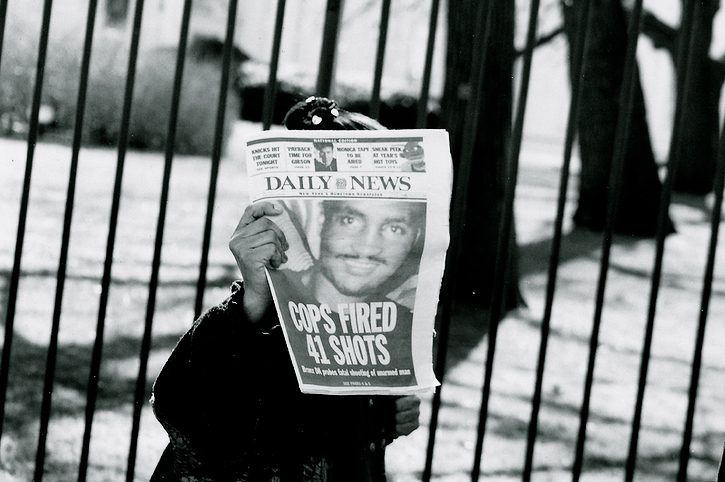
A 1999 protest against the NYPD murder of Amadou Diallo. Elvert Barnes / Flickr
The first friend I ever had was a little boy named Matt. We were maybe four or five years old. Matt came to me one day with a very serious look on his face and gave me a little talking-to. He explained to me: “Brian, you’re brown. And I’m peach.”
I don’t remember saying anything back, but I think in my mind I was like “Okay. . . ? Well these Legos aren’t going to build themselves.”
Matt was trying to do me a favor. He was trying to introduce me to the very bizarre and peculiar rules that we all know as grownups — very important things to understand. If you didn’t understand them, you’d find American life and society very strange. You’d do things you shouldn’t do, go places you shouldn’t go. You’d mess up if you didn’t understand the particular rules that govern the ideology of race in the United States.
Sometimes when you go outside of the American context you begin to appreciate how particular and unique these rules are. I remember reading about a (probably apocryphal) interview with the former dictator of Haiti,
Papa Doc Duvalier, who referred to the “white majority population” of Haiti. The American journalist interviewing him didn’t understand, so they had to define to each other what makes somebody white or black. The American journalist explained that in the US, one metaphorical drop of black blood designates someone as black. And Duvalier replied, “Well, that’s our definition of white.”
The whole idea of this talk — if you take away nothing else — is this: the whole thing is made up. That’s it. And you can make it up different ways; and people have and do. And it changes. And it has nothing to do with biology or genetics. There’s a study of several decades of census records that found that twice as many people who call themselves white have recent African ancestry as people who call themselves black.
This is not just a matter of folksy beliefs, or prejudice, or wrong ideas, though those things are all in the mix. This is a matter of law.
How a Lie Becomes a Law
The
Naturalization Act of 1790 determined who got to call themselves an American citizen. It restricted citizenship to persons who resided in the United States for two years, who could establish their good character in court, and who were white. To jump ahead, the
Plessy v. Ferguson case of 1896 reaffirmed the legitimacy of having separate railroad cars for black people and white people.
One thing we often forget about that case is that Homer Plessy’s argument was that he was white! He got bounced from the white section because the conductor said he was black. The question wasn’t that all train passengers should be able to sit together, rather Plessy said, “No, I’m a white person, actually.” The court admitted that it was very important to be able to determine who was white and who was not, and that having the ability to be white is a form of property, that it’s valuable, extremely valuable, in 1896.
The court said in its decision that “if he be a white man, and be assigned to the color coach, he may have his action for damages from the company, for being deprived of his so-called property. If he be a colored man and be so assigned, he has been deprived of no property, since he is not lawfully entitled to the reputation of being a white man.”
People sued over this. Native Americans and others were going to the courts and, saying “no, I won’t be treated as I’m being treated” and demanding the property interest in the reputation of being a white person. So in 1921 the powers-that-be decided they needed a definition of a white person.
Here’s what they
came up with:
A White person has been held to include an Armenian born in Asiatic Turkey, a person of but one-sixteenth Indian blood, and a Syrian, but not to include Afghans, American Indians, Chinese, Filipinos, Hawaiians, Hindus, Japanese, Koreans, negroes; nor does white person include a person having one fourth of African blood, a person in whom Malay blood predominates, a person whose father was a German and whose mother was a Japanese, a person whose father was a white Canadian and whose mother was an Indian woman, or a person whose mother was a Chinese and whose father was the son of a Portuguese father and a Chinese mother.
You know . . . white people!
So when I say it’s all made up, I mean it. It’s made up.
But that’s not to say it’s not real. It’s very real. It’s real in the same way that Wednesday is real. But it’s also made up in the same way that Wednesday is made up.
Human beings that look the way we do evolved around two hundred thousand years ago in the African continent and began leaving it around seventy-five to fifty thousand years ago. They settled in various parts of the globe and in bands of people that were, for the most part, cut off from each other.
And as all travel was by foot, they stayed in the same place for many thousands of years. And by staying in the same place for many thousands of years, these groups actually did evolve to look differently from each other, for reasons that have to do with the various environments in which they found themselves.
So there is a biological basis to the reason people look differently from each other. And if you look at those people before the modern era of tremendous transportation, of people going all over the place for political reasons, of people being carved up geographically into nations — all things that are pretty much brand new in human history — the people that settled around the band of the equator, where they get the most intense direct sunlight, all over the earth, those people have darker complexions. Now why is that?
All human beings, regardless of their complexion, have the ability to produce melanin as a protection from UV radiation. If you are fair skinned and subject to intense direct sunlight for prolonged periods you are likely to develop skin cancer. Skin cancer might not stop you from reproducing (and therefore passing on your genetic material) because in general you’re going to develop that when you’re older.
But there is evidence that UV radiation interrupts processes associated with folic acid (folate) which can cause birth defects and other problems. So people with darker complexions of course absorb UV radiation, but they are protected not only from skin cancers but also from related interruptions to reproduction.
But if you’re one of those people who has been living for thousands of years in regions far from the equator, regions of scarce or indirect sunlight, you have a different problem — the problem of Vitamin D deficiency. The sun is a crucial source of Vitamin D for humans, so you’re going to have illnesses associated with Vitamin D deficiency. You actually need to absorb more sunlight, and so paler skin is advantageous in those places.
This is really the only biological basis we can find between people who have different complexions around the world, but that’s a far different thing from saying that people with different complexions actually comprise races of people in a biological sense.
This is important because scientists have certainly tried for a long time to prove that there are different races, and it’s all been disproven. It’s bunk. Today we even understand that there is more genetic diversity within the so-called races than between them.
The anthropologist Carol Mukhopadhyay
writes about how things that we think of as demonstrating a biological basis of “race” are just not true: “In the United States, the sickle cell gene is more common among African Americans than other populations — but it is not a ‘racial’ gene. The genetic variation that causes it is also found in parts of South Asia, southern Europe, and the Middle East. And it is found in only some areas in Africa.”
She also writes about genetic diversity among what we call “black” people:
When we turn to the racial category ‘Black’, we find enormous geographic and human variability — Africa has deserts, mountains, oceans, tropical areas, and spans a range of latitudes, some distant from the equator. It has hundreds, if not thousands, of linguistically, culturally, politically, and historically distinct populations. Africa is home to the shortest and the tallest people of the world. Other traits vary significantly, including skin color, facial traits (nose, eye shape), overall body shapes, even the frequency of sickle cell and lactose intolerance.
The problem with Americans’ folksy way of defining who’s who based on skin color, is that skin color is not a discrete trait. There’s a spectrum, a gradation, of skin colors, and so marking off at an arbitrary point at which to say somebody paler than this is one thing and somebody darker is another is not a naturally occurring division between people.
There are a few traits that are like that, actually — discrete traits where you either have one thing or the other. Earwax is one of those things, there’s only two types; you either have sticky or wet. But we’re not likely to see a sticky-earwax civil rights movement anytime soon. Or a Wet Earwax Party for Self Defense.
Here’s a thumbnail sketch of the history of the invention of “race.” Race is a new development. If human history were a two hundred page book, “race” begins on the last line of the last sentence of the last page. And it starts here, in the United States.