Hoiberg and Donovan's college teams hint to how Bulls, Thunder will play
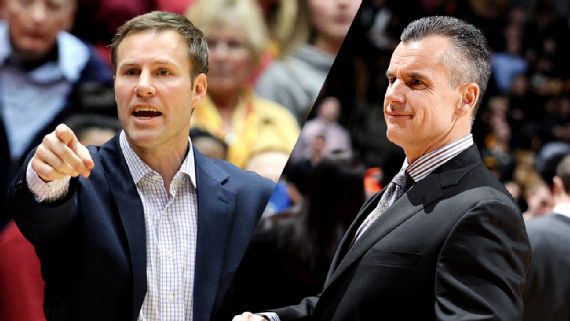
While Fred Hoiberg, who will be named head coach of the
Chicago Bulls on Tuesday, and recently hired
Oklahoma City Thunder head coach Billy Donovan are new to the NBA, there's ample statistical record from their college careers to help us understand how their teams might play next season.
Of course, the results the Bulls and Thunder achieve will be based as much or more on the teams' veteran rosters than their new coaches. But taking a look at how Donovan's Florida Gators and Hoiberg's Iowa State Cyclones played offers a look at their stylistic preferences. For the past five years, I've averaged both teams' performance in several key stats relative to the average NCAA team. For additional help in how that translates to the NBA, I'll compare those adjusted statistics to the closest NBA comparison from the 2014-15 season.
Pace of play
Hoiberg: plus-5.0 percent (
Golden State Warriors plus-4.6 percent)
Donovan: minus-4.1 percent (
Utah Jazz minus-3.7 percent)
Because of the longer shot clock (previously 35 seconds, though the NCAA men's basketball rules committee
has recommended shortening it to 30 seconds next season) and greater number of teams and styles, there's more variation among pace of play in college than the NBA. So don't necessarily expect Hoiberg's Bulls to play at the league's fastest pace and Donovan's Thunder its slowest, as the college numbers would imply.
Still, there's a consistent trend here, particularly in Hoiberg's case. Looking at overall pace actually understates how fast Iowa State was on offense under Hoiberg. The Cyclones'
average possession length was the country's second shortest, per KenPom.com. By contrast, while Donovan's early Florida teams played faster, he has settled on a slower style that emphasizes half-court execution. The Gators have ranked no higher than 235th in the country in pace the past six years.
The disparate styles have produced similarly efficient offenses, with both Florida and Iowa State rating in
KenPom.com's top 25 in adjusted offensive efficiency four times in the past five seasons.
Efficient Offenses (Florida And Iowa St.)
COACH EFG% FTA/FGA OR% TO% 3A% AST%
Hoiberg +7.5% -8.8% -3.7% -12.6% +19.0% +9.1%
Donovan +7.1% -7.7% +8.6% -8.0% +13.5% +3.8%
Atlanta Hawks) and neither team has used the foul line at an average rate (most similar to this year's
Phoenix Suns).
The one key offensive difference is that Donovan's teams have made more use of the offensive glass. Their offensive rebound rate is most similar to this year's
New Orleans Pelicans, while Hoiberg's teams have eschewed second chances like the 2014-15
Portland Trail Blazers.
Both coaches have seen their teams play low-turnover basketball, with Iowa State particularly excelling in this regard. Their turnover rate is comparable to this year's
Dallas Mavericks. Florida has been more similar to the 2014-15
Detroit Pistons.
By the 3-happy standards of the NCAA, both Donovan and especially Hoiberg have encouraged their players to pull the trigger from beyond the arc. The Cyclones have ranked as high as eighth in the country in 3-point attempt percentage in 2012-13. The Gators actually ranked fifth in 2011-12, when
Bradley Beal was part of Donovan's three-guard attack, but they were below average in 3 attempts the year before. Overall, Iowa State's 3 attempt rate under Hoiberg was similar to this year's
Philadelphia 76ers and Florida's similar to the
Toronto Raptors.
Hoiberg's style emphasizes playing with the pass, and only the Hawks and Warriors had higher assist rates relative to this year's NBA average than the Cyclones as compared to the typical college team. Of particular interest is that Hoiberg has empowered point forwards such as Royce White and Georges Niang to play key playmaking roles, something that bodes well for
Joakim Noah's ability to operate out of the high post. The Gators' assist rate has been modestly above average, similar to this year's 76ers.
On defense
As similar as their teams have been offensively, Donovan and Hoiberg diverge on defense. Under Donovan, Florida has pulled off the unique combination of effectively defending the basket and forcing turnovers. Again, the wide variance in college performance makes the comparison difficult, but the effective field goal percentage the Gators have allowed is better relative to league average than any NBA team managed this year. And their rate of forcing turnovers was similar to this year's
Miami Heat.
Divergent Defenses (Florida And Iowa St.)
COACH EFG% FTA/FGA DR% TO% 3A% AST%
Hoiberg -1.8% -23.0% +3.8% -7.8% -0.3% -0.2%
Donovan -6.0% -15.5% +3.8% +6.0% -3.2% -5.5%
adjusted defensive efficiency per KenPom.com. They've been conservative in terms of forcing turnovers, doing so at a rate similar to the 2014-15 Lakers, and have been only modestly better than average in opponent effective field goal percentage (similar to the Heat in a less positive context).
Both coaches do share a desire to keep opponents off the foul line. Iowa State opponents had the nation's third-lowest free throw rate last season, and the Cyclones have never ranked outside the top 100 under Hoiberg. Their foul avoidance is much more extreme than any NBA team: the
Cleveland Cavaliershad the league's lowest opponent free throw rate this season, 15.0 percent better than average. Donovan's teams also can top that, having ranked in the NCAA's top 50 in opponent free throw rate nine seasons running before slipping to 200th this year.
Florida and Iowa State also have been nearly identical in terms of defensive rebounding, regularly ranking in the nation's top 100. Overall, both teams have rebounded the past five seasons like this season's
Indiana Pacers.
While 3-point attempt percentage on defense might not seem important, there's strong evidence to suggest teams have little control over the percentages their opponents shoot from 3-point range,
particularly during the shorter college season. The better measure of 3-point defense, then, is limiting attempts -- something the Cyclones have done at only an average rate under Hoiberg, like the 2014-15
Houston Rockets and Raptors. Donovan's Gators have done a slightly better job of limiting 3-point attempts, similar to this year's
Boston Celtics.
Opponent assist rate is another hidden indicator, suggesting whether a defense is getting broken down and allowing passes to open shots. Iowa State was about average in opponent assist rate, similar to the Mavericks. Florida has limited assists better than average, like this year's
San Antonio Spurs.
Overall
Hoiberg's offensive track record with the Cyclones suggests an attack similar to this season's Warriors: fast-paced, efficient, with lots of 3s and assists and few free throws. That's an abrupt departure from this season's Chicago team under the defense-minded Tom Thibodeau, and it will be fascinating to see how the Bulls and Hoiberg meet in the middle. The element of Golden State under Steve Kerr that Hoiberg never duplicated at Iowa State was playing strong defense at a fast pace, and whether Chicago does that using the principles Thibodeau installed also will go a long way in determining Hoiberg's immediate success.
Donovan's style also could be a departure for the Thunder, who have played at a moderately fast pace under Scott Brooks. This season's
Memphis Grizzlies are probably the closest match to how the Gators executed at both ends in half-court settings, but as the league moves toward playing faster, there's nobody who has been as balanced at both ends at a snail's pace as Donovan's teams. There's a history of Donovan playing a very different, more aggressive style, and he might want to rediscover that to get the most out of stars
Kevin Durant and
Russell Westbrook.



 might have a better inaugural season than kerr
 I gotta get one of these insider accounts