
Workers in a Workers’ State
The Chinese state has dramatically escalated repression against workers organizations.
by Solidarity With Chinese Workers' Struggle
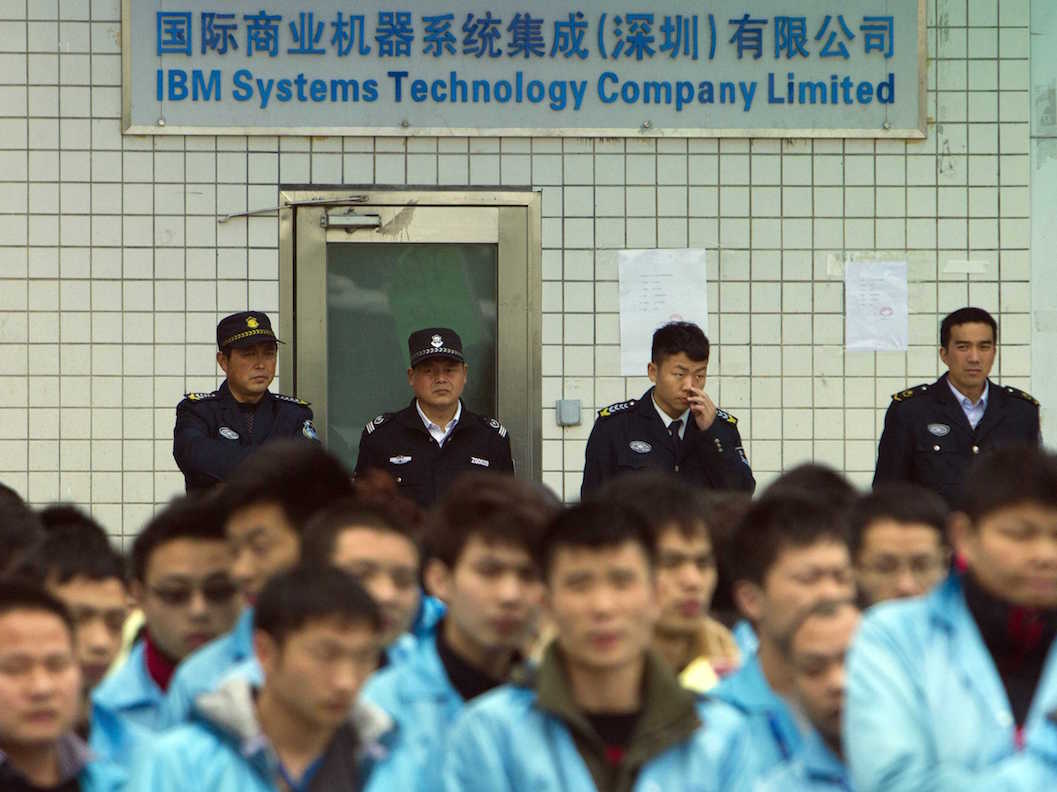
IBM workers protest at a factory in Shenzhen, China in 2014. Alex Lee / Reuters
Support Jacobin this holiday season. Check out our fundraising video and subscribe or donate today.
On December 3, four workers organizations in the southern manufacturing hubs of Guangzhou and Foshan came under attack from Chinese authorities. Dozens of staff, family members, and affiliated workers were questioned, and seven remained in custody for over a month. Four have now been formally charged: three of them for “assembling a crowd to disrupt social order” and one for “embezzlement.”
Little more is known about the detainees. While a group of sixty lawyers volunteered to represent the activists, they’ve been barred from meeting their potential clients. In the meantime, the state media has unleashed a harsh smear campaign aimed at destroying the activists’ personal and professional reputations and legitimating the crackdown.
The crackdown didn’t come from nowhere. Labor groups and activists in China are regularly subjected to state repression and harassment. What sets the current sweep apart are the number of workers organizations (or labor NGOs, as some call them) and individuals targeted, and the severity of the criminal charges they are facing. The Chinese state’s goal is to stifle these and other workers organizations through humiliation and fear.
So why does the Chinese state feel threatened by these workers organizations? What role have they played in the worker unrest that’s reached a fever pitch in recent year? And what does the sweep mean for the growth and development of the China’s labor movement?
Independent Struggles
Under China’s system of quasi–state corporatism, the official trade union body — the ACFTU (All-China Federation of Trade Unions) — monopolizes worker representation; independent unionism is strictly banned. But labor NGOs have carved out a limited space to work, helping foster a burgeoning constellation of labor groups and activists.
The organizations targeted in the current sweep are among the most vocal labor groups in China. The most prominent is the Panyu Dagongzu Center in Guangzhou (henceforth Dagongzu), one of China’s longest-running and most established workers organizations. Its director, Zeng Feiyang, a lawyer-turned-labor activist who is seen as the leader of a network of labor groups, is no stranger to harassment and assault.
Also swept up were former migrant workers who became activists and then Dagongzu organizers through their participation in labor struggles. Meng Han led a strike of hospital security guards (and served jail time as a result). Zhu Xiaomei, during her time as a workers representative, successfully sued her employer for illegal dismissal after trying to ensure the company made social insurance contributions. (A former Dagongzu organizer who has appeared in the state media accusing Zeng Feiyang of misconduct was also detained.)
Additional individuals targeted include He Xiaobo, who left Dagongzu to set up his own labor group in Foshan called the Nanfeiyan Social Work Service Organization. The director of Haige Labor Center, Chen Huihai, was also held but was later released; Deng Xiaoming, another organizer at Haige, remains in custody, as does Peng Jiayong of the Labor Mutual Aid Group.
Given the severe repression against any independent, oppositional groups like trade unions, such labor groups are the closest thing Chinese workers have to genuine workers organizations.
For the most part, these workers groups were established by former workers and labor activists. They support fellow workers in legal disputes and collective struggles. Usually with a staff of less than half a dozen and a peripheral layer of affiliated workers and lawyers, these groups resemble community-based workers centers more than professionalized non-governmental organizations.
The earliest labor groups — like Dagongzu — were established in the late 1990s in response to the millions of rural migrant workers experiencing gross violations of labor rights but unaware of labor laws. Taking advantage of the growing political space and discourse of civil society, NGOs sprung up in a wide range of areas such as labor, environment, gender, and health. But these groups lead a precarious existence, forced to register as nonprofit businesses rather than social organizations and subjected to close monitoring by the authorities.
Most Chinese labor groups started as legal aid centers, promoting awareness of laws and mutual aid among migrant workers. They expanded as migrant workers’ need for legal representation increased and the state sought to curb rising labor unrest by stressing workers’ statutory rights. There are now dozens of labor groups across China, with most based close to the manufacturing zones.
While many focus exclusively on legal aid and shy away from collective disputes, a number of labor groups — including the groups being targeted — have come to recognize the limitations of individual, court-based strategies and have embraced collective forms of struggle and collective negotiations with management. In the process they’ve been able to link up with militant workers, putting them at the center of labor struggles in China today.
Increasing Militancy
The current sweep comes amid intensifying labor protests in the slowing manufacturing sector.
From 2014 to 2015, recorded strikes doubled. Companies commonly inform workers that factories are closing only when machines are being moved out, with no intention of compensating workers. In response, workers have taken collective action to secure severance compensation and protest underfunded social insurance. Some lasted for months and featured highly organized, sustained mobilization — prompting a police response and detention of strike leaders.
The immediate catalyst for the latest crackdown was the targeted organizations’ involvement in such strikes, which was undermining the state’s efforts to isolate and atomize workers’ struggles.
Dagongzu, for example, helped leaders of a shoe workers strike strategize after strikers approached the labor group. While these labor organizations do not initiate strikes or protests, they supply important legal information and negotiation skills.
The ACFTU hasn’t taken kindly to labor organizations’ involvement. Regarding the more militant labor groups as competitors for workers’ allegiance, the trade union body has fiercely denounced them in speeches to striking workers. For their part, workers have largely shrugged off such vituperation, seeing labor groups as a useful resource and the ACFTU as a company ally.
The repression of worker groups should therefore be understood as part of a dual strategy in which the state co-opts and integrates some groups by purchasing their services while intimidating and suppressing others who do not cooperate. However, this is not a cut-and-dry process. Some of these labor groups — including organizations like Nanfeiyan that have accepted government funding — are also targeted because they remain too independent. Numerous other prominent labor groups, by contrast, adamantly refuse to cooperate with the authorities.
Even the best labor groups, however, are far from flawless. Most are heavily shaped by the personality and politics of the founders and directors, and are rarely democratic or transparent.
The opacity is partially a result of the circumstances in which these labor groups emerge, as well as the limited space they have to develop as organizations. Regardless, many are marred by undemocratic structures and misuses of funding. And as non-membership-based groups, they’re less accountable to workers than traditional trade unions.
Moreover, these groups are not allowed to raise funds domestically because they cannot register as non-profit, charitable organizations. Lacking other sustainable streams of money, they depend heavily on foreign funding.
Their source of funding, however, doesn’t so much shape their day-to-day decision-making as give authorities a pretext to detain labor organizations’ leaders (even though foreign sponsorship is not illegal). The issue of foreign funding is so fraught that the state has been crafting the Foreign NGOs Management Law, which will regulate and monitor the activities of international NGOs that operate in China.
The question of workers groups’ politics is also important. Even the more radical organizations tend to channel worker unrest into legal and wage negotiations, emphasizing collective bargaining as the means to resolving conflict. While partially necessitated by the repressive environment, this approach is also a partial reflection of their politics.
Still, reformism from below, emanating from the labor movement, is not the same as ACFTU-backed reformism from above. In the present conditions, something as simple as defending workers’ legal rights and settling for collective bargaining is a radical act, even though it may restrict the movement in the long run.
Ultimately, these labor NGOs are contradictory, at once advancing and limiting workers’ struggles. They supply resources and give strikes — especially those that demand sustained mobilization — an organized form. Their dedicated and militant organizers build and transmit experience and skills. But their specific form of organization, as well as their generally “pragmatic” approach, often limits the potential of labor struggles.
The Chinese state has dramatically escalated repression against workers organizations.
by Solidarity With Chinese Workers' Struggle
IBM workers protest at a factory in Shenzhen, China in 2014. Alex Lee / Reuters
Support Jacobin this holiday season. Check out our fundraising video and subscribe or donate today.
On December 3, four workers organizations in the southern manufacturing hubs of Guangzhou and Foshan came under attack from Chinese authorities. Dozens of staff, family members, and affiliated workers were questioned, and seven remained in custody for over a month. Four have now been formally charged: three of them for “assembling a crowd to disrupt social order” and one for “embezzlement.”
Little more is known about the detainees. While a group of sixty lawyers volunteered to represent the activists, they’ve been barred from meeting their potential clients. In the meantime, the state media has unleashed a harsh smear campaign aimed at destroying the activists’ personal and professional reputations and legitimating the crackdown.
The crackdown didn’t come from nowhere. Labor groups and activists in China are regularly subjected to state repression and harassment. What sets the current sweep apart are the number of workers organizations (or labor NGOs, as some call them) and individuals targeted, and the severity of the criminal charges they are facing. The Chinese state’s goal is to stifle these and other workers organizations through humiliation and fear.
So why does the Chinese state feel threatened by these workers organizations? What role have they played in the worker unrest that’s reached a fever pitch in recent year? And what does the sweep mean for the growth and development of the China’s labor movement?
Independent Struggles
Under China’s system of quasi–state corporatism, the official trade union body — the ACFTU (All-China Federation of Trade Unions) — monopolizes worker representation; independent unionism is strictly banned. But labor NGOs have carved out a limited space to work, helping foster a burgeoning constellation of labor groups and activists.
The organizations targeted in the current sweep are among the most vocal labor groups in China. The most prominent is the Panyu Dagongzu Center in Guangzhou (henceforth Dagongzu), one of China’s longest-running and most established workers organizations. Its director, Zeng Feiyang, a lawyer-turned-labor activist who is seen as the leader of a network of labor groups, is no stranger to harassment and assault.
Also swept up were former migrant workers who became activists and then Dagongzu organizers through their participation in labor struggles. Meng Han led a strike of hospital security guards (and served jail time as a result). Zhu Xiaomei, during her time as a workers representative, successfully sued her employer for illegal dismissal after trying to ensure the company made social insurance contributions. (A former Dagongzu organizer who has appeared in the state media accusing Zeng Feiyang of misconduct was also detained.)
Additional individuals targeted include He Xiaobo, who left Dagongzu to set up his own labor group in Foshan called the Nanfeiyan Social Work Service Organization. The director of Haige Labor Center, Chen Huihai, was also held but was later released; Deng Xiaoming, another organizer at Haige, remains in custody, as does Peng Jiayong of the Labor Mutual Aid Group.
Given the severe repression against any independent, oppositional groups like trade unions, such labor groups are the closest thing Chinese workers have to genuine workers organizations.
For the most part, these workers groups were established by former workers and labor activists. They support fellow workers in legal disputes and collective struggles. Usually with a staff of less than half a dozen and a peripheral layer of affiliated workers and lawyers, these groups resemble community-based workers centers more than professionalized non-governmental organizations.
The earliest labor groups — like Dagongzu — were established in the late 1990s in response to the millions of rural migrant workers experiencing gross violations of labor rights but unaware of labor laws. Taking advantage of the growing political space and discourse of civil society, NGOs sprung up in a wide range of areas such as labor, environment, gender, and health. But these groups lead a precarious existence, forced to register as nonprofit businesses rather than social organizations and subjected to close monitoring by the authorities.
Most Chinese labor groups started as legal aid centers, promoting awareness of laws and mutual aid among migrant workers. They expanded as migrant workers’ need for legal representation increased and the state sought to curb rising labor unrest by stressing workers’ statutory rights. There are now dozens of labor groups across China, with most based close to the manufacturing zones.
While many focus exclusively on legal aid and shy away from collective disputes, a number of labor groups — including the groups being targeted — have come to recognize the limitations of individual, court-based strategies and have embraced collective forms of struggle and collective negotiations with management. In the process they’ve been able to link up with militant workers, putting them at the center of labor struggles in China today.
Increasing Militancy
The current sweep comes amid intensifying labor protests in the slowing manufacturing sector.
From 2014 to 2015, recorded strikes doubled. Companies commonly inform workers that factories are closing only when machines are being moved out, with no intention of compensating workers. In response, workers have taken collective action to secure severance compensation and protest underfunded social insurance. Some lasted for months and featured highly organized, sustained mobilization — prompting a police response and detention of strike leaders.
The immediate catalyst for the latest crackdown was the targeted organizations’ involvement in such strikes, which was undermining the state’s efforts to isolate and atomize workers’ struggles.
Dagongzu, for example, helped leaders of a shoe workers strike strategize after strikers approached the labor group. While these labor organizations do not initiate strikes or protests, they supply important legal information and negotiation skills.
The ACFTU hasn’t taken kindly to labor organizations’ involvement. Regarding the more militant labor groups as competitors for workers’ allegiance, the trade union body has fiercely denounced them in speeches to striking workers. For their part, workers have largely shrugged off such vituperation, seeing labor groups as a useful resource and the ACFTU as a company ally.
The repression of worker groups should therefore be understood as part of a dual strategy in which the state co-opts and integrates some groups by purchasing their services while intimidating and suppressing others who do not cooperate. However, this is not a cut-and-dry process. Some of these labor groups — including organizations like Nanfeiyan that have accepted government funding — are also targeted because they remain too independent. Numerous other prominent labor groups, by contrast, adamantly refuse to cooperate with the authorities.
Even the best labor groups, however, are far from flawless. Most are heavily shaped by the personality and politics of the founders and directors, and are rarely democratic or transparent.
The opacity is partially a result of the circumstances in which these labor groups emerge, as well as the limited space they have to develop as organizations. Regardless, many are marred by undemocratic structures and misuses of funding. And as non-membership-based groups, they’re less accountable to workers than traditional trade unions.
Moreover, these groups are not allowed to raise funds domestically because they cannot register as non-profit, charitable organizations. Lacking other sustainable streams of money, they depend heavily on foreign funding.
Their source of funding, however, doesn’t so much shape their day-to-day decision-making as give authorities a pretext to detain labor organizations’ leaders (even though foreign sponsorship is not illegal). The issue of foreign funding is so fraught that the state has been crafting the Foreign NGOs Management Law, which will regulate and monitor the activities of international NGOs that operate in China.
The question of workers groups’ politics is also important. Even the more radical organizations tend to channel worker unrest into legal and wage negotiations, emphasizing collective bargaining as the means to resolving conflict. While partially necessitated by the repressive environment, this approach is also a partial reflection of their politics.
Still, reformism from below, emanating from the labor movement, is not the same as ACFTU-backed reformism from above. In the present conditions, something as simple as defending workers’ legal rights and settling for collective bargaining is a radical act, even though it may restrict the movement in the long run.
Ultimately, these labor NGOs are contradictory, at once advancing and limiting workers’ struggles. They supply resources and give strikes — especially those that demand sustained mobilization — an organized form. Their dedicated and militant organizers build and transmit experience and skills. But their specific form of organization, as well as their generally “pragmatic” approach, often limits the potential of labor struggles.

