- Porter firing a sign of Astros' major issues
-


- By Buster Olney | September 2, 2014 8:07:42 AM PDT
Brian Blanco/Getty Images
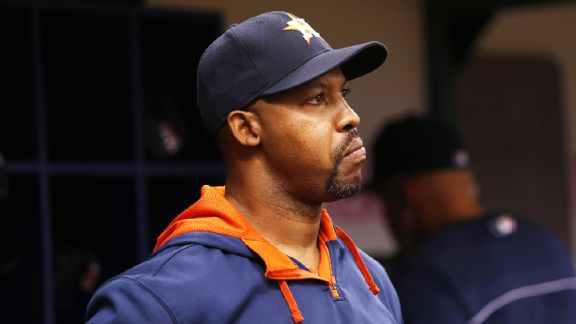
Manager Bo Porter was fired by the Astros just after his team posted a winning record in August.
With the benefit of 20/20 hindsight, we know a lot more about the position that Bo Porter signed up for in the fall of 2012, when he became manager of the
Houston Astros. Whether he knew it or not at the time, this is what the job notice probably should've looked like:
Wanted: Manager of a Major League Baseball team
(Note: Your team will be designed to lose more games than any other. It has been stripped down completely, with all 25 players making less money combined than CC Sabathia or the MLB commissioner.)
Benefits
• Tremendous opportunity to travel and see the whole country, with big league accommodations. Good pay.
(You will be paid less than other managers.)
• Tremendous opportunity for growth.
(We'll stock your team with what rival executives rate as Double-A talent, a lot of young guys who really aren't close to being finished products as players and will be completely overmatched in the big leagues. Good luck with that.)
• You'll be surrounded by young and energetic players.
(This is because we'll trade away anybody who has any experience and value to stock up on prospects and to ensure that, well, we're not very good and get to pick at the top of the draft.)
• You will get to implement organization strategy.
(We'll tell you who to play, and how much. Just hand your lineup card to the umpires and follow instructions.)
• You'll work with some of the best and brightest minds in the business of baseball.
(Your opinions will be asked for occasionally, but your input will not be especially desired or valued. Nothing you say will alter the organization's evaluation or development process substantively; we've got that covered.)
• You will be the most visible member of the organization.
(Sort of, in the way that the White House press secretary represents the President. You won't actually make the decisions, but it'll be your job to explain them, and to put a happy face on the organizational effort to lose games. Besides, the fans don't know any of the players besides Jose Altuve anyway.)
• You will be in a position of great leadership.
(We'll need you to cover for us in dealing with your players and staff, in keeping them in line and explaining why it's a good thing that the team is getting crushed day after day, and why better players who might be able to help immediately are being left in the minor leagues.)
• You'll have an opportunity to shape young minds.
(Because inevitably, as the failures multiply and we all have to live out the losses day after day after day, everybody -- players, staff, you, us -- will start to play the blame game. We'll need you to be a mental Jedi and keep everybody convinced this is all part of a master plan.)
Bo Porter did not thrive in these conditions, which is why so many of his coaches left after his first season. In fact, after that 2013 season, in which the Astros went 51-111, some within the front office had tremendous reservations about retaining Porter for the 2014 season. There was some preference for change. But sources say that the prevailing opinion was that it was too early to do that with a manager who had just been hired.
The Astros needed some combination of Mr. Miyagi, Gandhi and Abraham Lincoln to navigate through the past two seasons, to maintain some semblance of positivity through historic failure. It's one thing to come up with a plan built on statistical evaluation, but it's something completely different to expect actual human beings overflowing with ambition and competitiveness -- plus anger due to the competitiveness -- to adhere to it with the complete devotion of worker bees.
The meltdown from this amalgamation has been just about total, if some sources within the organization are correct. Players are angry, staffers have been outraged, and some club employees are looking for jobs elsewhere. The distrust of motives and skills and vision within the organization is extraordinary.
Porter's firing was inevitable. But hey, apparently the manager of the Astros is way down the list of who is really important within the organization. What must really change is the way the operating philosophy is carried out.
There needs to be greater inclusion rather than the sense that only a small group of people are making the decisions and everybody else is should stand outside the door. There needs to be debate and compromise, because as anyone who has worked in baseball will tell you, there are almost never absolutes; nobody is always right. The only sure thing is that the game will humble you.
Players and staff must be made to feel they are valued, and that their opinions and feelings are respected, if not always honored. If there's a funeral for a long-time employee, then folks within the organization need to show up.
I wrote here after the Brady Aiken fiasco that the Astros have a terrible perception problem, but that's not only about how prospective customers -- fans -- might view them. Their most significant perception problem is within their own organization.


 That's some real foul shyt, dude had them young boys playing hard...What the fukk did they want him to do with a Triple A squad? Altuve is the shyt but he can't win by himself! Fukk that gay ass team!!!