UN general assembly: International community has failed Syrians, says RouhaniWe’re closing the live blog now. The president of Mozambique, Filipe Jacinto Nyusi, has just addressed the assembly. He will be followed by the Netherlands’ King Willem-Alexander, Kazhakstan’s Nursultan Nazarbayev, Mexico’s Enrique Peña Nieto, Portugal’s Aníbal António Cavaco Silva, Denmark’s Lars Løkke Rasmussen, and Ethiopia’s Hailemariam Dessalegn. The assembly will then adjourn before the afternoon session. A full list of speakers is available here.
We’ve included a brief summary of what this morning’s key speakers - mainly Obama, Putin, Rouhani and Hollande - said below.
- Barack Obama said the US is willing to work with any nation – including Russia and Iran – to solve the conflict in Syria, and that bringing about an end to the four-year civil war means Syrian president Bashar al-Assad cannot stay in office. The US President also said the world cannot stand by while Russia violates Ukraine’s integrity and sovereignty. (Obama’s key points are available here).
- Vladimir Putin said Moscow has consistently fought against terrorism in all its forms, and is providing military equipment to the Syrian government. He said we should acknowledge that no-one except for Assad and his militia is truly fighting Isis in Syria. The Russian president also said his country will shortly convene a ministerial meeting to carry out an analysis of threats in the Middle East and complained about sanctions against Russia over its annexation of crimea. (Putin’s key points are available here).
- Hassan Rouhani complained about sanctions imposed on Iran and said the country never had the intention of producing a nuclear weapon. He added that nuclear weapons states now play a positive role in the creation of a nuclear weapons-free Middle East and should “not allow the Zionist regime” to remain the only impediment. He added that Iran is ready to assist in tackling terrorism and to bring about democracy in Syria and Yemen, via elections rather than arms. (An analysis of Rouhani’s speech is available here).
Thanks for reading and for your comments.
- François Hollande said Syrian refugees are not just fleeing war, but the regime of al-Assad, which has been “dropping bombs on innocent civilian population.” He emphasised that Assad is part of the problem in Syria and therefore cannot be part of the solution”. The French president also called for a reform of the UN and a limit to the use of the veto in cases of “mass atrocities”. (Hollande’s key quotes are available here).

You are using an out of date browser. It may not display this or other websites correctly.
You should upgrade or use an alternative browser.
You should upgrade or use an alternative browser.
2015 UN General Assembly
- Thread starter CHL
- Start date
More options
Who Replied?Obama and Putin spar at the UN – but do body blows count on absentee targets?
Obama and Putin spar at the UN – but do body blows count on absentee targets?The two presidents pointedly alluded to each other – over Ukraine, Syria and more – but neither was in the general assembly chamber to hear the other speak

Barack Obama addresses the 70th session of the United Nations general assembly in New York. Photograph: Mary Altaffer/AP
Ed Pilkington at the United Nations
@edpilkington
Tuesday 29 September 2015 04.30 AEST Last modified on Tuesday 29 September 2015 06.09 AEST
Shares
- Share on Facebook
- Share on Twitter
- Share via Email
- Share on Pinterest
- Share on LinkedIn
- Share on Google+
23
Comments
22
Save for later
The UN general assembly is nothing if it is not theatre – the annual opportunity of the leaders of 160 nations to have their moment on the world’s stage, literally. Every three years, like clockwork, one of them decides to throw convention to the winds and have the diplomatic equivalent of a hissy fit.
Who can forget Hugo Chávez, the late president of Venezuela, alluding to George Bush as the “devil” in 2006; or the then leader of Libya Muammar Gaddafi tearing up the UN charter in 2009; or Binyamin Netanyahu, the Israeli prime minister, with his 2012 cartoon drawing of a nuclear bomb? The three-year cycle has come round again, and so it was on Monday that the eyes of the world fell on those two great sparring partners, presidents Obama and Putin, in expectation that they would fulfil the role.
They didn’t. Neither the leader of the United States nor of the Russian Federation hurled his pacifier from the pram, nor stuck pins into an effigy of the other in front of the cameras. Neither mentioned his arch foe by name – or for that matter even bothered to be in the chamber to hear him speak.
But their words were daggers. And by the time each had finished – both straying well beyond their allotted 15-minute slots – there was blood flowing liberally from the dais on to the assembly floor.
Obama was first up. It was his seventh address to the annual gathering of the world parliament, and it showed. Each time he comes here, white hair has spread further across his head in a sort of reverse flow of the melting of the polar ice caps.
“Dictatorships are unstable,” Obama said, speaking directly to an invisible figure of Putin floating somewhere in front of him above the assembly. “The strongmen of today become the spark of revolution tomorrow.”
Putin would have been quaking at that threat, had he been there to hear it. As it was, Russian TV was focused as Obama spoke on the real news from Moscow’s perspective – the pointedly late arrival on the New York tarmac of Putin’s presidential plane.
— Shaun Walker (@shaunwalker7) September 28, 2015
Russian TV is showing the UNGA with a live box in the corner featuring Putin's plane landing in New York and taxiing about the tarmac
Obama’s theme was that tyrants and bullies want to turn the clock back to a more primitive age when conflicts were solved through fisticuffs rather than dialogue. “Dangerous currents risk pulling us back into a darker world,” he said.
In fairness, Putin wasn’t the only individual Obama had in mind. There was also that other would-be tyrant wanting to pull us back to a darker world: Donald Trump. “The United States is not immune” from the “politics of us versus them”, he said, before castigating those “calling for the building of walls to keep immigrants out. We see the fears of ordinary people being exploited.”
That said, the Russian leader, his annexation of the Ukrainian territory of Crimea, and his insistence on propping up the Syrian regime of Bashar al-Assad was clearly Obama’s bogeyman number one. “We see some major powers assert themselves in ways that contravene international law. We’re told that such retrenchment is required to beat back disorder, that it’s the only way to stamp out terrorism. In accordance with this logic, we should support tyrants like Bashar al-Assad … because the alternative is surely worse.”

Facebook Twitter Pinterest
President Vladimir Putin sits after urging leaders to ‘learn the lessons of the Soviet Union’ about exporting ‘social experiments’. Photograph: Spencer Platt/Getty Images
As if on cue, Putin made precisely that argument when his turn under the UN spotlight came around later on Monday morning. In his first appearance in the august chamber in a decade, he launched straight into a scathing attack on the US and its self-aggrandisement, lambasting its disastrous influence in Syria and through the Middle East.
Advertisement
“We all know that after the end of the cold war a single centre of domination emerged in the world, and then those who found themselves at the top of the pyramid were tempted to think they were so strong and exceptional they knew better than the rest,” he said.
In the diplomatic equivalent of a black-belt karate kick below the belt, he euphemistically likened the superpower excesses of the US to the former Soviet Union. “We should remember the lessons of the Soviet Union – social experiments for export,” he lunged.
“Instead of learning from other’s mistakes, people keep repeating them. Rather than bringing about reforms, we have aggressive foreign interference … I cannot help wanting to ask the people who have caused the situation: ‘Do you regret what you have done?’”
Later on Monday, Putin was expected to have the chance to put that question to Obama in person at their first one-to-one encounter in almost a year. Given the tone of their two UN addresses, it seemed likely to be a lively session.
United Nations: Obama and Putin meet after trading barbs on Syria and Isis
United Nations: Obama and Putin meet after trading barbs on Syria and IsisUS and Russian leaders are absent for each other’s speeches as Obama condemns ‘might makes right’ doctrine and Putin applauds Assad regime
Julian Borger in New York
Tuesday 29 September 2015 07.30 AEST Last modified on Tuesday 29 September 2015 08.04 AEST
- Share on Facebook
- Share on Twitter
- Share via Email
- Share on Pinterest
- Share on LinkedIn
- Share on Google+
Barack Obama and Vladimir Putin met on the sidelines of the United Nations general assembly on Monday after clashing with an exchange of blunt rhetoric as they vied for global leadership on Syria and the fight against Islamic State.
The sharply conflicting speeches from the US and Russian presidents offered little hope of a breakthrough at their face-to-face encounter, which promises to be more of an arm-wrestling session to test personal resolve rather than a meeting of minds.
Before the meeting Obama and Putin shook hands in a small room bedecked with Russian and American flags, wearing slight grins but answering no questions from the press, according to pool reports.

Facebook Twitter Pinterest
Russian president Vladimir Putin and US president Barack Obama shake hands for the cameras before the start of a bilateral meeting at the United Nations. Photograph: Chip Somodevilla/Getty Images
Earlier the men had swapped barbs over Syria and Ukraine at the annual gathering of world leaders, in a verbal duel that was reminiscent of some of the tensest episodes of the cold war.
In a throwback to that era, the Russian president, making his first appearance at the general assembly for a decade, was not in the chamber during Obama’s address. He was shown on Russian television walking down the steps of his official plane just as Obama began his address. He arrived at the UN headquarters in midtown Manhattan just after the US president had left the podium.
Likewise, when Putin was speaking, the US presence was reduced to relatively junior officials. And Ukrainian officials walked out during the Russian address.
The most contentious and divisive issue of all was over the continuing slaughter in Syria, the rise of Isis and the mass exodus of refugees from the conflict. And at the core of the US-Russian power struggle was the fate of Bashar al-Assad and whether he is the root of the problem or part of the solution.
It is a fundamental difference that has prevented concerted international action on Syria for the entirety of the four-year war, which has cost the lives of over 250,000 Syrians and driven more than 11 million from their homes. On Monday, against the green marble backdrop of the general assembly podium, the rift appeared as debilitating as ever.
Obama was first of the leaders to speak. He assailed states who gave in to the temptation of a “might makes right” philosophy.
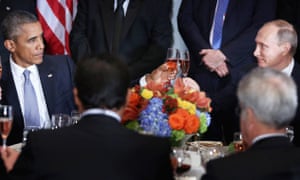
Facebook Twitter Pinterest
Obama and Putin toast during a luncheon hosted by United Nations secretary-general Ban Ki-moon. Photograph: Rex Shutterstock
“In accordance with this logic, we should support tyrants like Bashar al-Assad who drops barrel bombs to massacre innocent civilians because the alternative is surely worse,” Obama said in remarks clearly aimed primarily at Putin, who has repeatedly insisted that defeat of Isis can only be achieved by support of the “legitimate government” of Syria.
The US president indicated that he was ready to talk with everyone, including Russia and Iran, in seeking common ground on the issue, but equally clearly laid out US red lines, the most important of which was transition away from Assad.
“Yes, realism dictates that compromise will be required to end the fighting and ultimately stamp out Isil. But realism also requires a managed transition away from Assad and to a new leader, and an inclusive government that recognises there must be an end to this chaos so that the Syrian people can begin to rebuild,” he said.
UN's 70th general assembly: the greatest political show on earth
Obama’s address was also an ode to the twin virtues of democracy and diplomacy, interwoven with admissions of when the US had fallen short of those ideals, in the invasion of Iraq, and the xenophobia that has risen to the surface in the nation’s current political discourse.
Putin’s address was different in tone. While Obama had repeatedly paused for dramatic effect, the Russian leader galloped through his lines. The American president talked optimistically about the common aspirations that united all peoples; Putin struck darker, conspiratorial notes.
He noted how Isis had drawn its strength from former Iraqi servicemen made jobless by the US-led invasion in 2003 and then by the western bombing of Libya that led to the destruction of the Gaddafi regime in Tripoli. He suggested that the religious extremists were sent deliberately into Syria by unnamed powers to destroy the secular, anti-western government in Damascus.
Putin showed no sign of willingness to compromise on Assad’s fate, not even conceding that Damascus might be ripe for “reform” after Isis was defeated – a more conciliatory formula put forward by the Iranian president, Hassan Rouhani. Instead, he increased his praise for the regime, which he said was “fighting valiantly against terror face to face in Syria”. Furthermore, he said, the Syrian forces had been struggling almost alone up till now.
Putin not only presented a rival narrative for the Syrian conflict – he also offered an alternative mechanism for dealing for it. The Russian leader will have left New York by the time Obama chairs a summit on combating Isis and violent extremism on Tuesday. Putin did not mention it. Instead, he called on UN member states to take part in a ministerial meeting convened by Russia in its current role as president of the UN security council, which would lead to a new UN resolution on combating Isis, presumably built around support for the Damascus regime.
On the evidence of the opening morning of a week’s worth of speeches at the general assembly, Putin had gathered some momentum. In her brief remarks on Syria, the Brazilian president, Dilma Rousseff, blamed only Isis and “associated groups” for the violence. The Chinese president, Xi Jinping, did not mention Syria by name but stressed the importance of respect for national security as a pillar of the UN charter.
When his turn came, Rouhani blamed the US military campaigns in Iraq and Afghanistan and its support for Israel for creating an environment for terrorism to flourish. In earlier remarks on Sunday, he had stuck to a line on Syria that was close to the Russians’, calling for the fight against Isis to take precedence over any aspirations for reform in Damascus. But in the debating chamber on Monday, he opted to stay out of the US-Russian clash, with all its cold war echoes.