How MOVE Landed On Osage Avenue
Only two people managed to make it out of the MOVE compound alive: a woman named Ramona Africa and a young boy named Birdie Africa.
Growing up, I'd seen Ramona Africa a few times on television being interviewed by reporters during her civil suit against the city. I remembered her as a sleepy-eyed woman with dreadlocks. In 1996, a jury ordered the city to pay her $500,000, ruling that the siege on the MOVE compound violated her constitutional rights.
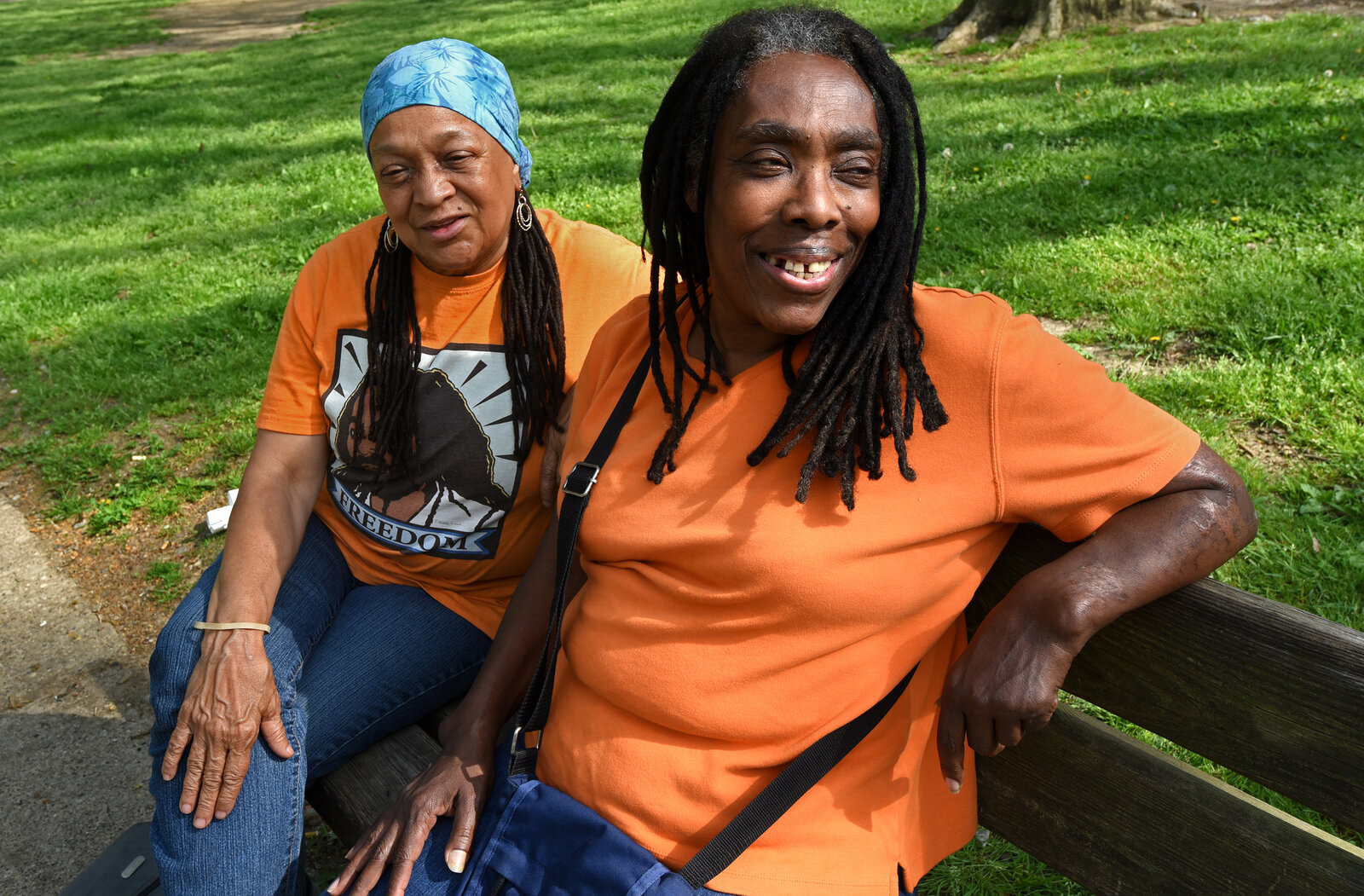
I met Ramona Africa last week, in a Philly park near where she'd lived since she was released from prison in 1992. (She was the only person involved in the MOVE bombing to serve any time.) She wore a peach shirt, shorts and sandals. Her signature dreadlocks were now flecked with gray. Her arms and legs were covered in burns.
She's close to 60 now, but she was still on message. "What makes Nathan Hale a freedom fighter and Delbert Africa an urban terrorist?" she asked me, rhetorically. "Either resisting wrong, resisting oppression [and] injustice despite legality is to be commended and celebrated, or it is to be penalized and never accepted. Can't have it both ways."
For some reason, I'd always remembered her from her TV interviews as erratic and raving. But as we talked in the park, I couldn't figure out where or how I'd formed that impression. Aside from the specifics of what she was saying, she seemed like the kind of person who might go to church with my mom and aunt — full of conviction, sure, but amiable and chatty.
As we sat in the park, she retraced her own story and told me how she linked up with MOVE. Ramona grew up in West Philly in a middle-class family, went to West Catholic High School, later to Temple University. She wanted to be a lawyer, she said, until she started working on community housing issues. "You cannot be a housing worker and not become an activist," she said. It was around this time, in the mid-1970s, when she started meeting members of MOVE, whom she would see in court. They were righteous, she thought.
I learned from other folks, though, that in those years, the MOVE organization enjoyed a weird reputation in the city, in part because no one could quite figure it out. The group was formed by a man who went by the name of John Africa; all of his followers dropped their surnames and adopted "Africa" instead. Members of MOVE would protest outside the city zoo for animal rights. They ate raw food. They were against technology.
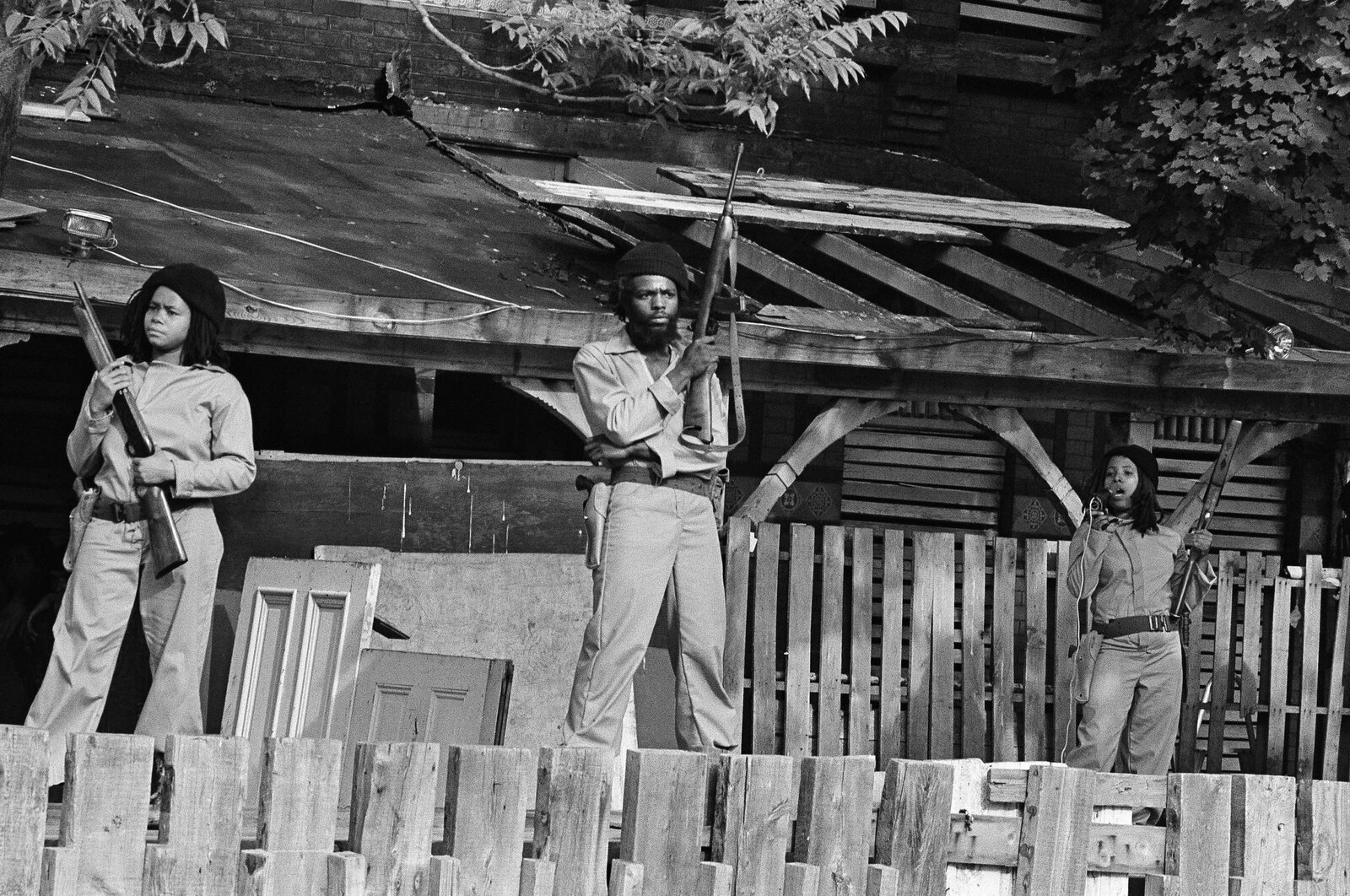
MOVE members hold sawed-off shotguns and automatic weapons as they stand in front of their barricaded headquarters on May 21, 1977.
AP
"You had the vegetarianism and some aspects of Rastafarianism," Robin Wagner-Pacifici,
an author who has written about MOVE, told me. "I think they had their own conscious desire to be uncategorizable."
In news accounts, they were often described as ideological kin of other black radical groups of the day, but Ramona told me that MOVE wasn't a black nationalist group and that it always boasted some nonblack members.
Indeed, their antics and outspokenness often put them on the wrong side of many local and community groups they were lumped in with. Washington, the former
Philadelphia Daily News stringer, told me that MOVE members once vocally interrupted and derailed a meeting brokered by community leaders between two local gangs that were set to agree to a truce. "The liberals and progressives and the nationalists in the city were like, 'Uhhh, what's up with this crew?' " he said.
But Washington said they weren't exactly outcasts, either. "There was this deference in terms of respecting rights," he said. "And [other groups] were saying, we may not like them, but if it's MOVE today, it's us tomorrow, so we've got to stand up ... and unpack the stuff they've gotten themselves into."
Over time, though, the group's reputation grew more menacing. MOVE members began squatting in a home in Powelton Village, a neighborhood in West Philadelphia not far from the University of Pennsylvania. It was an area whose residents were known for being amenable to countercultural, nontraditional family arrangements. But even there, it didn't take long for MOVE to exhaust the patience of its neighbors. MOVE members would pace the roof of the house they occupied, dressed in fatigues and brandishing weapons. In megaphoned harangues, often issued by a member named Delbert Africa, they would call for the release of imprisoned MOVE members and threaten city officials. Federal agents seized a cache of weapons from MOVE that included dozens of pipe bombs. At one point, the city barricaded several blocks surrounding the MOVE compound for 56 straight days.
In the summer of 1978,
MOVE members reached a deal with the city: they would turn over their weapons and leave their building if the city would release several MOVE members from city jails. The city honored the deal, but MOVE didn't leave. On Aug. 8, 1978, the tension reached what seemed like its peak. Police tried to remove MOVE from the building with water cannons and battering rams and were met with gunfire from the building's basement. An officer named James Ramp fell to the ground and died. Sixteen other police officers and firefighters were injured.
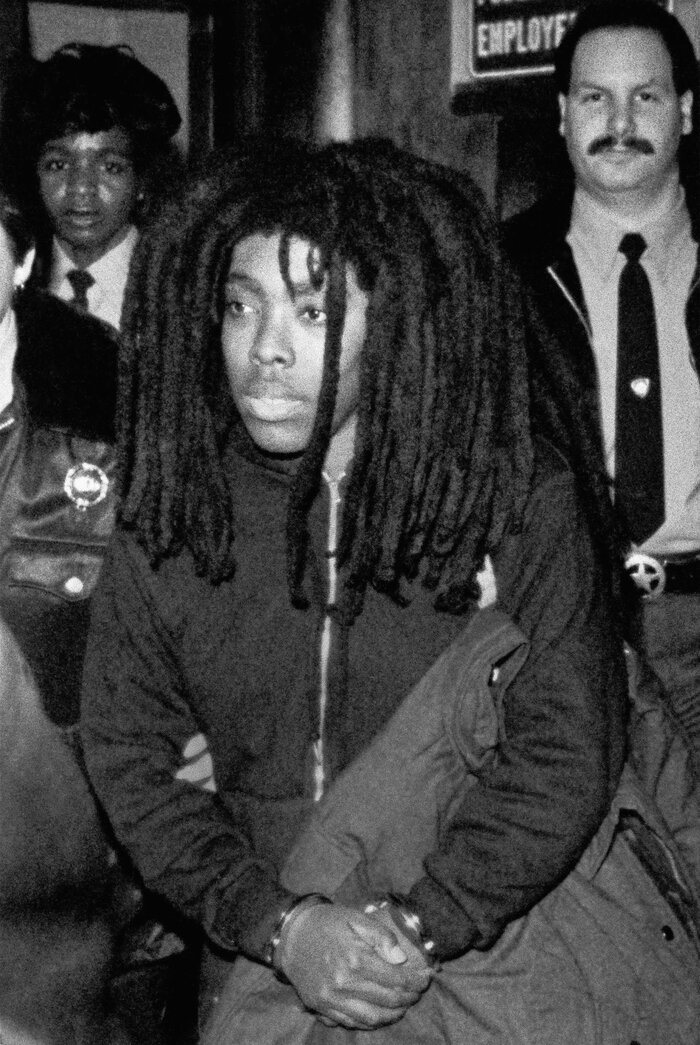
After several hours of holding out, the MOVE folks finally surrendered and began trickling out of the basement one at a time. But the cops were livid over Ramp's killing. They went after Delbert Africa — the MOVE member who had been taunting them from the building — grabbed him by his dreadlocks and threw him to the ground. Several officers joined in, kicking and stomping him. That moment was captured on film by a
Philadelphia Daily News photographer, and for many people, the police beating an unarmed, half-naked man
was the showdown's lasting image.
Two years later, nine MOVE members were convicted of third-degree murder in Ramp's death and sentenced to 30 to 100 years in prison — the MOVE 9, they were called.
After MOVE left Powelton Village, it set up a new base at 6221 Osage Ave., where one member's sister lived, on a quiet, middle-class block in a black neighborhood. It was around this time that Ramona became MOVE's "minister of information," handling most of its interviews with the press, and changed her last name to Africa.
But on Osage Avenue, too, tensions rose: MOVE began boarding up the windows and doors to the home with wood and rail ties, turning the row house on the narrow street into a fortified bunker. The residents continued their diatribes over the loudspeaker.
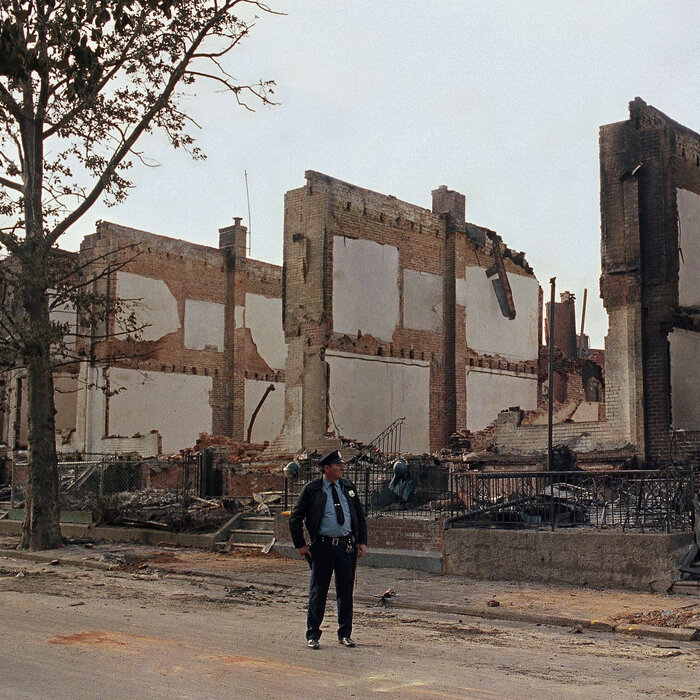
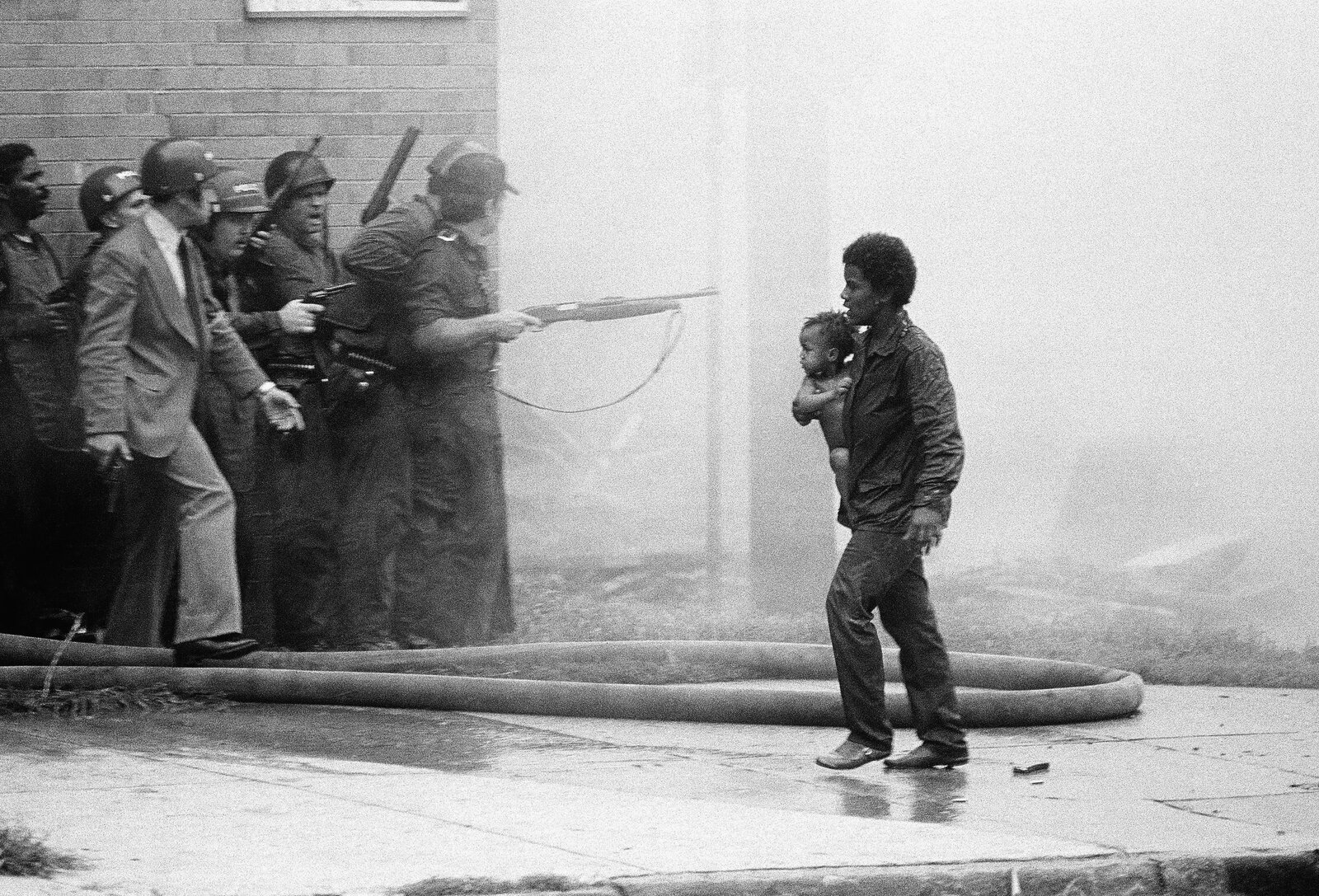
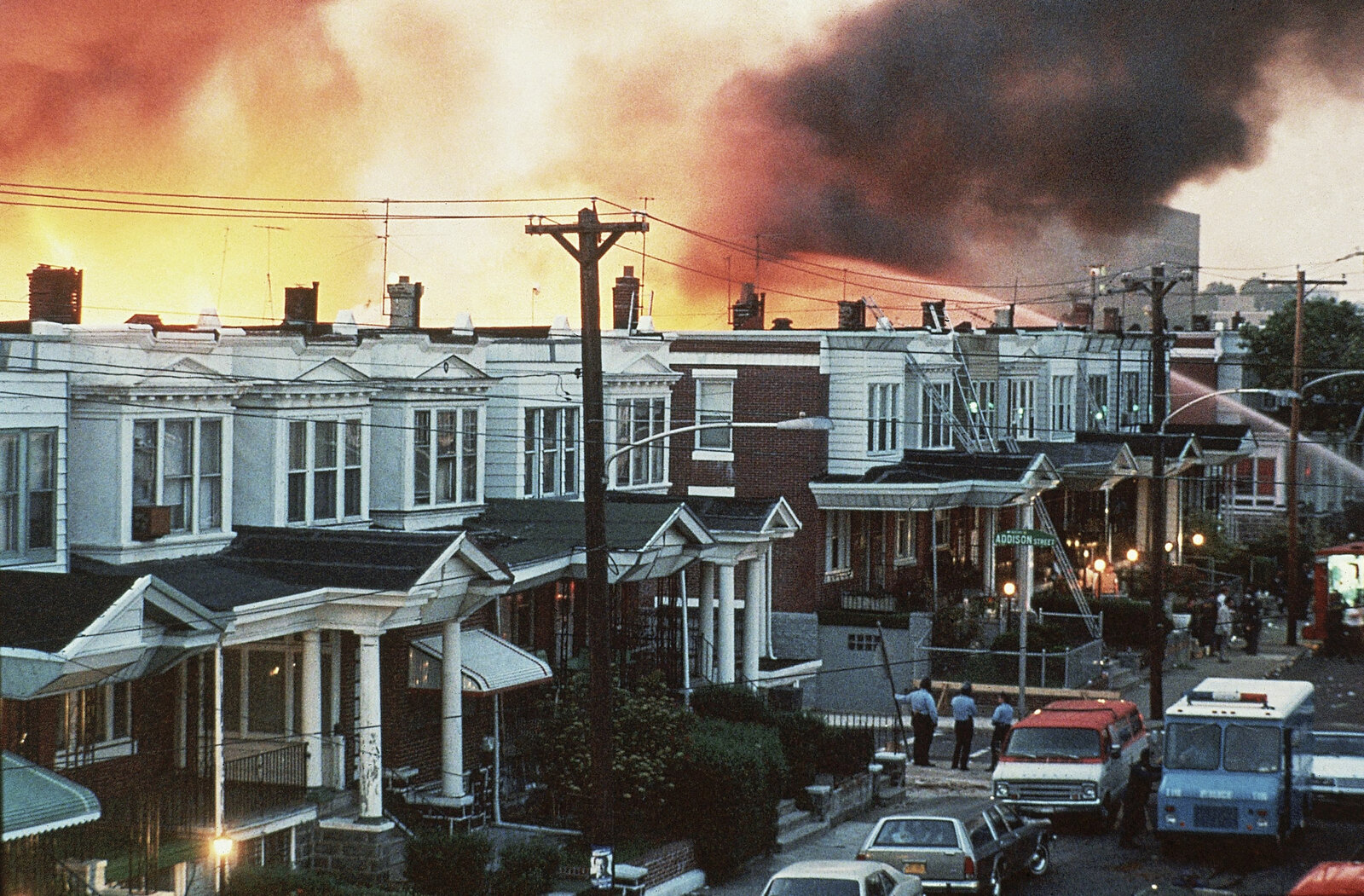
Their new neighbors pleaded with them. Then the neighbors contacted the city. The police had a detail on MOVE and the new compound. There were warnings from the police, and counterwarnings from MOVE. MOVE responded with more belligerence from the loudspeaker. On and on it went like that, until May 1985, when the city police and MOVE hunkered down for their fiery standoff.
Vote For Rizzo
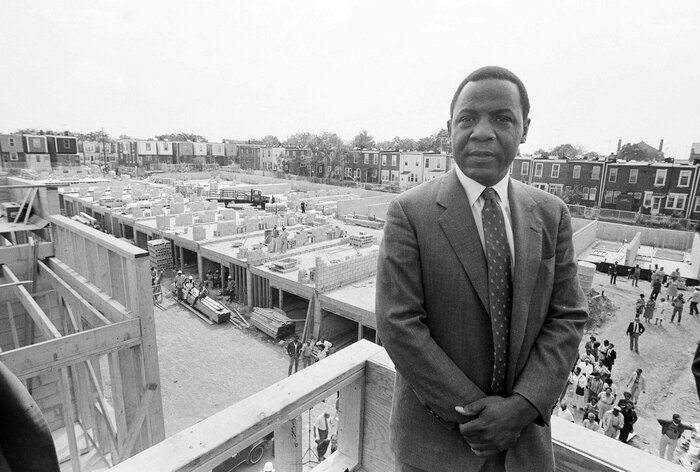
Philadelphia Mayor Wilson Goode stands on the roof of a newly constructed home, Sept. 17, 1985, on the site of the deadly battle with the group MOVE. Homeowners burned out as a result of the police siege of the MOVE headquarters watched the rebuilding process with skepticism.
George Widman/AP
I still vividly remember the first time I heard about MOVE and the bombing. It was 1987, two years after it happened, and my mom was getting my sister and me ready for school in the morning. The morning news was on TV, and a political ad came on during a commercial break. In the ad, a caricature of Mayor Wilson Goode was sporting goggles and one of those leather World War II-era bomber pilot helmets. An ominous voice, the kind you only hear in political ads, intoned:
Wilson Goode dropped a bomb on a Philadelphia neighborhood. Do you want him running your city?
Then the ad urged viewers to vote for Goode's challenger in the race, Frank Rizzo. I was only 6 years old, but I'd heard of Wilson Goode — he was the city's first black mayor, and he was on the TV all the time, besides. I'd never heard of this Frank Rizzo, but I knew he wasn't a bomber.
"Mom, you should vote for Frank Rizzo because the thing on the TV said that he firebombed some people's houses," I remember telling my mom.
Mom was not having it. "I'm voting for Wilson Goode." Her tone signaled that she was not about to entertain any further questions. I got the message.
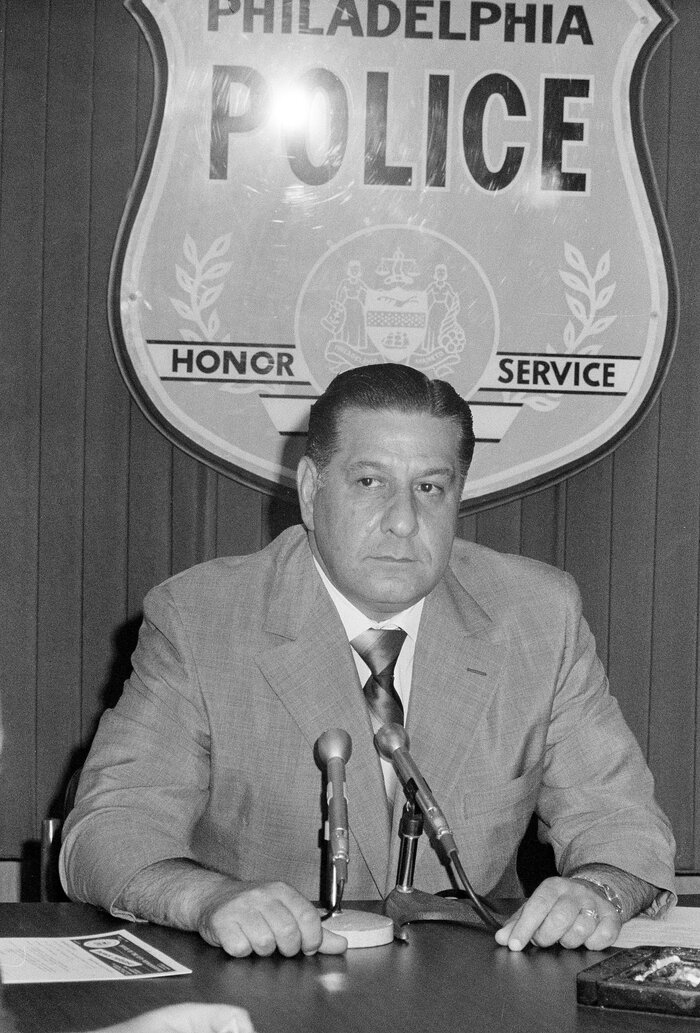
Philadelphia police commissioner Frank Rizzo at a press conference on Sept. 7, 1970.
Warren M. Winterbottom/AP
My mother never talked to me much about the messy politics of the MOVE bombing. I don't remember hearing about it from any other adults, or teachers I had. Indeed, until college, I'd only heard passing references to the group. But when folks did bring it up, I always remembered them expressing a weird ambivalence — vague sympathy toward MOVE abutting vague disdain.
And every now and then as I was growing up, a MOVE member named Ramona Africa would appear on the local television news, usually because of some legal fight she was engaging in with the city related to the bombing. Sometimes there was B-roll of what seemed like an endless line of row houses that looked like ours, going up in flames.
The first time my mom and I really talked about the MOVE bombing and what she remembered was this spring. She didn't recall me questioning her about Goode or Rizzo all those years ago, but she could imagine rolling her eyes at the idea of voting for Rizzo, even if it hadn't come from a chatty 6-year-old.
Back in 1986, Rizzo had been running for mayor again; he'd already served two terms in the 1970s before running up against term limits. He tried to have those term limits overturned,
openly appealing to white voters in the city to "vote white" regarding the ballot measure.
For a lot of black Philadelphians of a certain vintage, like my mother, the swaggering, profanity-spewing Rizzo, the city's former police commissioner, was the face and brains of Philadelphia's brutal, aggressive police force. My mom recounted to me the time he arrested a group of Black Panthers, strip-searched them in public, and invited the press to cover the whole ordeal;
photos of the naked, humiliated men were splashed across the pages of the local papers the next day.
And she told me about the time the police shot and killed her friend Ricky, who was a bystander during a shootout and had hidden beneath a nearby car for cover. There was the stuff she didn't witness: the melee that ensued after Rizzo sent hundreds of nightstick-wielding police officers to break up a peaceful demonstration of black high school and junior high school students who were protesting at the Board of Education building. ("Get their black asses!" he was widely quoted as saying during the fracas.) Or the fact that Philly cops
were infamous for "turf drops" — instead of taking black folks they'd arrested to jail, they'd leave them in hostile, white ethnic neighborhoods across town.
The enmity that black folks in Philly had for the police department was deep-rooted, and Rizzo had helped sow the seeds. And during his mayoralty, he became even more emboldened. ("I'm gonna be so tough as mayor, I gonna make Attila the Hun look like a fakkit,"
Rizzo was famously quoted as saying.) He was the city's mayor during the first MOVE siege in 1978; during his tenure, the Justice Department would file a lawsuit against the city's police department for brutality.
My mother had grown up in Rizzo's Philadelphia, and when we talked this spring she told me that he was essentially the reason I got
The Talk when I was growing up, why she always freaked out during my teenage years if I was out late at night and hadn't called to check in. That's why she could never have considered voting for Rizzo, even if it meant supporting the incumbent mayor who had firebombed a black neighborhood.
Goode won in 1986, but by the slimmest of margins: 51 percent for him, and 49 percent for Rizzo. Clearly, my mom wasn't the only black Philadelphian with a weird ambivalence toward MOVE. I remember picking up on that sentiment from other adults as a kid: On the one hand, there were the older folks who outright called the group dirty and weird. But then you'd also see signs reading "Free The MOVE 9" at any big-enough black cultural festival in the city.
Some of that ambivalence was certainly due to MOVE's own slow re-branding in the years after the bombing, an attempt to make the organization seem less antagonistic. But I suspect it also stemmed from a feeling held by a lot of black folks in Philly, then and now: While MOVE folks were crazy troublemakers whom they wouldn't want as neighbors, the police could be much, much worse.



There was an incredibly small sum of money between the members of MOVE, that's not why they were killed.