http://www.theguardian.com/global-d...laration-step-backwards-for-womens-rights-cswAs the Commission on the Status of Women meets, some UN states have been accused of trying to dilute a women’s rights declaration
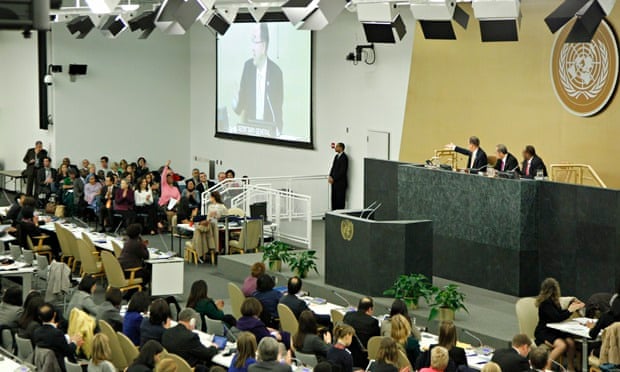
When many of the delegates who attended last year’s Commission of the Status of Women reconvene on 9 March in New York they can expect some lively debate. Photograph: Paulo Filgueiras/UN Photo
Guardian Women's rights and gender equality in focus is supported by:

Women’s rights activists have expressed alarm at the proposed wording of a UN declaration that they say could portend a major step backwards for women’s rights.
The text of the declaration, due to be published on 9 March at the start of the annual Commission on the Status of Women (CSW), has been branded bland and unambitious.
This year’s CSW will mark the 20th anniversary of the landmark fourth women’s world conference in Beijing in 1995. The conference’s platform for action, signed by 189 governments, identified 12 critical areas to empower women, such as greater involvement in decision-making and in conflict resolution, improving the rights of girls and ending violence. At the time, the agreement was seen as far-reaching and a blueprint for achieving women’s empowerment.
The two-week CSW, held in New York, will review progress made in implementing the Beijing recommendations over the past two decades.
But last week, the Women’s Rights Caucus, which monitors discussions at the CSW, said it was concerned that the language in the declaration was being watered down by certain UN states.
The caucus called on organisations to add their signatures to a statement demanding the declaration be strengthened.
“At a time when urgent action is needed to fully realise gender equality, the human rights and empowerment of women and girls, we need renewed commitment, a heightened level of ambition, real resources, and accountability,” said the statement.
“This political declaration, instead, represents a bland reaffirmation of existing commitments that fails to match the level of ambition in the Beijing declaration and platform for action and in fact threatens a major step backward.”
it added: “Governments cannot pick and choose when to respect, protect and fulfil the human rights of women and should not do so in this declaration.”
By Thursday, more than 770 organisations had signed the caucus statement.
It is understood that Russia, the Holy See (which has a seat on the UN as a non-member permanent observer state), Indonesia, Nicaragua and the Africa group of countries have tried to limit references in the text to human rights and to remove mention of the role feminist groups play in advancing gender equality. These states argue that human rights was just one chapter of the Beijing platform for action, rather than an overarching theme. Caribbean countries are also understood to have failed to step up to support women’s rights.
Turkey, Brazil, Argentina, Uruguay, Japan, Canada, Philippines, Chile, El Salvador, Australia and the EU are believed to be among those that have repeatedly challenged any removal of references to human rights.
The Holy See is also thought to have wanted mention of a standalone gender equality target proposed in the sustainable development goals removed from the declaration.
Any specific reference to women’s rights activists is expected to be lost.
The pushback on women’s existing rights from these states is not unusual in UN political statements, or are their attempts to block any progressive moves forward.
A record 8,600 civil society activists have signed up to attend this year’s CSW, which, as well as reflecting on the Beijing agreement, will discuss its relevance to the proposed SDGs, which are due to be implemented next year.

You are using an out of date browser. It may not display this or other websites correctly.
You should upgrade or use an alternative browser.
You should upgrade or use an alternative browser.
Activists blast 'bland' UN declaration as step backwards for women's rights
- Thread starter CHL
- Start date
More options
Who Replied?International Women's Day: Number of female lawmakers doubles in 20 years
Inter-Parliamentary Union reports worldwide increase in female MPs but says fast-track impact of quotas has reached its peak
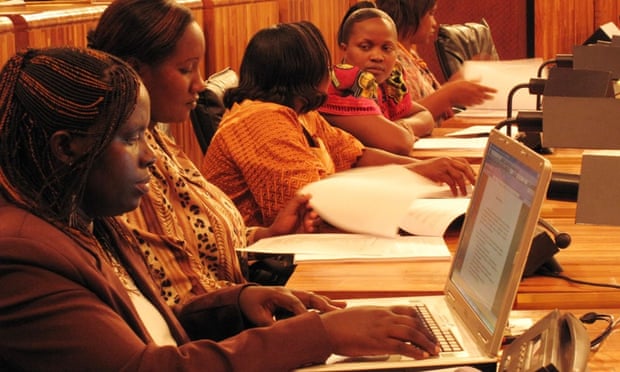
Rwanda has 63.8% of female lawmakers … above, the Rwandan parliament, pictured in 2008. Photograph: Stephanie McCrummen/Washington Post/Getty
Guardian Women's rights and gender equality in focus is supported by:
The percentage of female lawmakers has nearly doubled over the past two decades, but the hefty impact of quotas that require a minimum amount of women MPs may soon wear off, forcing new gender equality strategies to be introduced, the Inter-Parliamentary Union (IPU) has said.
Electoral quotas, which require countries to appoint a minimum number of female lawmakers, have been rolled out in more than 120 countries, according to the IPU. These quotes are “central” to the strides the world has made in closing the political gender gap, it said.
The global average of women in parliament has increased from 11.3% in 1995 to 22.1% in 2015, according to the IPU. But progress in raising the number of female lawmakers has slowed in recent years, said the IPU’s secretary general, Martin Chungong.
But the organisation said “a significant brake on progress in 2014 could be an indicator that the fast-track impact of quotas has reached its peak and other measures investing in women’s political empowerment are needed to complement quotas”.
“After the optimism and belief in 2013 that gender parity in parliament was within reach in a generation, the lack of significant progress in 2014 is a major blow,” said Chungong.
The IPU is a 126-year-old organisation that coordinates dialogue between parliamentarians from around the world, with the aim of promoting human rights and democracy.
Rwanda came top of the most recent rankings with 63.8% female lawmakers, while 13 countries registered 40% or more women in the lower or single houses of parliament.
Along with Rwanda, Andorra and Bolivia have made the most progress since 1995 in improving women’s political reputation, the IPU said.
Only three countries – Finland, the Seychelles and Sweden – ranked among the top 10 countries for female MPs in both 1995 and 2015.
Four countries from sub-Saharan Africa – Rwanda, Seychelles, Senegal and South Africa – ranked in this year’s top 10 for women lawmakers.
The Americas region made the biggest strides in promoting political gender equality during the reporting period, raising the percentage of female lawmakers from 12.7% in 1995 to 26.4% in 2015.
Chungong said the data is “a timely reminder that progress is not a given” and added: “Political action and will must remain a constant if we are to successfully tackle the gender deficit in politics. There is no room for complacency.
“Although 2014 didn’t deliver on the expectations of 2013, the last 20 years have made it clear that women are now partners at the political table. The challenge now is in making sure women become equal partners in how democracy is delivered.”
http://www.theguardian.com/global-d...umber-of-female-lawmakers-doubles-in-20-years
International Women's Day: Time to fund women's role in the cause of peace
A UN resolution passed 15 years ago to promote women in peace-building remains woefully underfunded, robbing the world of an effective response to radicalisation
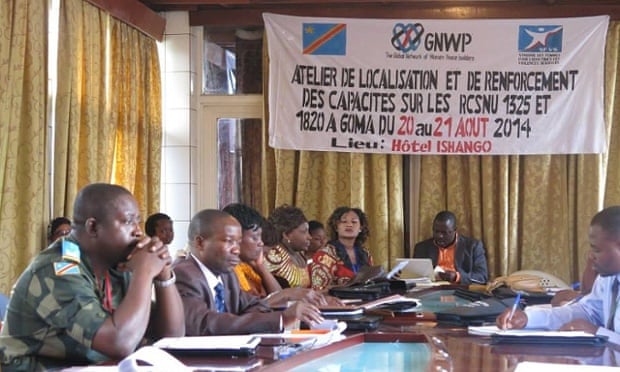
Implementing resolution 1325 … Global Network of Women Peacebuilders workshop in Goma, DRC, in August 2014. Photograph: GNWP
Guardian Women's rights and gender equality in focus is supported by:
In 2000 the United Nations security council passed resolution 1325 which vowed to ensure that women and gender equality were placed at the forefront of international, regional and local peace-building and security policies.
But 15 years later resolution 1325 is handicapped by woeful underfunding and women remain largely on the periphery at a time when enlisting their talents in the cause of peace and to combat extremism has never been so badly needed.
Every day we hear about radicalisation and its devastating impact: families losing their sons or daughters to Isis in Syria or Iraq; the massacre in a school in Pakistan; Boko Haram’s kidnapping of more than 200 girls in Nigeria; and al-Shabaab’s attack on a mall in Nairobi.
The international community’s response is to eliminate violent extremism with military might, while at home governments spend billions on security measures.
Those responses are deemed to be necessary, but do we really think we can wipe out extremism and violence by applying extreme violence? Shouldn’t we focus more prominently on tackling the causes of radicalisation? If we don’t give people a perspective on human security, justice, schooling, health services, skills, and a basic income, there will always be a next generation of extremists.
To create these perspectives in hotbeds of extremism such as Syria, Libya, Nigeria, and Afghanistan, thousands of local peace campaigners, community leaders and human rights activists, including many women, are risking their lives.
But women are working at a considerable disadvantage and as long as we, the international community, do not give our full political and financial support to their peace-building and state-building efforts, we will only see more violence in the future, however large the military response. By failing to take women and girls on board in issues of peace and security, the world loses a lot of its potential power to counter violent extremism.
Resolution 1325 gave us the political framework to get women on board and to change the perception of women from victims to decision-makers in conflict resolution processes. Yet 15 years later, donor countries invest billions in military security to counter violent extremism, but fail to allocate the resources to implement 1325. This lack of political will to generate adequate funding deprives the world of a most effective response to radicalisation.
Without women and their leadership in peace and security issues, a peaceful future barely stands a chance
Take the Afghan Women’s Network (AWN), a network of more than a hundred women’s organisations and 5,000 courageous individuals. They work tirelessly in perilous conditions to push for the implementation of resolution 1325 and also take part in rebuilding the country. They fought and survived Taliban rule. They risked their lives by casting a vote in the 2014 presidential elections. They refused to go back to square one. And their struggle continues.
Advertisement
Afghan women remain shamefully under-represented in government. More than a decade after Taliban rule, “rights that should be handed to us are not recognised. We still have to go to the streets to take them”, says Samira Hamidi, board member of AWN.
In 2000 the world promised to support women who dismantle the culture of violence and promote gender equality in the direst of situations. We broke that promise. Only 46 out of 193 UN member states have developed national plans on resolution 1325. None of these plans have yet received adequate funding. And as Hassina Safi, AWN director, puts it: “If our pocket is empty, we cannot do anything. If we have little money, are planned and strategised, we can really trouble shoot a lot of problems.”
The costs of inaction are high. Women are active agents of change in their communities and societies. Preventing them from using their full economic, peace-building and state-building potential in their countries is a threat to global security.
So how can we pressure governments to put their money where their mouths are? The framework of security council resolutions is clearly not enough. What we need now are sustainable and effective funding mechanisms to back their implementation.
Building on the mandate of resolution 1325, UN Women, Cordaid and the Global Network of Women Peacebuilders (GNWP) led the formation of a discussion group. At the first meeting in June 2014, the members embraced the idea of establishing a five-year mechanism to address the shortfalls in quality funding, titled a global acceleration instrument (GAI) on women, peace and security.
But the GAI envisaged by the group, which also includes donor governments and post-conflict UN member states, would be more than a financial mechanism. It would also act to empower women in the forefront of the struggle for gender equality and human rights in areas of armed conflict.
Several member states have been very active in supporting the GAI, in particular Japan and Sierra Leone, which both have government representatives on the committee preparing the detailed proposal for the GAI. Sierra Leone is also championing collaboration with local NGOs, and Japan has unofficially communicated its commitment to financial support for the initiative.
UN secretary general Ban Ki-Moon underlined that “adequate financing [of resolution 1325] remains a pervasive challenge”. Capitalising on the momentum of the 15th anniversary of 1325, Cordaid, GNWP and UN Women aim to launch the GAI in October 2015. At the 59th session Commission on the Status of Women from 9-20 March, we will call on leaders and policy makers all over the world to follow the example of Sierra Leone and Japan.
After 15 years of promises, it’s time to act and to pay. Without women and their leadership in peace and security issues, a peaceful future barely stands a chance.
http://www.theguardian.com/global-d...ternational-womens-day-fund-womens-role-peace