
Sounds like someone who didn’t click playNot anybody living today for sure.

You are using an out of date browser. It may not display this or other websites correctly.
You should upgrade or use an alternative browser.
You should upgrade or use an alternative browser.
Best documentary about Egypt plus confirmation about black Egyptians
- Thread starter TEH
- Start date
-
- Tags
- egyptian egyptians egyptology
More options
Who Replied?
Chrishaune
Veteran
Sounds like someone who didn’t click play
I've seen many videos on pyramids. If you want to give Africans credit for building the pyramids in Egypt fine, but you have to also acknowledge the witchcraft elements of these sites and other megalithic sites in other places.
If you want to give Africans credit for all of the human sacrifice evidence at these places like the pyramids in Mexico, ok.
I'm not going to claim that.
If that's what ya'll want to do, ok.

Egypt was also a true melting pot of cultures and customs. People from all over the world would come there trading ideas and making babies
Simply put It was Africa’s North America
remember Africa is a big whole ass continent..
that was at one point even bigger than that
Simply put It was Africa’s North America
remember Africa is a big whole ass continent..
that was at one point even bigger than that

I’ve only lightly skipped through but watched the part discussing Diop and the melanin concentration of the mummies of Tuthmose II, Seti I, and Rameses II
What I know for sure is that Seti I and his son Rameses II were of Nubian descent.
Seti was the son of Pa Rameses, the founder of the 19th Dynasty.
Pa Rameses father was also named Seti, who was a courtier during the reigns of Akhenaten, Tutankhamen, Aye, and Horemheb, the last kings of the 18th Dynasty.
Here is a snippet of Seti’s ancestry.
So Seti’s brother was Chief of the Bowman of Kush (Nubia). And his brother’s wife was the sister to Huy, the Viceroy of Kush (Nubia) during the reign of Tutankhamen.
The Viceroys of Kush were the rulers of Nubia who reported to the Pharaoh under Egyptian occupation.
This fresco is taken from the tomb of Huy, the Viceroy of Kush during the reign of Tutankhamen.

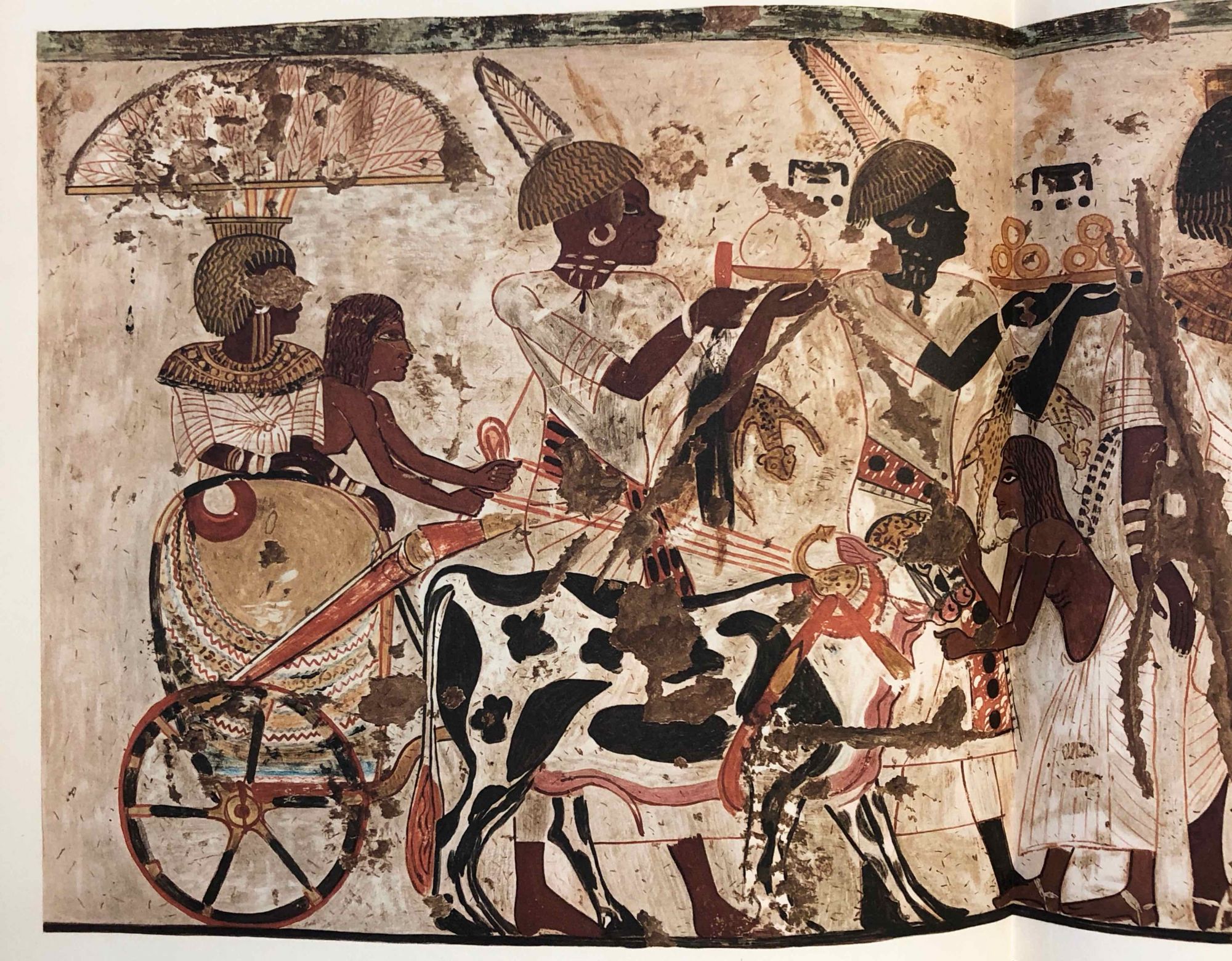
The 25th Dynasty, which consisted of the Nubian Kings that ruled over Egypt, were the descendants of these Viceroys.
But what they fail to mention is that the Ramessid Family (19th Dynasty) and therefore Ramesses II (considered to be the greatest Egyptian Pharaoh) were descendants of Nubians as well.
As for Tuthmose II, a predecessor of Tutankhamen, they traced their genetics and found that it originated around the Great Lakes region in Central Africa, which is the source of the Nile. Which lends to the most logical explanation of the origins of the Ancient Egyptians, being that of a group of people from the Great Lakes region, who migrated down the Nile to the Delta that empties into the Mediterranean.
What part of that video do they start discussing race?

Dafunkdoc_Unlimited
Theological Noncognitivist Since Birth
- Joined
- Jul 25, 2012
- Messages
- 45,062
- Reputation
- 8,010
- Daps
- 122,436
- Reppin
- The Wrong Side of the Tracks
This is not about Sumerians going back and forth. Cuneiform was used by different societies back in the day.
The writing doesn't match ANY known script aside from 2 characters....
The Fuente Magna Bowl: Not Cuneiform and not Sumerian - Archaeology Review
The Fuente Magna Bowl: Not Cuneiform and not Sumerian - Archaeology Review
Clyde Winters, a former professor of education at Governer’s State University in Chicago, claims that the writing is Sumerian. The right side of the bowl he says is Sumerian cuneiform and the left side is “Proto-Sumerian.” The problem is the signs don’t match the transliterations he claims. And Winters’ translation is the most prominent one to come across when you search the internet for “Fuente Magna translation.”
Also, “proto-Sumerian” really isn’t a thing. Sumerian is the language that was expressed by cuneiform script. Think of a book written in English using the Roman alphabet. Another book might be written in Spanish using the same Roman alphabet. You’ll recognize the letters and many of the pronunciations, but unless you speak the language, much of the text is meaningless. This is the same with cuneiform in a way. Languages that might use cuneiform script are Sumerian, Akkadian, Assyrian, Hittite, and some others. So, instead of “proto-Sumerian” script, Winters probably meant proto-cuneiform. For which there is a syllabary of known signs. In any case, the symbols in cuneiform don’t generally look all that different from language to language, but the meanings of the symbols do change.
To illustrate the problems in detail, let’s look at the symbols on the bowl as he pretends to translate them on his own website. I’ve made some tables that can serve as visual aids.

In the table above, you can see the signs that Winters has identified with his pretended transliteration in the next column. In the 3rd column are the actual signs for the transliterations Winters claims. But honestly, only two symbols came close to being real. They were, perhaps, the two easiest to remember for someone looking at a book of cuneiform texts. The two are DINGIR / AN and ASH. The rest were nonsense. KUR was the next closest, but it, too, had the appearance of being very sloppily done if we’re to accept it as actually being KUR. In this Panel there is also the introduction of one “proto-Sumerian” sign (to use Winters’ description). The problem is it doesn’t show up on the list of known proto-cuneiform signs. Check for yourself. Nor does it show up in any other sign or syllabary list that I looked at. If someone finds it, I’d love to know where.
Dafunkdoc_Unlimited
Theological Noncognitivist Since Birth
- Joined
- Jul 25, 2012
- Messages
- 45,062
- Reputation
- 8,010
- Daps
- 122,436
- Reppin
- The Wrong Side of the Tracks
No one really knows how the pyramids were built…
Actually, they do....

I’ll put this in modern termsI've seen many videos on pyramids. If you want to give Africans credit for building the pyramids in Egypt fine, but you have to also acknowledge the witchcraft elements of these sites and other megalithic sites in other places.
If you want to give Africans credit for all of the human sacrifice evidence at these places like the pyramids in Mexico, ok.
I'm not going to claim that.
If that's what ya'll want to do, ok.
Just because you build a skyscraper for someone or teach them how to build it … doesn’t mean that you dictate or even influenced in any way what happens in that building
Last edited:

Jean Jacket
NOPE
Actually, they do....
Were the builders Black people according to your belief/research?
Actually, they do....
Again
this doesn’t make sense
the documentary I posted explained how the stones would be too heavy … at least watch it even if you disagree
Chrishaune
Veteran
The writing doesn't match ANY known script aside from 2 characters....
The Fuente Magna Bowl: Not Cuneiform and not Sumerian - Archaeology Review
Clyde Winters, a former professor of education at Governer’s State University in Chicago, claims that the writing is Sumerian. The right side of the bowl he says is Sumerian cuneiform and the left side is “Proto-Sumerian.” The problem is the signs don’t match the transliterations he claims. And Winters’ translation is the most prominent one to come across when you search the internet for “Fuente Magna translation.”
Also, “proto-Sumerian” really isn’t a thing. Sumerian is the language that was expressed by cuneiform script. Think of a book written in English using the Roman alphabet. Another book might be written in Spanish using the same Roman alphabet. You’ll recognize the letters and many of the pronunciations, but unless you speak the language, much of the text is meaningless. This is the same with cuneiform in a way. Languages that might use cuneiform script are Sumerian, Akkadian, Assyrian, Hittite, and some others. So, instead of “proto-Sumerian” script, Winters probably meant proto-cuneiform. For which there is a syllabary of known signs. In any case, the symbols in cuneiform don’t generally look all that different from language to language, but the meanings of the symbols do change.
To illustrate the problems in detail, let’s look at the symbols on the bowl as he pretends to translate them on his own website. I’ve made some tables that can serve as visual aids.
In the table above, you can see the signs that Winters has identified with his pretended transliteration in the next column. In the 3rd column are the actual signs for the transliterations Winters claims. But honestly, only two symbols came close to being real. They were, perhaps, the two easiest to remember for someone looking at a book of cuneiform texts. The two are DINGIR / AN and ASH. The rest were nonsense. KUR was the next closest, but it, too, had the appearance of being very sloppily done if we’re to accept it as actually being KUR. In this Panel there is also the introduction of one “proto-Sumerian” sign (to use Winters’ description). The problem is it doesn’t show up on the list of known proto-cuneiform signs. Check for yourself. Nor does it show up in any other sign or syllabary list that I looked at. If someone finds it, I’d love to know where.
You're still trying to convince me it wasn't Sumerians when I just said I don't believe what anybody is pushing.
Cuneiform had to descend from an earlier form of communication.
So that earlier form went through an evolution to end up with the people that were at Puma Punku, just like it did to end up in Sumeria, and other ancient societies.
But where did this earlier form originate from? Well that would lead you to where this ancient technology to build megalithic structures came from.
This was way before Ancient Egypt.
Last edited:

In
Chrishaune
Veteran
I’ll put this in modern terms
Just because you build a skyscraper to someone or teach them how to build it … doesn’t mean that you dictate or even influenced in any way what happens in that building
Human sacrifices has a long history into ancient times breh. There is no escape from that if you want to claim these sites.

They didn't use anything but sand, stone hammers, and copper saws/chisels to cut granite. They molded some limestone blocks, the rest were quarried.
No evidence exists detailing the process or the implements used to perform that work. Also, it was completely unnecessary.
yo what’s your problem?? Nikka you wasn’t there!
Dafunkdoc_Unlimited
Theological Noncognitivist Since Birth
- Joined
- Jul 25, 2012
- Messages
- 45,062
- Reputation
- 8,010
- Daps
- 122,436
- Reppin
- The Wrong Side of the Tracks
yo what’s your problem?? Nikka you wasn’t there!
Good thing Egyptians recorded how they did all that using heiroglyphs, steles, and papyrus.