Essential Black/African Women's History

Poitier

My Words Law
Supporter
Joined
Jul 30, 2013
Messages
69,412
Reputation
15,494
Daps
246,429
tumblr_mvza9dfTon1ru5s3yo1_1280.jpg


Carlota, a slave woman, took up the machete in 1843 to lead a slave uprising at the Triumvirato sugar mill in Matanzas Province and was killed. She was one of the 3 leaders of the rebellion. Her name was later given to Cuba’s 1980’s operation Black Carlota in Southern Africa, which culminated in the battle of Cuito Cuanavale and the defeat of the South African army in pitch battle.
 

Poitier

My Words Law
Supporter
Joined
Jul 30, 2013
Messages
69,412
Reputation
15,494
Daps
246,429
nzinga2011_illustration.jpg


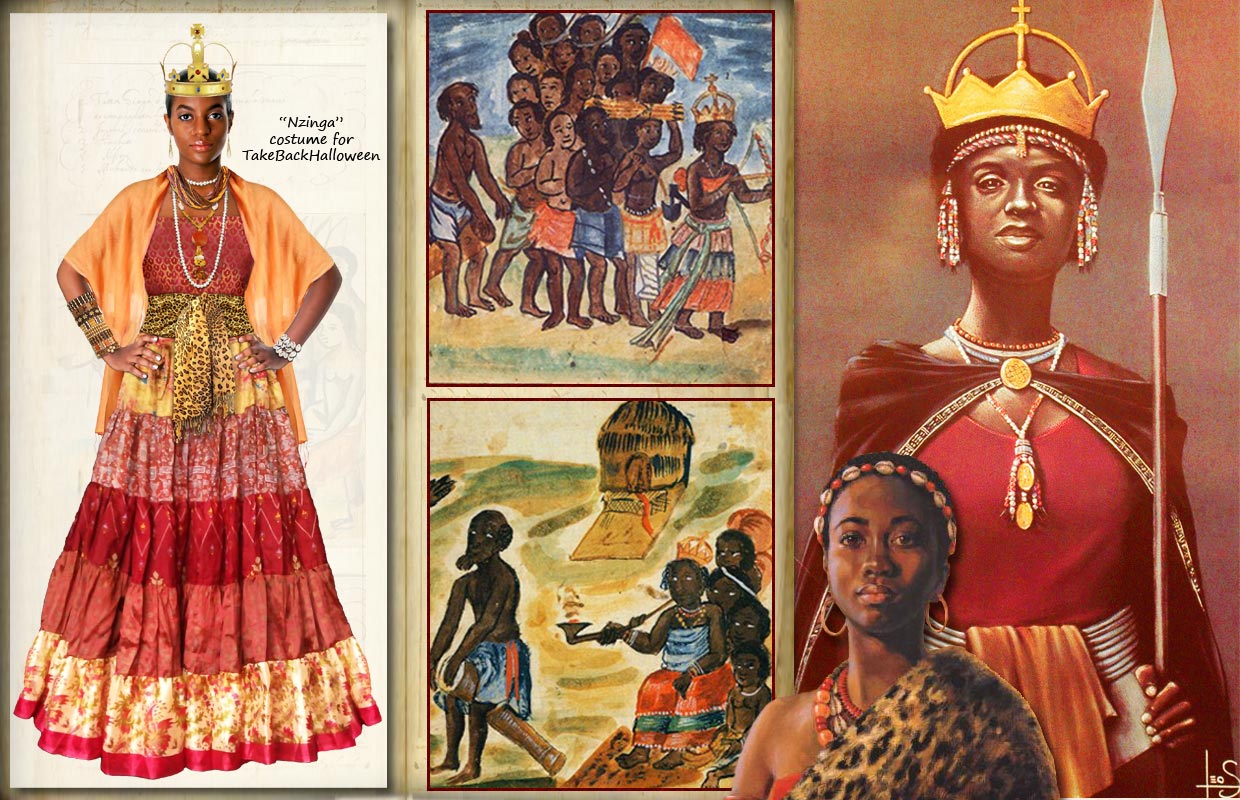
Queen Nzinga (Nzinga Mbande), the monarch of the Mbundu people, was a resilient leader who fought against the Portuguese and their expanding slave trade in Central Africa.

During the late 16th Century, the French and the English threatened the Portuguese near monopoly on the sources of slaves along the West African coast, forcing it to seek new areas for exploitation. By 1580 they had already established a trading relationship with Afonso I in the nearby Kongo Kingdom. They then turned to Angola, south of the Kongo.

The Portuguese established a fort and settlement at Luanda in 1617, encroaching on Mbundu land. In 1622 they invited Ngola (King) Mbande to attend a peace conference there to end the hostilities with the Mbundu. Mbande sent his sister, Nzinga, to represent him in a meeting with Portuguese Governor Joao Corria de Sousa. Nzinga was aware of her diplomatically awkward position. She knew of events in the Kongo which had led to Portuguese domination of the nominally independent nation. She also recognized, however, that to refuse to trade with the Portuguese would remove a potential ally and the major source of guns for her own state.

In the first of a series of meetings Nzinga sought to establish her equality with the representative of the Portugal crown. Noting that the only chair in the room belonged to Governor Corria, she immediately motioned to one of her assistants who fell on her hands and knees and served as a chair for Nzinga for the rest of the meeting.

Despite that display, Nzinga made accommodations with the Portuguese. She converted to Christianity and adopted the name Dona Anna de Souza. She was baptized in honor of the governor's wife who also became her godmother. Shortly afterwards Nzinga urged a reluctant Ngola Mbande to order the conversion of his people to Christianity.

In 1626 Nzinga became Queen of the Mbundu when her brother committed suicide in the face of rising Portuguese demands for slave trade concessions. Nzinga, however, refused to allow them to control her nation. In 1627, after forming alliances with former rival states, she led her army against the Portuguese, initiating a thirty year war against them. She exploited European rivalry by forging an alliance with the Dutch who had conquered Luanda in 1641. With their help, Nzinga defeated a Portuguese army in 1647. When the Dutch were in turn defeated by the Portuguese the following year and withdrew from Central Africa, Nzinga continued her struggle against the Portuguese. Now in her 60s she still personally led troops in battle. She also orchestrated guerilla attacks on the Portuguese which would continue long after her death and inspire the ultimately successful 20th Century armed resistance against the Portuguese that resulted in independent Angola in 1975.

Despite repeated attempts by the Portuguese and their allies to capture or kill Queen Nzinga, she died peacefully in her eighties on December 17, 1663.

- See more at: http://www.blackpast.org/gah/queen-nzinga-1583-1663#sthash.f2zdelFm.dpuf

 

Poitier

My Words Law
Supporter
Joined
Jul 30, 2013
Messages
69,412
Reputation
15,494
Daps
246,429
isis9.jpg

Before_After-WayAfter.JPG


Isis was worshipped as the ideal mother and wife as well as the patroness of nature and magic. She was the friend ofslaves, sinners, artisans and the downtrodden, but she also listened to the prayers of the wealthy, maidens, aristocrats and rulers.[1] Isis is often depicted as the mother of Horus, the falcon-headed deity associated with king and kingship (although in some traditions Horus's mother was Hathor). Isis is also known as protector of the dead and goddess of children.

The name Isis means "Throne".[2] Her headdress is a throne. As the personification of the throne, she was an important representation of the pharaoh's power. The pharaoh was depicted as her child, who sat on the throne she provided. Her cultwas popular throughout Egypt, but her most important temples were at Behbeit El-Hagar in the Nile delta, and, beginning in the reign with Nectanebo I (380–362 BCE), on the island of Philae in Upper Egypt.
 
Last edited:

Poitier

My Words Law
Supporter
Joined
Jul 30, 2013
Messages
69,412
Reputation
15,494
Daps
246,429
2_-_La_reine_Tin_Hinan%2C_125x150cm%2C_huile_sur_toile.jpg


Tin Hinan (4th century) was the legendary queen of the Tuareg people, the matrilineal desert-dwelling Berbers who are famous for their blue clothing—and for the fact that it’s their men, rather than their women, who wear face veils. Tin Hinan is credited as the first leader and founding matriarch of the tribe, and is revered by the Tuareg today as “the Mother of Us All.” Her story is shrouded in myth, but unlike most myths, this one has a skeleton attached: the tomb of Tin Hinan was excavated in Algeria in 1925. The lady buried inside was loaded with splendor—a jeweled robe, armband cuffs in gold and silver, heavy gold necklaces, emeralds and pearls, coins, headdress, the whole bit. The main image above is a painting of Tin Hinan by Algerian artist Hocine Ziani. The inset image is “Berber Woman” by Émile Vernet-Lecomte, which we include because the style of clothing depicted (unsewn tunic pinned at the shoulders) may be closer to what people were actually wearing in the 4th century.
 

Poitier

My Words Law
Supporter
Joined
Jul 30, 2013
Messages
69,412
Reputation
15,494
Daps
246,429
nehanda.jpg


Nehanda Nyakasikana

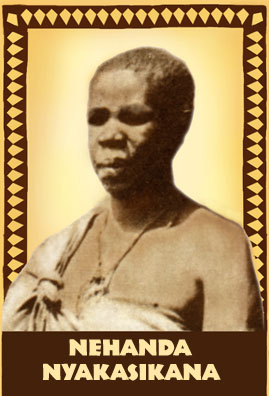
Nehanda Charwe Nyakasikana (1863–1898) was a female spiritualist leader from Mashonaland, Zimbabwe, and a key leader in the First Chimurenga, or ‘the war of liberation’, against British colonial settlers in 1896–1897. She was considered to be the female incarnation of the oracle spirit Nehanda. After being captured by the British, she predicted that her spirit would lead the second Chimurenga against the British, which eventually culminated in the independence of present-day Zimbabwe.
 

Poitier

My Words Law
Supporter
Joined
Jul 30, 2013
Messages
69,412
Reputation
15,494
Daps
246,429
queen-taytu.png


Taytu Betul
Taytu Betul (c.1851–1918) was a formidable queen and empress of Ethiopia. An astute diplomat, she proved to be a key figure in thwarting Italian imperialist designs on Ethiopia. Later, she and her husband Emperor Menelik II, led a huge army to battle at Adwa, where they won one of the most important victories of any African army against European colonialist aggression.
 

Poitier

My Words Law
Supporter
Joined
Jul 30, 2013
Messages
69,412
Reputation
15,494
Daps
246,429
Ahosi-or-Mino-Dahomey-Amazons.jpg

dahomey5.jpg

tumblr_msc7qhFd751rqkjy0o2_400.jpg


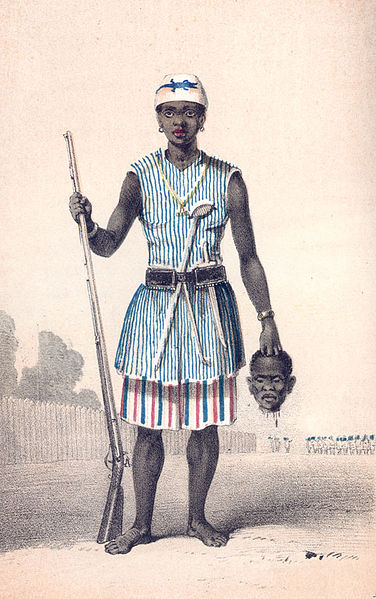
The women soldiers of Dahomey

Elite troops of women soldiers contributed to the military power of the Kingdom of Dahomey in the eighteenth and nineteenth centuries. Admired in their country and feared by their adversaries, these formidable warriors never fled from danger. The troops were dissolved following the fall of Behanzin (Gbêhanzin), the last King of Dahomey, during French colonial expansion at the end of the nineteenth century.
 

Poitier

My Words Law
Supporter
Joined
Jul 30, 2013
Messages
69,412
Reputation
15,494
Daps
246,429
La-princesse-Yennega.jpg

carte_perso_yennega.jpg


Yennega

Yennega, an emblematic figure in Burkina Faso, was the mother of Ouedraogo, the founder of the dynasties of the Moose chieftains. She is thought to have lived between the fourteenth and fifteenth centuries. Weary of the warrior role in which she had been cast by her father, the King of Gambaga, she ran away and met a solitary hunter. A legendary figure in West Africa, Yennega is the epitome of the female warrior, a free and independently minded woman.
 

Poitier

My Words Law
Supporter
Joined
Jul 30, 2013
Messages
69,412
Reputation
15,494
Daps
246,429
yaa1.jpg

Ghana-1303-0187_medium.jpg

Queen-Mother-Yaa-Asantewaa1-182x300.jpg

Asantewaa.jpg

cede7d76227cd59f368ee088d9d1eadb.400x187x1.jpg

Yaa Asantewaa
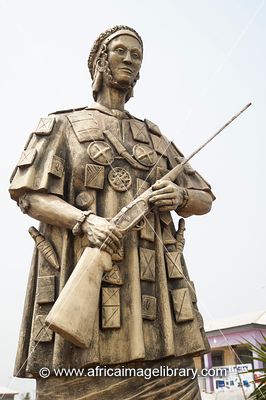
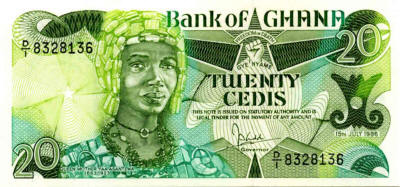
Yaa Asantewaa (1840–1921) was an ‘Edwesohemaa’, a queen mother of the Edweso tribe of the Asante in modern day Ghana. In March 1900, she led an army of thousands in the Yaa Asantewaa War for Independence against the British colonial forces in Ghana. Despite mounting a strong attack, she was defeated in 1901 by the British and exiled to the Seychelles where she spent two decades until her death in October 1921.
 

Poitier

My Words Law
Supporter
Joined
Jul 30, 2013
Messages
69,412
Reputation
15,494
Daps
246,429
mahin.jpg


Luiza Mahin
Luiza Mahin, born at the beginning of the nineteenth century, was an Afro-Brazilian freedom fighter. A natural leader, Mahin became involved in revolts and uprisings of slaves in the Brazilian province of Bahia. A street vendor by profession, she used her business as a distributory cell for messages and leaflets in the resistance struggle. She played a central role in the significant “Revolta dos Males” (1835) and “Sabina” (1837-1838) slave rebellions.
 

Poitier

My Words Law
Supporter
Joined
Jul 30, 2013
Messages
69,412
Reputation
15,494
Daps
246,429
mulatresse_solitude_1.jpg

carte_perso_mulatresse_solitude.png


The Mulatto Solitude
In May 1802, while a few months pregnant, the Mulatto Solitude took part in the Guadeloupian uprisings against the reinstatement of Lacrosse, who had been appointed Captain-General of Guadeloupe by Napoleon Bonaparte and expelled in October 1801 following a coup by the army’s officers of colour. After her arrest, Solitude was imprisoned and subsequently tortured, possibly to death, a day after giving birth. Solitude symbolizes all Caribbean women and mothers who fought for equality and freedom from slavery.
 

Poitier

My Words Law
Supporter
Joined
Jul 30, 2013
Messages
69,412
Reputation
15,494
Daps
246,429
Queen-Nanny.png

Queen Nanny
Queen Nanny was an eighteenth-century leader, warrior and spiritual advisor. Born in 1686 in present-day Ghana, Western Africa, she was sent as a slave to Jamaica, where she became leader of the Maroons, a group of runaway Jamaican slaves. She is believed to have led attacks against British troops and freed hundreds of slaves. She was also known as a powerful Obeah practitioner of folk magic and religion.
 

Bawon Samedi

Good bye Coli
Supporter
Joined
Mar 28, 2014
Messages
42,473
Reputation
18,794
Daps
166,537
Reppin
Good bye Coli(2014-2020)
Bet they don't know about this...:lupe:

Dahomey Amazons
376px-Dahomey_amazon1.jpg


"The Dahomey Amazons are the only documented all-female official front-line combat arms military unit in modern history.
Tough, uber-intense asskicking women single-mindedly devoted to hardening themselves into ruthless instruments of battlefield destruction, these machete-wielding, musket-slinging lady terminators were rightly-feared throughout Western Africa for over250 years, not only for their fanatical devotion to battle, but for their utter refusal to back down or retreat from any fight unless expressly ordered to do so by their king. If you were some poor conscript douchebag militia soldier hanging out around your barracks and you saw these scary-as-**** kill-chicks suddenly start charging out of the woods in your direction, screaming their war chants with their muskets barking fire and their signature double-edged two-foot-long machetes brandished threateningly over their heads, you had one fleeting moment to overcome your crippling panic and defend yourself. Because if you failed to kill them – and I mean if you failed to kill every single last fukking one of them, some murderous woman was going to club you unconscious with a musket butt, drag you back to her capital, chop off your head with one swing of her machete, boil the skin off of your decapitated face, and then use your skull to decorate the royal palace."


"Created around 1645 by the Dahomey King Ada Honzoo, the Amazons weren't initially designed to serve as frontal assault shock troops sent in to crush the enemy's spirits (and skulls) in a frenzied wave of bloodlusted fury. Instead, they started out as a small team of women who specialized in bringing down elephants, and who would go out on organized, efficient pachyderm hunts while the men were out fighting in wars. Eventually, possibly due to a lack of manpower or possibly because of their ruthless efficiency, Ada Honzoo promoted them to his personal bodyguard unit, expanding the unit to 800 women warriors with spears, bows, and war clubs, which in turn grew in size to an elite military unit of over 4,000 warriors. As a shout-out to their roots the Amazons chose to honor their heritage by naming their first battalion the Elephant Destroyers. The second battalion, it should be noted, were known as the Reapers – women who ditched those pesky flintlock muskets and instead went to battle armed with a razor-sharp three-foot machete they wielded with two hands."


"The Amazons went through intense physical training that far exceeded anything the male soldiers were willing to undertake. They wrestled, fought, and underwent grueling calesthenics and brutally-long runs on a daily basis. They climbed a thirty-foot wall lined with thorny brambles without showing pain. Recruits were sent into the woods with just a machete and told to survive for nine days. They trained for live-fire exercises by arming enemy prisoners of war with clubs, positioning them behind a stockade, and then assaulting it and killing everyone they could catch. Yeah, it's fukked up, but that's just how it was – the Amazons were in constant competition for glory with the male units, and they knew that if anyone was going to take them seriously either at home or on the battlefield, they needed to be twice as hard as anyone else out there. And they were. They kept their weapons and uniforms clean, marched in lock-step precision, and when these women sprinted barefoot and pissed into combat beneath their unit battle flag – a Voodoo fetish made from the bones and skin of dead enemy soldiers – everyone who saw them pretty much pissed themselves and ran for it."
Source:
Badass of the Week: The Dahomey Amazons


From this thread.
 

Poitier

My Words Law
Supporter
Joined
Jul 30, 2013
Messages
69,412
Reputation
15,494
Daps
246,429
ellen_johnson_sirleaf.jpg


Ellen Johnson Sirleaf is a Liberian politician and economist. After studying in the United States, including at Harvard, she became Assistant Minister of Finance followed by Minister of Finance on her return to Liberia.

Her now dead ex-husband used to unleash violent outbursts as he struggled to accept his wife's career...

In 2005, Ellen Johnson Sirleaf became the first woman to be elected president of an African state, following elections organised by the UN.

In mid-October 2011, during new elections in Liberia, Ellen Johnson Sirleaf also came out ahead during the first round.

On the 7th October 2011, Ellen Johnson Sirleaf received the Nobel Peace Prize, which she shares with two other women, Leymah Gbowee and Tawakkul Karman, for their pacifist commitment in favour of male-female equality.
 
Top