
Brazil's Marina Silva gains lead over Dilma Rouseff

TTT

All Star
Joined
Feb 9, 2013
Messages
2,249
Reputation
460
Daps
5,557
Reppin
NULL
Brazil's presidential election
Marina gains momentum
Aug 30th 2014, 6:43 by J.P. | SÃO PAULO
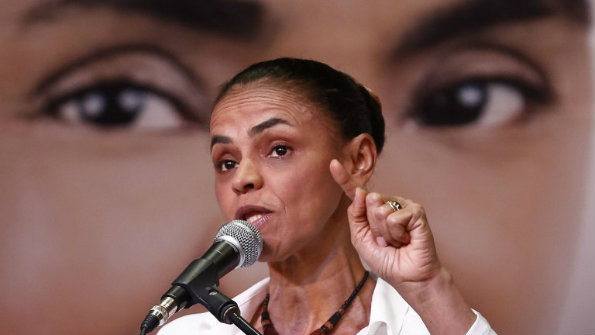
  • mvd6632878_595.jpg

    “A PASSING wave.” That is how Aécio Neves, the presidential candidate of the centre-right Party of Brazilian Social Democracy (PSDB), earlier this week dismissed the rising popularity of Marina Silva. Ms Silva was propelled to the top of the centrist Brazilian Socialist Party (PSB) ticket in the wake of the tragic death in a plane crash two weeks ago of its leader and candidate, Eduardo Campos. “Groundswell” would have been a more appropriate description. Nor does it look like dissipating any time soon.

    Support for Ms Silva, a former environment minister and green activist, has surged from 21% in the days immediately following the accident to 34%, according to a poll published on August 29th by Datafolha. With five weeks left before the election this pushes Mr Neves into distant third and puts Ms Silva neck and neck with President Dilma Rousseff, who had until now enjoyed a healthy first-round lead. In a second-round run-off, the Datafolha poll has Ms Silva beating the incumbent by ten percentage points.

    The poll numbers can be explained in part by the spotlight shone on Ms Silva since Mr Campos’s death. She has been gazing upon voters from covers of most newspapers and magazines. Brazilians—20m of whom plumped for her in the 2010 presidential election, when she came a solid third—have been constantly reminded of her remarkable life story: a poor rubber-tappers’ daughter who only learned to read at 16 but went on to become a world-renowned environmentalist. On August 27th she was interviewed on Brazil’s main evening news, watched every night by an average of 36m people.

    But there is more to Ms Silva’s rise than mere media exposure. For one thing, she has used the attention well. During the TV interview, for instance, contrary to her reputation as something of a radical, she came across as calm and measured, if somewhat vague. The previous night she had delivered a similarly robust performance in the first televised debate, helped by Mr Neves’s and Ms Rousseff’s insistence on trading mutual barbs while apparently forgetting that she is now the biggest threat to both of them. That allowed Ms Silva to strike a conciliatory note and reinforce her message of a “third way” between Mr Neves’s PSDB and the left-wing Workers’ Party (PT) of the president. That stance is appealing to the 70% of Brazilians who tell pollsters they crave change.

    Then, on August 29th, Ms Silva’s nebulous notion of renewal gained flesh when she unveiled her detailed government programme in São Paulo. The 250-page document, mostly elaborated together with Mr Campos before his death, is replete with sensible policies. On economics it reads much like Mr Neves’s business-friendly platform. Proposals include tax reform, fiscal discipline, flexible exchange rates and robust inflation targeting by an independent central bank—all of which the PT has been accused of forsaking, with dire consequences: official GDP figures released earlier in the day showed Brazil sliding into recession in the second quarter.

    The programme also brought a number of welcome surprises. It advocates gay marriage, seemingly at odds with Ms Silva’s devout Pentacostalism, and praises hydropower, expansion of which she had opposed on environmental grounds as minister in the government of Ms Rousseff’s predecessor and mentor, Luiz Inácio Lula da Silva, between 2003 and 2008. Mr Neves and Ms Rousseff will surely intensify their attacks on Ms Silva from now on. But events of the past two weeks have made it harder to paint Ms Silva as a dangerous radical unprepared to govern. The wave may be hard to stop.

    http://www.economist.com/blogs/americasview/2014/08/brazils-presidential-election-0


theworldismine13

God Emperor of SOHH
Joined
May 4, 2012
Messages
22,799
Reputation
570
Daps
22,758
Reppin
Arrakis
http://en.wikipedia.org/wiki/Marina_Silva
On 19 August 2009, Silva announced her switch from the Workers' Party to the Green Party, primarily in protest against the environmental policies endorsed by the PT. Confirming the expectations,[22] Marina Silva launched her candidacy[23] to the 2010 election under the Green Party ticket on 16 May 2010 in the city of Nova Iguaçu, state of Rio de Janeiro. Silva said she wanted to be "the first black woman of poor origin" to become president of Brazil.[24]

:banderas:
 

Poitier

My Words Law
Supporter
Joined
Jul 30, 2013
Messages
69,412
Reputation
15,494
Daps
246,426
Marina Silva wants to be the first black woman president of Brazil, but should blacks vote for someone is the choice of elites?


Note from BW of Brazil: So by now, millions of people around the world have heard of Marina Silva, the rising political star of poor origin who was illiterate until the age of 16. In the 2010 election, she surprised many when she claimed about 20% of the vote before being eliminated from the race eventually won by the current incumbent Dilma Rouseff. But there are many enigmas about Marina Silva. Many are wondering how it is that she rose from the ashes of the tragic death of her running mate Eduardo Campos in a plane crash to being on the brink of defeating Rouseff in the October election. What are the sacrifices she’s had to make to satisfy her supporters, and more importantly, her financial backers? She’s already turned some of her supporters away due to her stances and flip-flops on key issues and hasn’t really been called out for her support of controversial pastor Marco Feliciano who enraged blacks and gays with his controversial remarks back in March of 2013.

Silva claimed back in 2010 that she wanted to become Brazil’s first black woman president, but is she someone who the black population should support? According to recent research, the Afro-Brazilian population (pretos and pardos) continue to solidly back President Dilma Rouseff, who is seen as the candidate who will more likely enact policies beneficial to blacks and the poor while Silva has more support among upper-middle classes and elites. One can’t help but compare the differences here between this black/mixed race candidate with another “beige” rising star in the United States. In that situation (2008), 96% of African-Americans voted for Barack Obama even though a background check would have shown that he had huge backing by the elites who put him in office. African-American identity and connection with what they perceived to be a qualified black candidate played a huge whole in his election. In Brazil, by contrast, black identity among Brazilians of visible African ancestry is not as strong in terms of race and they clearly see the white Rouseff having more of their interests in mind as the poorer parcel of the population regardless of how they identify in terms of race or color.

But Brazil is also a country that is not too kind to non-white political candidates. Thelack of political representation in Congress mirrors the sheer lack of power that the (would be) black population has in the country overall. As such, could it be that Silva could glide into the Palácio do Planalto (presidential palace) without even reaching out to the black population because she already knows whose interests she serves? This topic hasn’t really been fully explored up this point but it will be interesting to see how Silva deals with this issue as we head into October. In the case of the United States, many African-Americans have felt a huge disappointment after five and half years of Obama. Racial identity is a whole other game in Brazil and candidate support proves this. But if she should become the leader of Brazil, based on the treatment of a past Afro-Brazilian politician, Silva may indeed be headed for a similar situation of political disrespect as the “beige one” in the White House.

Marina Silva – from black woman rubber tapper to conservatism of elites

By Dennis Oliveira

I have posted here in the Quilombo column not only articles denouncing racism – because much information is already more known by the vast majority of society and only those who are blind or pretend not to see it don’t see racism in Brazil – but mostly critiques of certain personalities of African descent that ascended to certain positions and, for convenience or options, changed their discourse.

When I make these statements in some circumstance I am questioning the merit of these personalities or wishing that they – and all of us – always remain on the ground floor. Especially because many of these personalidades afrodescendentes (personalities of African descent), when they cease to interest the system they are simply discarded and all the mechanisms of racial oppression act to put them in limbo. I cite a case of a conservative black politician – Celso Pitta- who was mayor of the largest city in the country, supported by São Paulo’s Paulo Maluf right and is perhaps one of the rare cases of “corrupt politician” who died in misery. And one of the principal architects of the “Máfia dos Fiscais” (Mafia of Taxes), the scandal that hit the Pitta government is today simply the leader of a conservative party that is part of the government base: the former mayor Gilberto Kassab, who was secretary of the sub-districts during the Pitta administration’s tax scandal.


In the 1990s, when I was still in a militant in an organization of the Movimento Negro (black rights movement), one of our actions was to bring a racial slant to the tenure of a black councilman from the São Paulo left, the former head of the Metalworkers Union of São Paulo, Eustáquio Vital Nolasco. At that time, he had a great contribution in this racial slant from his office aide, journalist Juarez Tadeu de Paula Xavier, now a professor at UNESP/Bauru, and at that time, director of this organization that he helped to found in São Paulo in the 1990s. One first actions of the office of councilor Vital Nolasco was to concede the title of São Paulo citizen to three important personalities of the anti-racist struggle: the former president of South Africa, Nelson Mandela, who was visiting the country soon after the agreements that ended the regime of apartheid; and the first black women senators, elected by the PT, Benedita da Silva and Marina Silva.

Marina Silva represented in the popular imagination, tenacity and the fight against oppression of class, gender and ethnicity. A rubber tapper, she reminded us, upon receiving the commendation in the Municipality of São Paulo, of the struggle of Chico Mendes to defend the rights of the people of the Forest. She spoke of the difficulties of a black woman becoming an active subject in the political process, facing sexism and racism. And she presented herself as a representative of the struggle for social, ethnic and gender equity.


Young Marina Silva supporter waves the flag of the candidates’ party (PSB) before a presidential debate

This is not the Marina Silva that we’ve seen recently. Not because of her choice to break with the PT and then with the PV or even wanting to build up another party, the Rede de Sustentabilidade (Sustainability Network). But by the positions she has come to publicly support. The statements given by Marina to the Diário de Pernambuco, commented on here by my colleague Renato Rovai, in defense of Marco Feliciano are worrying.

Who could imagine Marina Silva, a black woman senator who deserved to be honored by the Movimento Negro in São Paulo, defending a congressman who believes thatafrodescendentes deserve the situation in which they live because they are descended from a son of Noah cursed by God? A similar argument given by the Catholic Church during colonization in which blacks could be enslaved and treated as objects because they “had no soul” (because they were not Christians).

This is the Marina Silva in the last election that took third place in her state (Acre) and had her best voting districts in the middle and upper-middle classes of Rio and São Paulo. The convenience brought the former black woman senator and rubber tapper votes from persons who have been, for the most part, against the rights of maids, against quotas and against any process of social inclusion. It’s not dealing with a religious chose but rather an ideological choice.

I don’t consider that all black men and women have to be from the left. But the Brazilian right, the Brazilian elites are so steeped in racism that there is a strong tendency for instrumental use of black personalities who adhere to this ideological spectrum – and always after their utilization, their destination is like that of the orange membrane: they’re thrown in the trash.

Source: Revista Fórum
 

4fossa

All Star
Joined
Nov 26, 2013
Messages
2,496
Reputation
339
Daps
3,711


Yeah I saw the other day on the news that she have a lead.

But I gave up politics, simple can't handle all the bullshyt over here.


anyway, I ain't voting on noone. I was hoping that the goat Joaquim Barbosa would run for the presidential elections but he ain't. So fukk those cacs
 
Top