
http://www.thecoli.com/goto/post?id=13865005#post-13865005So why now? One explanation is that it is partly in response to Thursday’s publication of David Anderson’s 373-page report on surveillance. David Cameron asked the QC to conduct an independent review and there is much in it for the government and intelligence services to like, primarily about retaining bulk data.
Anderson is scathing, however, about the existing legal framework for surveillance, describing it as intolerable and undemocratic, and he has proposed that the authority to approve surveillance warrants be transferred from the foreign and home secretaries to the judiciary.

You are using an out of date browser. It may not display this or other websites correctly.
You should upgrade or use an alternative browser.
You should upgrade or use an alternative browser.
BREAKING: RUSSIANS & CHINESE HACK SNOWDEN FILES--British spies 'moved after Snowden files read'
- Thread starter ☑︎#VoteDemocrat
- Start date
More options
Who Replied?put our national anthem on repeat and watch videos of eagles on youtube until a freedom tear rolls down your cheek
 .............................................
had I seen your post I would not have replied at allIf anything I'm disturbed by the speed at which you and the rest of the twitterverse are spreading information.
What is the purpose of making this announcement and who benefits from it? Does telling the entire world that the Russians/Chinese were successful:
1) save the lives of those British spies?
2) extend the shelf life of those secret operations?
3) allow for international sanctions?
4) allow for military action?
Another thing, of the millions of files taken, how/why am I supposed to:
a) believe there was a file breach
a1- How can the British prove there was a file breach without exposing their own technological capabilities? (seems counterintuitive)
a2 - Since the files that were stolen were top secret and I'll never be able to see them, how can I actually be sure that they're not planting old evidence of their systems being hacked on Snowden
b) believe that of the millions of files stolen, all of them resulted in the movement of British spy(ies)
b1- see a2
b2 - If only 2 spies had to be moved, this would still legally fit the category of "spies," so see a2
It sounds like you all received the same Iraq WMD press releases.

you da real mvp
I'm trying to see if you realize you're basing your entire argument on faith in government sources who will never be named and evidence you will never see.
Why did Snowden lie about his handling of documents in foreign territory?had I seen your post I would not have replied at all
you da real mvp
don't seem that complicated, do itI call bullshyt on this whole story. This is the British government doing a solid for the US because our governments attempt to spin the Snowden leak have basically amounted to jack shyt.
And why exactly wouldn't they have pulled any agents mentioned in the files Snowden took out of the field when they realized Snowden had absconded with them?
Waiting around for a hostile government to officially crack the files seems pretty fukking reckless and is more of a situation where those agents home governments are playing with people's safety than Snowden.

we just getting started

Back to our story
I must break the story here to remind us all, when essentially asked why we should trust this story by trumac,The Sunday Times sends DMCA notice to critics of Snowden hacking story
Headline claimed Russia and China got Snowden cache; article didn't deliver.
by Joe Mullin - Jun 15, 2015 6:00pm EDT
49
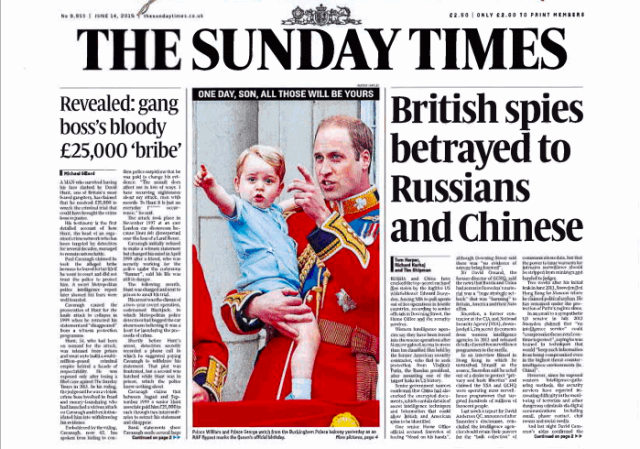
Sunday Times image from DMCA notice sent to First Look Media
The Sunday Times dropped a bombshell this weekend, reporting that the top secret files leaked by Edward Snowden have been obtained by the Russian and Chinese governments. The story claimed Western intelligence agencies were "forced into rescue operations" to mitigate the damage, and one UK government source claimed that Snowden had "blood on his hands."
It would be a major blow to Snowden and the journalists who worked with him—if it were true. But the bold claims started falling apart shortly after it was published this weekend.
The story is behind a paywall but available elsewhere. It's based entirely on anonymous British officials and contains some glaring inaccuracies.(no way!)
Snowden confidante Glenn Greenwald immediately attacked it as "journalism at its worst." Greenwald is a predictable critic, to be sure, but Times reporter Tom Harper was later questioned about his story on CNN and admitted he's been unable to check out any of the far-reaching claims told to him by government sources.The reporter answered one question after another with some version of "I don't know," admitting he has no idea how any "hack" took place, how or when any foreign governments got the files, or if the files were encrypted at all.
Harper simply maintained that the Snowden hacking story was the "official position of the British government."
that someone told usIf anything I'm disturbed by the speed at which you and the rest of the twitterverse are spreading information.
What is the purpose of making this announcement and who benefits from it?
and so now we have the reporter of the story basically admitting that he was the face for a government press releaseThe news reported this.This wasn't a government press conference
Back to our story
This morning, lawyers at Times Newspapers took a step to limit Greenwald's criticism, sending a notice telling The Intercept that Greenwald's story, which included a low-res image of the Times' front page, violates their copyright. The Intercept quickly published the takedown notice, and on Twitter Greenwald made clear that his publication won't be deleting his copy of the Times' "humiliating headline."
(guess they don't want he story out there too much now, what about all that free press)
The relevant portions of the copyright letter, from the legal department of Times Newspapers, reads:
We write on behalf of Times Newspapers Limited (TNL) the publisher of The Times and The Sunday Times. TNL owns the copyright in the typographical arrangement of the front page of The Sunday Times published on 14 June 2015 (Material). The Material is an original work created by employees of TNL. A copy of the Material is enclosed.
A copy of the Material appears at [link] under the headline: SUNDAY SNOWDEN STORY IS JOURNALISM AT ITS WORST—AND FILLED WITH FALSEHOODS (Infringing Content). The Infringing Content has been reproduced, communicated to the public and published onto the Website without permission and as such infringes the intellectual property rights of TNL. A copy of the Infringing Content is enclosed.
The "infringing" picture of The Sunday Times' front page, reproduced in part, above, doesn't have sufficient resolution to allow the article to be read. And Greenwald didn't reproduce the Times story in full, although considering how much he had to say about the piece, doing so would likely be well within his rights.
The Sunday Times legal department didn't respond to Ars' request for comment on the DMCA notice.
Errors and omissions
The Times' behavior since publication has become a perfect example of why outside criticism and fact-checking are so necessary. (indeed)The article's most glaring error, a statement that Greenwald's partner David Miranda visited Snowden in Moscow, was deleted without any notice. A Times spokesperson promised there will be a correction in this Sunday's edition.
Critics have pointed to numerous inconsistencies in the Sunday Times piece, including the fact that the piece misuses the terms "agents" and "officers," which have specific meanings in the context of British intelligence.
The story asserts that it isn't clear "whether Russia and China stole Snowden’s data, or whether he voluntarily handed over his secret documents." Of course, if Snowden handed over the documents willingly, it isn't clear why they would need to be "cracked" by foreign governments in the first place. Further, Snowden and the journalists working with him have stated he kept no files after handing them to journalists in Hong Kong.
The quote suggesting Snowden has "blood on his hands" is immediately followed by a statement noting that there was "no evidence of anyone being harmed." (that makes sense)
Other critics have suggested that the story's timing is no coincidence, having come just days after a 373-page report was published in the UK critical of the nation's terrorism laws. The report's author, David Anderson, called the current system "undemocratic, unnecessary, and in the long run, intolerable."
Carl Sagan famously said "extraordinary claims require extraordinary proof." Journalism isn't exempt. The Times has published a story that's evidence-free and raises questions about the practice of using anonymous sources as the sole foundation of reporting. Greenwald has lambasted the story as "pure stenography," a critique that the story's authors have not rebutted.
Lets say the story about the spying is completely and absolutely false. (and I don't believe that it is)we just getting started
I must break the story here to remind us all, when essentially asked why we should trust this story by trumac,
that someone told us
and so now we have the reporter of the story basically admitting that he was the face for a government press release
Back to our story
Whats that got to do with Snowden lying about his accounting of those documents?
Snowden told a lie????
I can't handle this right now
you mean the guy who has been accused of treason, the one on the run? may have lied about something?
what is this world coming to?

we just getting started with this story, which is starting to look like the most thinly veiled false flag character assassination piece in the history of propaganda, to be only fed to the foolest© of fools
I can't handle this right now
you mean the guy who has been accused of treason, the one on the run? may have lied about something?
what is this world coming to?
we just getting started with this story, which is starting to look like the most thinly veiled false flag character assassination piece in the history of propaganda, to be only fed to the foolest© of fools
Last edited:
@tmonster if you let western governments tell it, the world is a scary place with evolving and irrational enemies who are seemingly unstoppable unless we evolve and change our legal rights.
But when it comes to trade and economics, every country is a friend, all peoples want to work toghether.
Oochie walley or one mic?

Broke Wave
The GOAT
@tmonster im just arguing against the whole idea that if Snowdown exposed "national secrets" that somehow i should hate him and hes a traitor.
I havent evem begun to dig in to the absolutely nonsenical article and premise, in which I am to believe the "Russians and Chinese" hacked snowdens stash and now agents have to move around. - source : US government LMAO
The sunday times also ran the article " weapons in Iraq confirmed" im sure their credibility is untarnished however.
I havent evem begun to dig in to the absolutely nonsenical article and premise, in which I am to believe the "Russians and Chinese" hacked snowdens stash and now agents have to move around. - source : US government LMAO
The sunday times also ran the article " weapons in Iraq confirmed" im sure their credibility is untarnished however.
It makes the whole "we are so much less safe now" angle a lot less validLets say the story about the spying is completely and absolutely false. (and I don't believe that it is)
Whats that got to do with Snowden lying about his accounting of those documents?
And the way they have it set up is so perfect. "We cant tell you HOW we are less safe, but TRUST US.... just SIGN OVER YOUR RIGHTS so we can 'PROTECT' you"
Its a very important lie.Snowden told a lie????
I can't handle this right now
you mean the guy who has been accused of treason, the one of the run? may have lied about something?
what is this world coming to?
Did he, or did he not let foreign governments get access to those files?
Because he and greenwald LIED.
But NO ONE is talking about it.
It doesn't change anything IF the hypothetical is asserted....because Snowden and Greenwald already are being seen as lying about their handling of those documents.It makes the whole "we are so much less safe now" angle a lot less valid
And the way they have it set up is so perfect. "We cant tell you HOW we are less safe, but TRUST US.... just SIGN OVER YOUR RIGHTS so we can 'PROTECT' you"
Do you remember that a Hong Kong paper had published some of the first findings on the material???????? How the entire fukk did they get those documents?
Broke Wave
The GOAT
Noone is talking about it?Its a very important lie.
Did he, or did he not let foreign governments get access to those files?
Because he and greenwald LIED.
But NO ONE is talking about it.
Why?
Liberal media conspiracy?