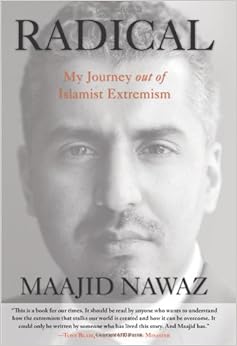
NAWAZ:
I've often commentated that satire, the lampooning and criticizing political thought and irony and indeed sarcasm, are concepts that are often lost on Islamists and jihadists and generally on religious fundamentalists and religious conservatives.
They insist on reading things in a vacuously literal way. When I was an Islamist, I would have seen blasphemy as anything that, on the face of it, looks like it's being disrespectful to my prophet, anything that on the face of it looks as if it's denigrating the stature of the prophet or in any way ridiculing him.
------------------------------------
NAWAZ: However, that's a very different conversation to the one we should be having in France because the real challenge for Muslims across the world and therefore, for wider society as well - because we all live together as we should - the real challenge is in being able to distinguish between a Muslim who holds sacred symbols to be dear to them and then, the second step, interprets a particular piece of political satire as indeed being a mockery of their sacred symbols.
And then going a third step there and saying, OK, I find this offensive, but you know what? You're not a Muslim, and I cannot oblige you. I cannot force you to adhere to my definition of mockery in the religion and into my interpretation that that particular cartoon is indeed mockery.
------------------------------------
GROSS: Preach to me. Like, pretend like I'm a potential recruit, and you're trying to get me. This is, like, years ago, and you're trying to get me to join your group.
NAWAZ: Yeah, so - but, you know, depending on the person you are, we would use any given number of approaches. We would say that there's a scriptural approach. If you're a particularly religious Muslim, we would argue from scripture. So in the case of - let's take an example of Charlie Hebdo. Scripturally, we would bring all of the passages that prohibit blasphemy and mockery of religion to rile you up and to then link it to the next point, once you're riled up and sufficiently emotional about it, to say, how are you going to stop this? You know, the religion obliges you to do something to stop the insult to your prophet. Well, you can't stop it unless you have the strength and the power of a caliphate to intimidate people from taking such action. So there would be a religious approach using scripture. To stick with the Charlie Hebdo example, there's also a - what we call a political approach. And that would be to argue that democracy is effectively hypocrisy, that freedom of speech is used selectively, only to bash Muslims. In fact, you know, they don't adhere to their own principles of freedom of speech when they want to. We would say - we would put out tropes, and they are tropes, such as how, you know, Holocaust denial is illegal in France. And therefore, you know, why are the Jews protected and Muslims aren't protected? And that point there in particular fails to distinguish between criticizing a philosophy and picking on a people. That would be the political approach. And again, there's a third approach, which is the intellectual approach. And here, we would - if we're speaking to somebody who's slightly more thoughtful, contemplative about things, we would have a philosophical discussion about freedom and its limits and why there's no such thing as real democracy. There's no such thing as real freedom. And philosophically, who has the right to set these parameters - and try and approach religion from a philosophical perspective. So there are different approaches we would use.
great interview:
http://www.npr.org/2015/01/15/377442344/how-orwells-animal-farm-led-a-radical-muslim-to-moderation





 :indicaumad: