Democracy Dies in Darkness
Food
One chef’s social experiment: Charge minorities $12, white people $30.
By Maura Judkis
March 2, 2018 at 2:00 PM
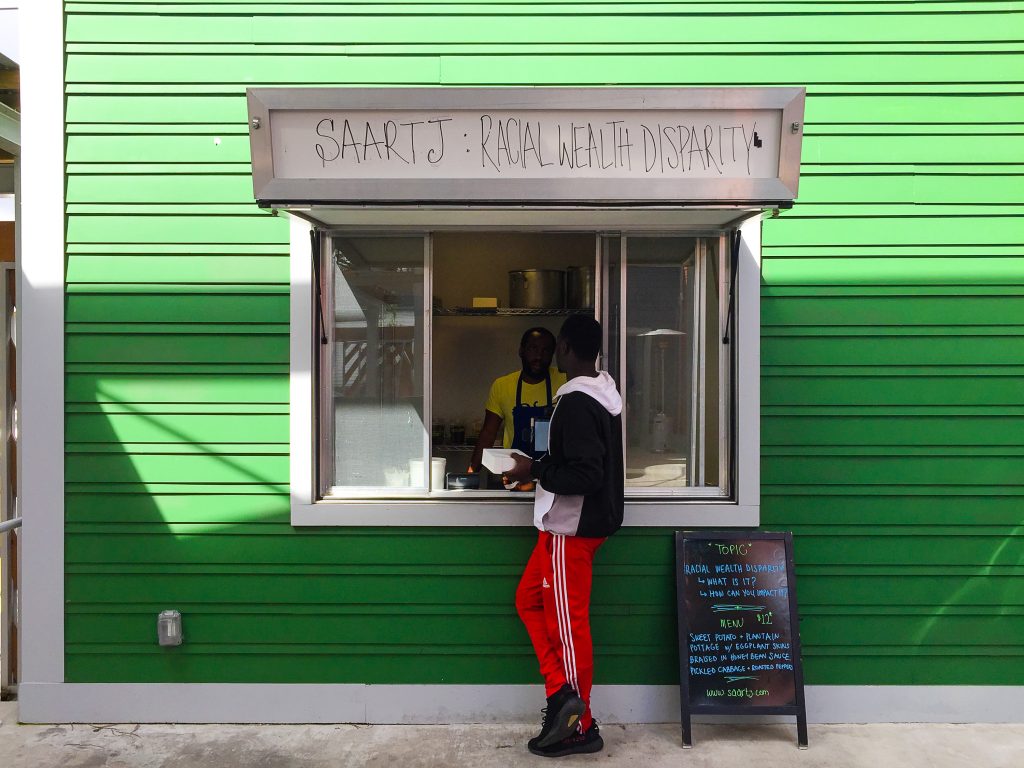
Tunde Wey’s lunch counter aims to address inequality. (Deji Osinulu/)
Approach Tunde Wey’s lunch counter/sociology experiment at the Roux Carre market in New Orleans, and — if you’re white — you’ll have a decision to make. And it’s not just whether you want to try his jollof rice or his fried plantains. Wey serves his Nigerian food with a lesson about racial wealth disparity: The median income among African American households in New Orleans is only $25,806, compared to $64,377 for white households. According to the Urban Institute, the national average wealth of white families is $919,000, while the average wealth of black families is $140,000. Wey will share some stats with his customers, and then he’ll tell them the price of their lunch.
If they’re a person of color, they pay $12. If they’re white, he’ll tell them they can either pay $12, or they can pay $30 — two and a half times the base price, which reflects the wealth disparity in New Orleans. He tells them the profits will be redistributed to people of color, but not as charity — just to any minority customers of his who want it, regardless of their income or circumstance.
“When I tell black folks what’s happening, 90 percent of them start laughing, like, ‘For real?’ They’re tickled,” he said. “White folks, there’s this blank — ” he paused and laughed, “— this blank look. They’re like, ‘Huh, okay.’”
Wey is familiar with that look. In 2016, he traveled across the country hosting a dinner series he called “Blackness in America.” He would cook a Nigerian feast for his guests and engage them in conversation about some of the most pervasive problems facing our country, such as racism, sexism and police brutality. Black guests found these discussions cathartic, while many white guests found them uncomfortable. “White folks or privileged folks are quick to try to find a solution, or ask for a solution, as opposed to sitting in the discomfort,” Wey told The Washington Post during one of the dinners.
Related: [Discomfort food: Using dinners to talk about race, violence, and America]
The lunch counter, Saartj, is named after Saartjie Baartman, a South African woman who was put on display in the early 1800s in Europe because of her large buttocks, and given the nickname “the Hottentot Venus.” When Wey devised the project in New Orleans, he wanted to study people’s reactions to it, so he enlisted a student from Tulane University to devise an exit interview that would help him understand why people decided to pay the amount that they chose. After the price reveal, the conversation would typically take one of several established paths. People of color, who were asked if they wanted their money back after the conclusion of the experiment on March 4, typically said no — many said it should go to someone who needed it more than them. Some black people tried to also pay the $30, saying that because they could afford it, they felt obligated to pay the higher price. (Wey would accept only $12 from people of color.) In the end, when Wey totals up the profits, he expects the customers who opted to receive money will get about $75 each. He says he is not keeping any profit for himself.
As for white customers: A handful of them immediately canceled the transaction and walked away. The remainder were faced with “this awkward moment where they have to make a choice” — and, importantly, they had to make that choice in front of Wey.
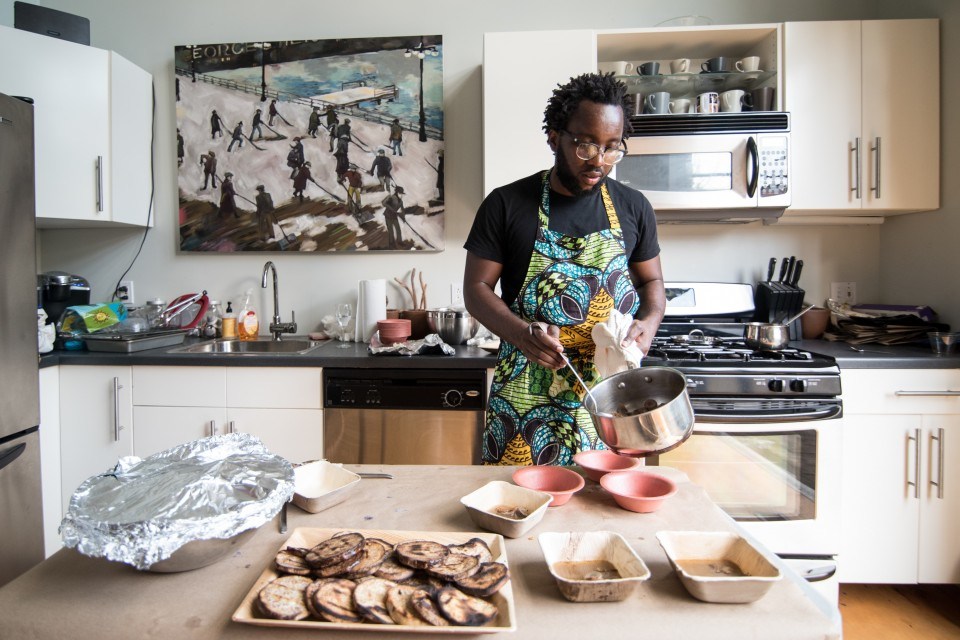
Nigerian chef Tunde Wey prepares pepper soup for one of his “Blackness in America” dinners, in Pittsburgh. (Dixie D. Vereen for The Washington Post)
Initially, he expected that few white people would pay the $30.
“I thought, if given the chance to voluntarily give up privilege, folks would not because it is not in their interest,” he said. But he was wrong: So far, more than 80 percent of white customers have opted to pay the higher price, and Wey realized that he had been underestimating the power of social pressure.
“If I created the framework where I outline a problem that is indisputable, and I position you as an antagonist, and I give you a way to solve the problem tidily and be the hero — in the moment, anything other than the $30 choice becomes antisocial behavior,” he said. Social pressure also explained why the handful of white people who decided to pay the $12 did so with apologies, trying to justify their choice. “That explained to me why the folks who refused to pay the $30 were equivocating, because they understood that they were participating in antisocial behavior.”
Wey’s experience aligns with research on what is — in a way — another form of wealth redistribution: tipping. We’re not legally required to tip at a restaurant, and unless we’re regulars at a particular place, it’s unlikely that we’ll see the same server twice, so it doesn’t incentivize better service in the future for us, individually. Studies have found that social pressures and stigmas are what makes people compelled to tip, even in scenarios when there would be no consequences if they decided not to. Economists have found that people tip to “feel positive feelings like pride or avoid negative feelings like guilt,” and “receive social approval/status or avoid social disapproval.” Tipping, they found, is also a way to exercise power over a server.
Would the white people who paid $30 have made the same choice if they were presented with the same scenario by, instead of Wey’s smiling black face, a white woman? Or an automated kiosk? Wey can’t say. “They could be more dismissive, they could be more openly resentful, but still pay the $30,” he said.
While some people have been hostile, the majority have been willing to engage with him on the topic. He and his researcher have had conversations with many of the customers about the privileges, or lack thereof, that have informed their life decisions. The consequences of racial wealth disparity were perfectly illustrated, he said, by two men who came to buy lunch one day, one right after another. The first man, who was black, was from a rougher neighborhood, but had gone to a well-to-do high school one neighborhood over. He told Wey about how he was a good student and got into a prestigious university, along with his classmates who didn’t have grades as good as his. Other students’ parents paid for them to attend the university, but “he only got half-funded, so he had to go to a less prestigious school, which impacted him and the generation of folks to come after him,” said Wey. Next in line was a white man who gladly paid the $30. When Wey talked to that man about his education, he said that he had gone to a prestigious school because his father gave him a loan, and that he had the well-paying job he has now because of that university.
“Decisive moments in these individuals’ lives changed their direction — the idea of what their trajectories would be,” said Wey. “That was an example for me of what wealth looks like. It doesn’t look like magical benevolent gifts. … That sort of ordinary intervention has repercussions across generations, across lives.”
Though Wey’s lunch counter is only temporary, he says that people who want to use food to address racial wealth disparity can do so by patronizing minority-owned restaurants, because minority businesses are more likely to hire other minorities.
“It takes more than that to change things. We also have to change things on a policy level,” he said. But “It’s a good place to start, for