
Climate summit’s pledges on carbon cuts ‘won’t avert global disaster’
Government targets leave emission levels too high to prevent a big temperature rise, warns team of experts led by economist Nicholas Stern
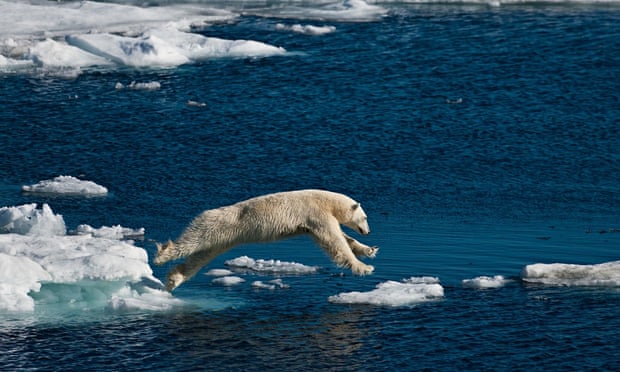
Melting of the tundra at the polar ice cap would release more methane and other greenhouse gases. Photograph: Paul Goldstein/Exodus/Rex
Pledges at this year’s climate summit to cut carbon emissions are likely to fall far short of the targets needed to avoid heating the planet by more than 2C. That is the stark conclusion of a report by a team led by British economist Nicholas Stern.
The group, based at the Grantham Research Institute on Climate Change at the London School of Economics, concludes that action planned by countries – in particular the European Union, the US and China – will still leave the world emitting 10bn tonnes of carbon a year in excess of levels needed to prevent global warming from having devastating consequences.
“Intended national contributions will not be consistent with the international goal of limiting the rise in global mean surface temperature to no more than 2C,” states the report, whose publication follows Saturday’s climate action march in London which organisers say was attended by 20,000 people.
Scientists say 2C is the maximum increase in temperature the world can tolerate without risking environmental mayhem – which could include rises in sea level, melting of the ice caps, drought in Africa, America and Asia, storms and ocean acidification. Loss of ice caps would lead to less solar energy being reflected back into space, while thawing tundra would release more methane and other greenhouse gases currently frozen in polar regions . Both processes could lead to even greater temperature rises.
The UN Framework Convention on Climate Change is to hold talks in Paris at the end of 2015 in an attempt to get nations – particularly in the developed world – to agree to binding reductions in emissions of carbon dioxide and other greenhouse gases. This would be achieved by closing fossil-fuel power stations, building renewable energy plants and improving energy efficiency in homes and factories.
The EU, US and China – which, combined, emit the most carbon – have all indicated the likely pledges they intend to give in Paris towards cutting emissions so that by 2030 global temperatures will be limited to no more than 2C above pre-industrial levels. In carrying out their analysis, the group split countries into two groups: one including the EU, the US and China, the other made up the remaining nations. The EU has proposed cutting its carbon emissions by 40% of 1990 levels by 2030, while the US has announced that it intends to cut emissions by 26%-28% of 2005 levels by 2025. At the same time China has said it plans to stop its emissions rising beyond 2030.
The group worked out how much carbon the EU, US and China – if they keep their promises – would then be putting into the atmosphere by 2030 and concluded that they would, in total, be emitting 21-22bn tonnes a year. By contrast, the rest of the world – which includes growing economies such as Brazil and India – are likely to be emitting around 34bn tonnes, according to figures supplied by the International Energy Agency. In total, this gives a likely carbon emissions output of 55-56bn tonnes a year by 2030.
However, the maximum emissions target that has a reasonable chance of curtailing temperatures at 2C has been calculated as having a median value of about 36bn tonnes. In short, the world will still be emitting far too much carbon – an excess of some 20bn tonnes a year – to give the planet a reasonable chance of holding back the heat to a manageable level.
The authors conclude three courses of action must now be followed to rectify the dangerous gap they have uncovered:
■ Nations should work even harder over the next few months to improve emission pledges at Paris.
■ Investment should be increased in innovation aimed at improving renewable clean energy generation.
■ A mechanism should be created for countries to review and improve their emission reductions in future years.
They say: “The period following the summit in Paris in December 2015 will be crucial, not just to bridge the gap between aggregate intentions and the goal by 2030, but also to lay foundations for even greater action after 2030.”
http://www.theguardian.com/environm...mmit-pledge-fail-carbon-cuts-temperature-rise


 .
.
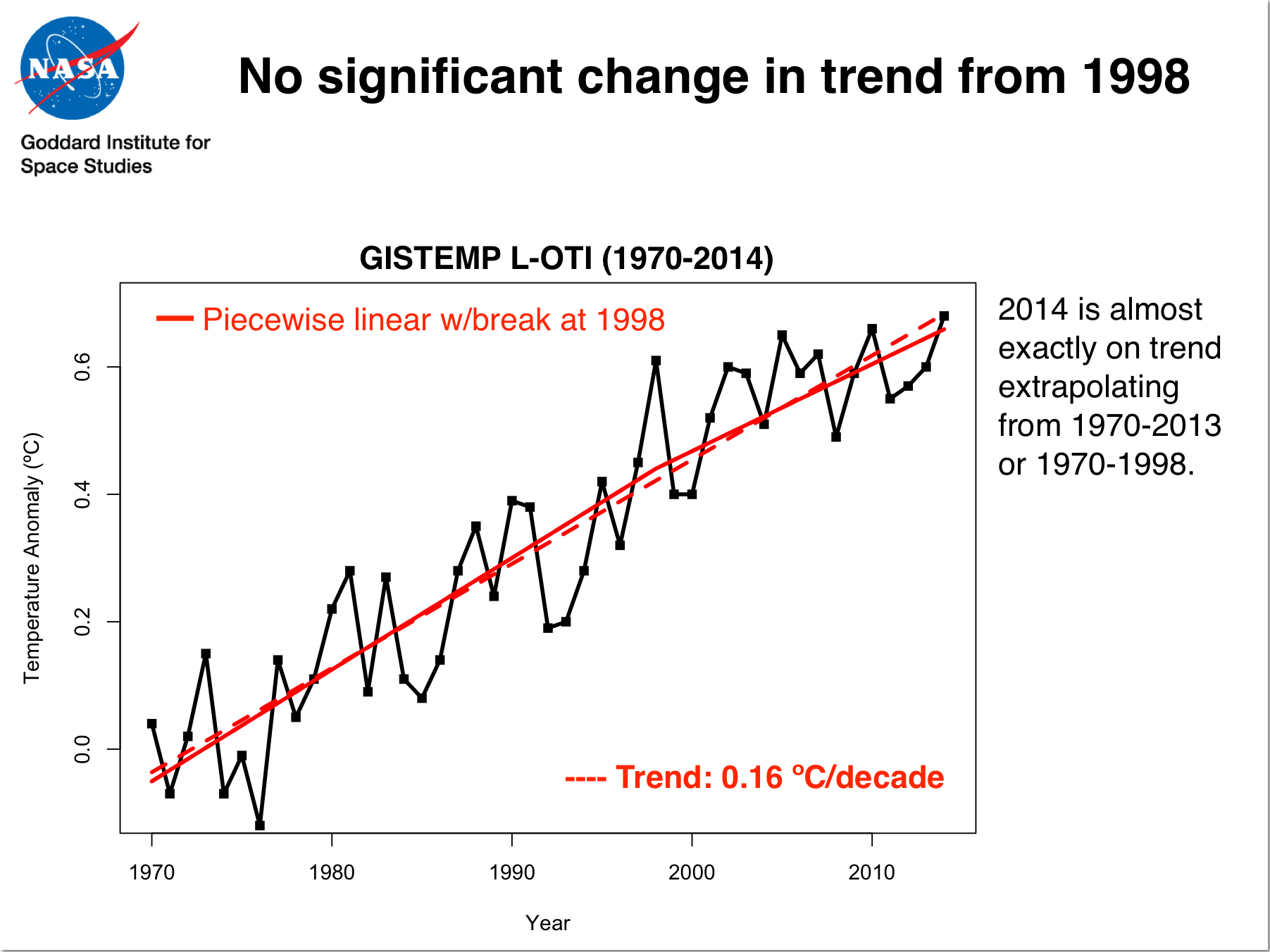

 progress in combatting climate change needs to be significantly faster than it is or we are even more fukked