

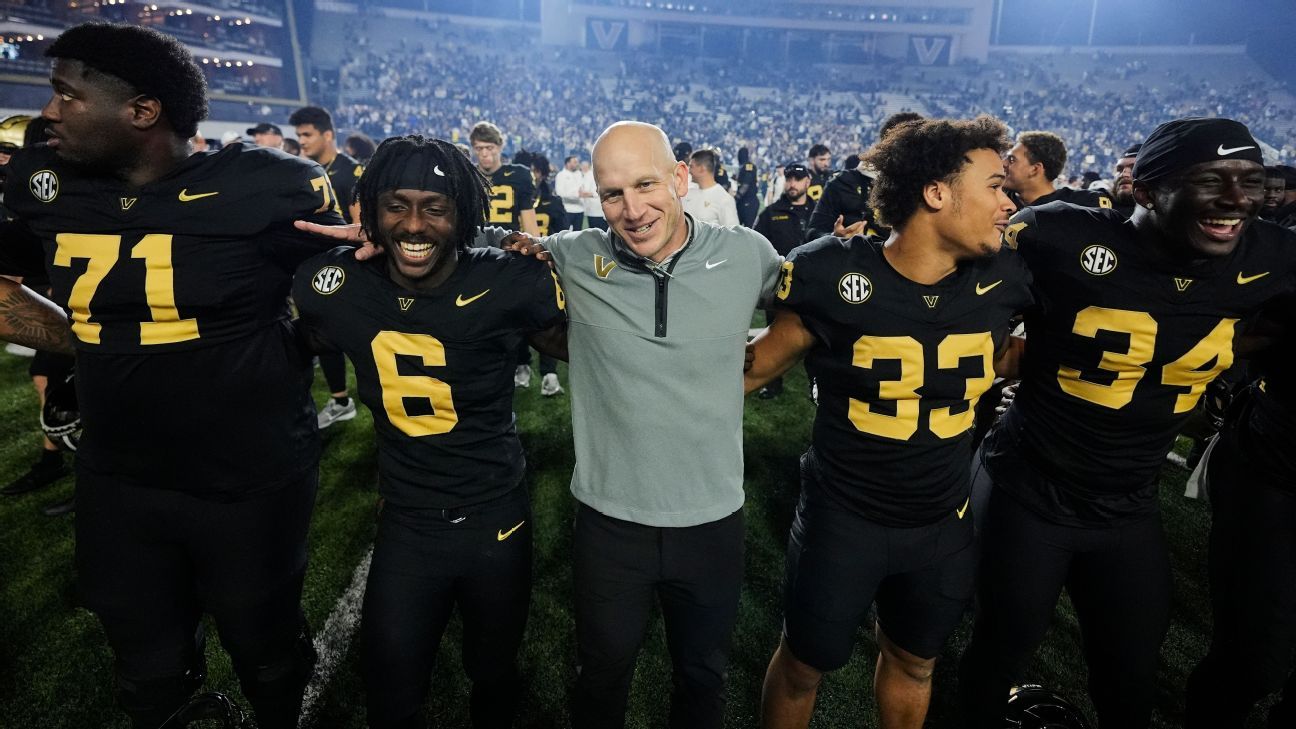
But Lea had been thinking about a new approach, something he had floated in bits and pieces to his athletic director, Candice Storey Lee. If Bama and Georgia could spend big on their third-stringers, couldn't Vandy pay those same guys to be starters?
It's an idea that has caught on at places like Indiana, Texas Tech and Virginia -- all afterthoughts a few years ago but now on the doorstep of the College Football Playoff. The new era of college football -- NIL, revenue sharing, the transfer portal, player empowerment -- has changed the landscape and allowed every team in the country an opportunity to get into the game, as long as the program is willing to ante up.
At Vandy, it began in that miserable December meeting. Lea found Storey Lee later and issued something of an ultimatum.
"All of this was snowballing," Lea said. "If we don't find $3 million by the time we got to winter of '24, we weren't going to have a program."
Storey Lee wasn't surprised by the request. In fact, she fully supported it. Lea's appeal was clear, concise and reasoned. The rest of Lea's formula didn't need to change, Storey Lee said. The culture would still underpin the entire program. But if he could persuade everyone else at Vandy to aim higher, spend more and get behind a new, audacious plan, Vandy really could become the best program in the country.
Storey Lee had already been laying the groundwork with donors for a few years, and within a week, she had $6 million for her football coach.
"He decided to take a bit of a leap," Storey Lee said. "In order for him to meet the vision, we had to unhook from some of the things that had been tried and true before."
In the old days, said Duke coach Manny Diaz, coaches were limited by all sorts of factors outside their orbit -- geography, history, facilities, budgets. Now, most of those barriers have crumbled, and with enough cash -- like the reported $8 million Duke is paying star QB Darian Mensah -- it's possible to lure talent just about anywhere.
"Retention and acquisition is now all controllable," Diaz said.
So the money is flowing. At Texas Tech, a program that hadn't finished a season in the AP Top 25 since 2009, a nearly $30 million roster has changed everything and has the Red Raiders atop the Big 12. Virginia, Duke and other low-profile football programs have followed suit, albeit to a lesser degree.
Georgia coach Kirby Smart compared talent distribution to sand. For a long time, it stacked up in massive dunes. Now, it has spread -- though not quite evenly -- across the whole beach.
While the new era of college football can only open more windows, it's up to a program to figure the rest out.
"I think it does reset the market a little bit where schools can look at what's happened here or Vanderbilt or other schools that haven't had much success and think, 'Hey, we can get there as well,'" Dolson said. "The tough part is, not everyone can win."
 www.espn.com
It's an idea that has caught on at places like Indiana, Texas Tech and Virginia -- all afterthoughts a few years ago but now on the doorstep of the College Football Playoff. The new era of college football -- NIL, revenue sharing, the transfer portal, player empowerment -- has changed the landscape and allowed every team in the country an opportunity to get into the game, as long as the program is willing to ante up.
At Vandy, it began in that miserable December meeting. Lea found Storey Lee later and issued something of an ultimatum.
"All of this was snowballing," Lea said. "If we don't find $3 million by the time we got to winter of '24, we weren't going to have a program."
Storey Lee wasn't surprised by the request. In fact, she fully supported it. Lea's appeal was clear, concise and reasoned. The rest of Lea's formula didn't need to change, Storey Lee said. The culture would still underpin the entire program. But if he could persuade everyone else at Vandy to aim higher, spend more and get behind a new, audacious plan, Vandy really could become the best program in the country.
Storey Lee had already been laying the groundwork with donors for a few years, and within a week, she had $6 million for her football coach.
"He decided to take a bit of a leap," Storey Lee said. "In order for him to meet the vision, we had to unhook from some of the things that had been tried and true before."
In the old days, said Duke coach Manny Diaz, coaches were limited by all sorts of factors outside their orbit -- geography, history, facilities, budgets. Now, most of those barriers have crumbled, and with enough cash -- like the reported $8 million Duke is paying star QB Darian Mensah -- it's possible to lure talent just about anywhere.
"Retention and acquisition is now all controllable," Diaz said.
So the money is flowing. At Texas Tech, a program that hadn't finished a season in the AP Top 25 since 2009, a nearly $30 million roster has changed everything and has the Red Raiders atop the Big 12. Virginia, Duke and other low-profile football programs have followed suit, albeit to a lesser degree.
Georgia coach Kirby Smart compared talent distribution to sand. For a long time, it stacked up in massive dunes. Now, it has spread -- though not quite evenly -- across the whole beach.
While the new era of college football can only open more windows, it's up to a program to figure the rest out.
"I think it does reset the market a little bit where schools can look at what's happened here or Vanderbilt or other schools that haven't had much success and think, 'Hey, we can get there as well,'" Dolson said. "The tough part is, not everyone can win."
'Not everyone can win': Are CFB's blue bloods really losing their grip on the sport?
With NIL, revenue sharing, the transfer portal and player empowerment, CFB's landscape is changing.