Two Architects of Broken Windows Policing Go On the Defensive
William Bratton and George Kelling say the critics just don't understand.
Jason Allen / Flickr
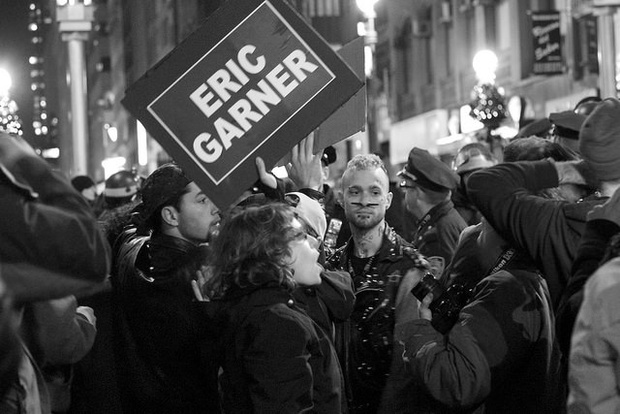
Few city-related topics have generated as much debate in 2014 as broken windows policing. New York has played host to this discussion, especially in the aftermath of the over-aggressive arrest that led to Eric Garner's terrible death, but the whole country has taken part. Critics suggest the broken windows approach—which holds that stopping petty crimes ultimately deters big ones—
is broken itself: unfairly targeting minorities, destroying community trust in police, and arguably doing
more harm to the city than good.
Two architects of broken windows policy
come to its defense in the Winter 2015 issue of
City Journal, a quarterly from the Manhattan Institute. NYPD Commissioner William Bratton, who's been using a broken windows strategy in major U.S. cities for decades, and criminal justice scholar George Kelling, who (along with James Q. Wilson) popularized the concept in a
1982 issue of
The Atlantic, counter their critics point by point. In hopes of a sharper public discourse, we summarize some of their key arguments below, then raise additional challenges.
Broken windows is not stop-and-frisk. Bratton and Kelling argue that these two policing approaches have been wrongly conflated in the public mind. Stop-and-frisk—the widely condemned practice that New York has dialed back significantly—is based on a "reasonable suspicion" of criminal activity, leaving lots of room for officer interpretation, and thus abuse. In contrast, they say, broken windows policing directly addresses illegal behavior in action.
Most people want to stop minor offenses. Bratton and Kelling also argue, based on their experience in "countless" public meetings, that locals consider it extremely important to stop the types of small-scale disorderly conduct at the heart of broken windows policing (from graffiti to litter to public drug use). They point to an
August 2014 poll, conducted in the wake of Garner's death, which found that a majority of New York voters want police to enforce quality-of-life offenses. That support was true not only of whites (61-33) but also blacks (56-37) and Hispanics (64-34).
published in Science, found similar results: people stole an envelope of cash placed near a mailbox significantly more often when it was surrounded by litter and graffiti than when it wasn't.
Broken windows doesn't lead to over-incarceration or excessive force. Here Bratton and Kelling bring several trends to their side. They note that the New York City jail population has declined 45 percent since 1992, and that fewer than 10 percent of misdemeanor arrestees receive jail sentences. They also note that force was used less than 2 percent of the time during misdemeanor arrests in the first half of 2014, and that it wasn't used at all during this period in the 321 arrests for untaxed cigarettes—which was Garner's offense.
Disorder is not a victimless crime. Broken windows critics often contend that public disorder doesn't harm anyone, and therefore should be left alone. Bratton and Kelling disagree. Subway fare evasion is a minor offense, for instance, but it erodes the city's ability to provide strong mobility and job access—and besides, they argue, three of four evaders are issued summonses rather than arrested. So even if quality-of-life crimes don't have a clear victim, they have a serious impact on "the way people feel about their homes, their safety, and their general well-being."
• • • • •
Bratton and Kelling are as expert as it gets on the subject of broken windows policing, and many of their points in its defense are very well taken. But they do themselves a disservice by taking a dismissive tone; at one point they huff at "ivory-tower studies … treated with reverence by the media," a rather odd shot coming from a think tank journal. And their conclusion that broken windows policing is directly responsible for the high quality of life in New York City today also feels like a stretch in light of all the evidence:
Crime has been plummeting for two decades. … Tourism is booming. Public spaces are safe. Property values have escalated. It's a good place to live and work. Lawlessness no longer characterizes the subway system. These conditions didn't just happen. They resulted from thousands of police interventions on the street, which restored order and civility across the five boroughs.
Of course, reduced crime is very high among the reasons why New York City is a great place today. But the specific role played by broken windows in that reduction remains in question.
For one thing, crime has fallen
everywhere in recent years. A
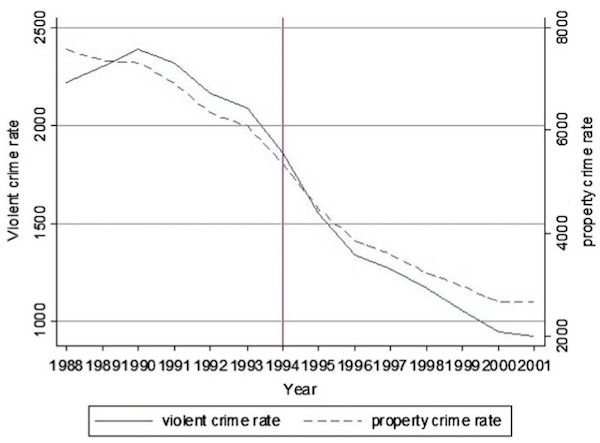
2004 study on policing by the National Academy of Sciences failed to find strong evidence that "enforcement strategies (primarily arrest) applied broadly against offenders committing minor offenses lead to reductions in serious crime." Even in New York the case isn't cut and dry; one recent study, done by New York University sociologist David Greenberg, re-analyzed city crime numbers from 1988 to 2001 and found a
clear downward trend that began well before 1994:
Justice Quarterly
In other words, it's not clear whether declines in city (and New York City) crime are the result of broken windows policing, or whether order and civility were restored by other broad social trends. (Popular alternative explanations include the waning urban crack epidemic, or decreased toxic lead exposure, or more community-based police tactics.) And many of the other points made by Bratton and Kelling require additional scrutiny or context.
Stop-and-frisk may be distinct from (and more pernicious than) broken windows policing, for instance, but it remains a logical extension. Most New Yorkers may approve of public order (who wouldn't?), but they also disapprove of the type of aggression that led to Eric Garner's death, with 68 percent of those polled in August saying there was no excuse for police behavior in that case. Broken windows policing may not always lead to excessive force, but the fact that it has done so at all—in
several recent instances aside from Garner—shows something about the policy itself is, at the very least, fractured.
And even assuming broken windows does work—again, a leap beyond much of the evidence—any benefits must be weighed against the policy's divisiveness. Justin Peters
recently argued in
Slate that broken windows is rooted in racism, noting that Kelling and Wilson initially offered no answer to the question of how police using the approach can avoid being "agents of neighborhood bigotry." Writing today in the
Boston Globe, columnist Derrick Jackson suggests that black people
themselves have become the broken windows that a neighborhood must clean up, the very color of their skin a
"primary offense."
Tina Leggio / Flickr
So if broken windows policing is sound in theory, or even if it's effective at times in practice, plenty of questions remain as to how it's being applied on city streets. That's not the same as calling for broken windows to end—and for sure, it's not much help to criticize an existing approach
without offering ideasfor a new one (though
these ideas do exist). But it does suggest something has to change for the police to "strengthen their relationships with citizens, civic organizations, and communities," as Bratton and Kelling say the NYPD must.
Because such a bond should seem very far off the way things stand now. To critics and honest supporters alike.
http://www.citylab.com/crime/2014/1...-windows-policing-go-on-the-defensive/384080/







 . What's funny is, I bet she is!
 dealing with stress.
 they did it again