
loyola llothta
☭☭☭
Did you know that the US State Department held secret meetings with Jack Dorsey trying to get him to buy Zunzuneo, a Cuban Twitter-style app they made for regime change?
Last edited:

Did you know that the US State Department held secret meetings with Jack Dorsey trying to get him to buy Zunzuneo, a Cuban Twitter-style app they made for regime change?
14 July 2021
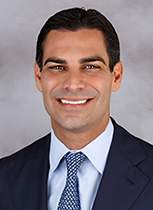
Miami Mayor Says the US Should Consider Bombing Cuba
Mayor Francis Suarez said military options need to be 'discussed'
By Dave DeCamp
In the wake of anti-government demonstrations in Cuba, many US officials are calling for Washington to intervene. The mayor of Miami has gone as far to suggest that the US should consider bombing Cuba.
link: Miami Mayor Says the US Should Consider Bombing Cuba - News From Antiwar.com

Yet its users were neither aware it was created by a U.S. agency with ties to the State Department, nor that American contractors were gathering personal data about them, in the hope that the information might be used someday for political purposes.
It is unclear whether the scheme was legal under U.S. law, which requires written authorization of covert action by the president and congressional notification. Officials at the USAID would not say who had approved the program or whether the White House was aware of it. The Cuban government declined a request for comment.
USAID Administrator Rajiv Shah said Thursday that it was not a covert program, though “parts of it were done discreetly” in order to protect the people involved. Shah said on MSNBC that a study by the U.S. Government Accountability Office found the project to be consistent with the law.
“This is simply not a covert effort in any regard,” he said.
Congressional investigators were asked by John Kerry, then chairman of the Senate Foreign Relations Committee and now secretary of state, to examine whether or not U.S. democracy promotion programs in Cuba were operated according to U.S. laws, among other issues. The report released by GAO in January 2013 does not examine whether or not the programs were covert. It does not say that any U.S. laws were broken.
The report does not refer to the project, dubbed ZunZuneo, but does note that USAID programs included “support for the development of independent social networking platforms.”
White House spokesman Jay Carney echoed Shah’s statement and said he was not aware of individuals in the White House who were aware of the program. Carney also said President Barack Obama does support efforts to expand communications in Cuba.
At minimum, details uncovered by the AP appear to muddy the U.S. Agency for International Development’s longstanding claims that it does not conduct covert actions, and the details could undermine the agency’s mission to deliver aid to the world’s poor and vulnerable — an effort that requires the trust and cooperation of foreign governments.
Sen. Patrick Leahy, D-Vt., and chairman of the Appropriations Committee’s State Department and Foreign Operations Subcommittee, called the program “dumb, dumb, dumb” on Thursday and said he was not aware of the effort.
“And if I had been, I would have said, ‘What in heaven’s name are you thinking?’” Leahy said on MSNBC. “If you’re going to do a covert operation like this for a regime change, assuming it ever makes any sense, it’s not something that should be done through USAID.”
The Republican chairman of a House oversight panel said it would be looking into the project.
“That is not what USAID should be doing,” said Rep. Jason Chaffetz, R-Utah, chairman of the House Oversight and Government Reform National Security Subcommittee. “USAID is flying the American flag and should be recognized around the globe as an honest broker of doing good. If they start participating in covert, subversive activities, the credibility of the United States is diminished.”
But several other lawmakers voiced their support for ZunZuneo, which is slang for a Cuban hummingbird’s tweet. Sen. Bob Menendez, D-N.J., chairman of the Senate Foreign Relations Committee, said USAID should be applauded for giving people in Cuba a platform to talk to each other.
“The whole purpose of our democracy programs, whether it be in Cuba or other parts of the world, is in part to create a free flow of information in closed societies,” Menendez said.
USAID and its contractors went to extensive lengths to conceal Washington’s ties to the project, according to interviews and documents obtained by the AP. They set up front companies in Spain and the Cayman Islands to hide the money trail, and recruited CEOs without telling them they would be working on a U.S. taxpayer-funded project.
“There will be absolutely no mention of United States government involvement,” according to a 2010 memo from Mobile Accord Inc., one of the project’s creators. “This is absolutely crucial for the long-term success of the service and to ensure the success of the Mission.”
ZunZuneo was publicly launched shortly after the 2009 arrest in Cuba of American contractor Alan Gross. He was imprisoned after traveling repeatedly to the country on a separate, clandestine USAID mission to expand Internet access using sensitive technology that only governments use.
USAID said in a statement that it is “proud of its work in Cuba to provide basic humanitarian assistance, promote human rights and fundamental freedoms, and to help information flow more freely to the Cuban people,” whom it said “have lived under an authoritarian regime” for 50 years. The agency said its work was found to be “consistent with U.S. law.”
The AP obtained more than 1,000 pages of documents about the project’s development. It independently verified the project’s scope and details in the documents through publicly available databases, government sources and interviews with those involved in ZunZuneo.
ZunZuneo would seem to be a throwback from Cold War, and the decades-long struggle between the United States and Cuba. It came at a time when the historically sour relationship between the countries had improved, at least marginally, and Cuba had made tentative steps toward a more market-based economy.
The social media project began development in 2009 after Washington-based Creative Associates International obtained a half-million Cuban cellphone numbers. It was unclear to the AP how the numbers were obtained, although documents indicate they were done so illicitly from a key source inside the country’s state-run provider. Project organizers used those numbers to start a subscriber base.
ZunZuneo’s organizers wanted the social network to grow slowly to avoid detection by the Cuban government. Eventually, documents and interviews reveal, they hoped the network would reach critical mass so that dissidents could organize “smart mobs” — mass gatherings called at a moment’s notice — that could trigger political demonstrations, or “renegotiate the balance of power between the state and society.”
The Cuban government has a tight grip on information, and the country’s leaders view the Internet as a “wild colt” that “should be tamed.” ZunZuneo’s leaders planned to push Cuba “out of a stalemate through tactical and temporary initiatives, and get the transition process going again toward democratic change.”
At a 2011 speech at George Washington University, Secretary of State Hillary Rodham Clinton said the U.S. helps people in “oppressive Internet environments get around filters.” Noting Tunisia’s role in the Arab Spring, she said people used technology to help “fuel a movement that led to revolutionary change.”
Suzanne Hall, then a State Department official working on Clinton’s social media efforts, helped spearhead an attempt to get Twitter founder Jack Dorsey to take over the ZunZuneo project. Dorsey declined to comment.
The estimated $1.6 million spent on ZunZuneo was publicly earmarked for an unspecified project in Pakistan, public government data show, but those documents don’t reveal where the funds were actually spent.
ZunZuneo’s organizers worked hard to create a network that looked like a legitimate business, including the creation of a companion website — and marketing campaign — so users could subscribe and send their own text messages to groups of their choice.
“Mock ad banners will give it the appearance of a commercial enterprise,” one written proposal obtained by the AP said. Behind the scenes, ZunZuneo’s computers were also storing and analyzing subscribers’ messages and other demographic information, including gender, age, “receptiveness” and “political tendencies.” USAID believed the demographics on dissent could help it target its other Cuba programs and “maximize our possibilities to extend our reach.”.
“It was such a marvelous thing,” said Ernesto Guerra, a Cuban user who never suspected his beloved network had ties to Washington.
“How was I supposed to realize that?” Guerra asked in an interview in Havana. “It’s not like there was a sign saying, ‘Welcome to ZunZuneo, brought to you by USAID.’”
Executives set up a corporation in Spain and an operating company in the Cayman Islands — a well-known British offshore tax haven — to pay the company’s bills so the “money trail will not trace back to America,” a strategy memo said. That would have been a catastrophic blow, they concluded, because it would undermine the service’s credibility with subscribers and get shut down by the Cuban government.
Similarly, subscribers’ messages were funneled through two other countries — but never through American-based computer servers.
Denver-based Mobile Accord considered at least a dozen candidates to head the European front company. One candidate, Francoise de Valera, told the AP she was told nothing about Cuba or U.S. involvement.
James Eberhard, Mobile Accord’s CEO and a key player in the project’s development, declined to comment. Creative Associates referred questions to USAID.
For more than two years, ZunZuneo grew and reached at least 40,000 subscribers. But documents reveal the team found evidence Cuban officials tried to trace the text messages and break into the ZunZuneo system. USAID told the AP that ZunZuneo stopped in September 2012 when a government grant ended.
ZunZuneo vanished abruptly in 2012, and the Communist Party remains in power — with no Cuban Spring on the horizon.
“The moment when ZunZuneo disappeared, (it) was like a vacuum,” said Guerra, the ZunZuneo user. “In the end, we never learned what happened. We never learned where it came from.”
Wow. The @nytimes has gone back and quietly stealth edited its original story on the protests in Cuba to boost the numbers. So the story changes from "hundreds" nationwide to "thousands" in one small town alone!


2:49 PM · Jul 17, 2021
High-ranking communist officials in Cuba should be given an ultimatum now: Either immediately assist in the transition of government away from communism or be prosecuted and executed thereafter #SOSCuba
10:02 PM · Jul 11, 2021
Streamed live on Jul 15, 2021
Host Mnar Adley is joined by Grayzone assistant editor and journalist Ben Norton and MintPress senior staff writer Alan Macleod to talk Cuba protests and what you need to know.

As many have reported, the protests, which started on Sunday in the town of San Antonio de los Baños in the west of the island, were led and vocally supported by artists and musicians, particularly from its vibrant hip-hop scene.
“For those new to the issue of Cuba, the protests we are witnessing were started by artists, not politicians. This song ‘Patria y Vida’ powerfully explains how young Cubans feel. And its release was so impactful, you will go to jail if caught playing it in Cuba,” said Florida Senator Marco Rubio, referencing a track by rapper Yotuel.
Both NPR and The New York Times published in-depth features about the song and how it was galvanizing the movement. “The Hip-Hop Song That’s Driving Cuba’s Unprecedented Protests,” ran NPR’s headline. Yotuel himself led a sympathy demonstration in Miami.
But what these accounts did not mention was the remarkable extent to which Cuban rappers like Yotuel have been recruited by the American government in order to sow discontent in the Caribbean nation. The latest grant publications of the National Endowment for Democracy (NED) — an organization established by the Reagan administration as a front group for the CIA — show that Washington is trying to infiltrate the Cuban arts scene in order to bring about regime change. “A lot of what we do today was done covertly 25 years ago by the CIA,” NED co-founder Allen Weinstein once told The Washington Post.
For instance, one project, entitled “Empowering Cuban Hip-Hop Artists as Leaders in Society,” states that its goal is to “promote citizen participation and social change,” and to “raise awareness about the role hip-hop artists have in strengthening democracy in the region.” Another, called “Promoting Freedom of Expression in Cuba through the Arts,” claims it is helping local artists on projects related to “democracy, human rights, and historical memory,” and to help “increase awareness about the Cuban reality.” This “reality,” as President Joe Biden himself statedthis week, is that the Cuban government is an “authoritarian regime” that has meted out “decades of repression” while leaders only “enrich themselves.”
Other operations the NED is currently funding include enhancing Cuban civil society’s ability to “propose political alternatives” and to “transition to democracy.” The agency never divulges with whom it works inside Cuba, nor any more information beyond a couple of anodyne blurbs, leaving Cubans to wonder whether any group even vaguely challenging political or societal norms is secretly bankrolled by Washington.
“The State Department, the U.S. Agency for International Development, and the U.S. Agency for Global Media have all financed programs to support Cuban artists, journalists, bloggers and musicians,” Tracey Eaton, a journalist who runs The Cuba Money Project, told MintPress. “It’s impossible to say how many U.S. tax dollars have gone toward these programs over the years because details of many projects are kept secret,” he added.
A currently active grant offer from the NED’s sister organization, USAID, is offering $2 million worth of funding to groups that use culture to bring about social change in Cuba. Applicants have until July 30 to ask for up to $1 million each. The announcement itself references Yotuel’s song, noting, “Artists and musicians have taken to the streets to protest government repression, producing anthems such as ‘Patria y Vida,’ which has not only brought greater global awareness to the plight of the Cuban people but also served as a rallying cry for change on the island.”
The hip-hop scene in particular has long been a target for American agencies like the NED and USAID. Gaining popularity in the late 1990s, local rappers had a considerable impact on society, helping bring to the fore many previously under-discussed topics. The U.S. saw their biting critiques of racism as a wedge they could exploit, and attempted to recruit them into their ranks, although it is far from clear how far they got in this endeavor, as few in the rap community wanted to be part of such an operation.
The graphic below shows how much money various artists have received from the US government. Credit | Cuba Money Project
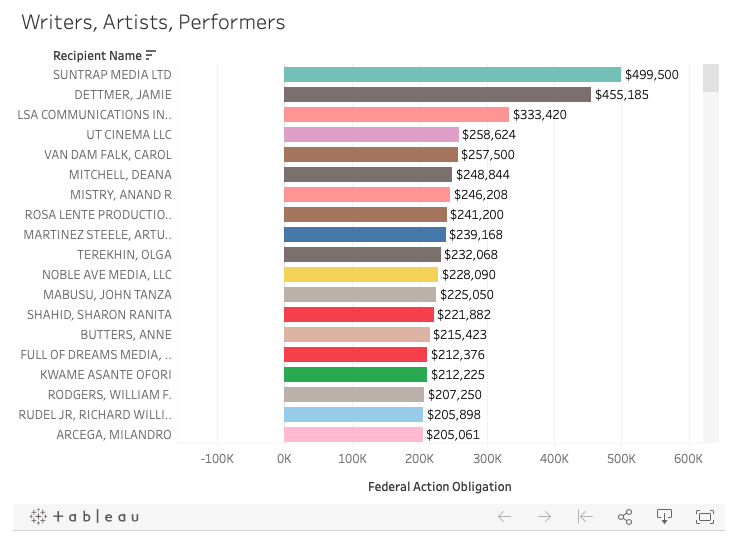
Click here for the full list.
MintPress also spoke with Professor Sujatha Fernandes, a sociologist at the University of Sydney and an expert in Cuban music culture. Fernandes stated:
For many years, under the banner of regime change, organizations like USAID have tried to infiltrate Cuban rap groups and fund covert operations to provoke youth protests. These programs have involved a frightening level of manipulation of Cuban artists, have put Cubans at risk, and threatened a closure of the critical spaces of artistic dialogue many worked hard to build.”
Other areas in which U.S. organizations are focussing resources include sports journalism — which the NED hopes to use as a “vehicle to narrate the political, social, and cultural realities of Cuban society” — and gender and LGBTQ+ groups, the intersectional empire apparently seeing an opportunity to also use these issues to increase fissures in Cuban society.
The House Appropriations Budget, published earlier this month, also sets aside up to $20 million for “democracy programs” in Cuba, including those that support “free enterprise and private business organizations.” What is meant by “democracy” is made clear in the document, which states in no uncertain terms that “none of the funds made available under such paragraph may be used for assistance for the government of Cuba.” Thus, any mention of “democracy” in Cuba is all but synonymous with regime change.
The protests began on Sunday after a power outage left residents in San Antonio de los Baños without electricity during the summer heat. That appeared to be the spark that led to hundreds of people marching in the street. However, Cuba’s economy has also taken a nosedive of late. As Professor Aviva Chomsky of Salem State University, author of “A History of the Cuban Revolution,” told MintPress:
Cuba’s current economic situation is pretty dire (as is, I should point out, almost all of the Third World’s). The U.S. embargo (or, as Cubans call it, blockade) has been yet another obstacle (on top of the obstacles faced by all poor countries) in Cuba’s fight against COVID-19. The collapse of tourism has been devastating to Cuba’s economy — again, as it has been in pretty much all tourism-heavy places.”
However, Chomsky also noted that it could be a mistake to label all the protestors as yearning for free-market shock therapy. “It’s interesting to note that many of the protesters are actually protesting Cuba’s capitalistreforms, rather than socialism. ‘They have money to build hotels but we have no money for food, we are starving,’ said one protester. That’s capitalism in a nutshell!” Chomsky said.
Eaton was skeptical of the idea that all those marching were in the pay of the U.S. “Certainly, much of the uprising was organic, driven by Cubans who are desperate, poor, hungry and fed up with their government’s inability to meet their basic needs,” he said. Yet there were signs that at least some were not simply making a point about the lack of food in stores or medicines in pharmacies. A number of demonstrators marchedunderneath the American flag and the events were immediately endorsed by the U.S. government.
“We stand with the Cuban people and their clarion call for freedom,” read an official statement from the White House. Julie Chung, Biden’s Acting Assistant Secretary for U.S. Department of State’s Bureau of Western Hemisphere Affairs, added:
Cuba’s people continue to bravely express yearning for freedom in the face of repression. We call on Cuba’s government to: refrain from violence, listen to their citizens’ demands, respect protestor and journalist rights. The Cuban people have waited long enough for ¡Libertad!”
Republicans went much further. Mayor of Miami Francis Suarez demanded that the United States intervene militarily, telling Fox News that the U.S. should put together a “coalition of potential military action in Cuba.” Meanwhile, Florida Congressman Anthony Sabbatini called for regime change on the island, tweeting:
Corporate media were also extremely interested in the protests, devoting a great deal of column inches and air time to the demonstrations. This is extremely unusual for such actions in Latin America. Colombia has been living through months of general strikes against a repressive government, while there have been three years of near-daily protests in Haiti that were almost completely ignoreduntil earlier this month, when U.S.-backed President Jovenel Moïse was assassinated.
The effect of U.S. sanctions was constantly downplayed or not even mentioned in reporting. For example, The Washington Post’s editorial board came out in favor of the protestors, claiming Cuban President Miguel Díaz-Canel was reacting “with predictable thuggishness…blaming everything on the United States and the U.S. trade embargo.” Other outlets did not even mention the embargo, leaving readers with the impression that the events could only be understood as a democratic uprising against a decaying dictatorship.
This is particularly pernicious because government documentsexplicitly state that the goal of the U.S. sanctions is to “decrease monetary and real wages, to bring about hunger, desperation and [the] overthrow of [the] government” — exactly the conditions brewing in Cuba right now. Professor Chomsky noted:
The U.S. embargo/blockade is one (not the only) cause of Cuba’s economic crisis. The U.S. has overtly and continuously said that the goal of the embargo is to destroy Cuba’s economy so that the government will collapse. So it’s not just reasonable, it’s obvious that the U.S. has some kind of hand in this.”
Chomsky also took issue with the media’s explanation of events, stating:
Look at coverage of Black Lives Matter or Occupy Wall Street protests in this country. One thing that we see consistently is that when people protest in capitalist countries, the media never explains the problems they are protesting as caused by capitalism. When people protest in communist or socialist countries, the media attributes the problems to communism or socialism.”
Media were at pains to emphasize how large and widespread the anti-government demonstrations were, insisting that the pro-government counter-demonstrations were smaller in number, despite images from the protests suggesting that the opposite might be true. As Reuters reported, “Thousands took to the streets in various parts of Havana on Sunday including the historic centre, drowning out groups of government supporters waving the Cuban flag and chanting Fidel.”
If this were the case, it is odd indeed that so many outlets usedimages of pro-government movements to illustrate the supposed size and scope of the anti-government action. The Guardian, Fox News, The Financial Times, NBC and Yahoo! News all falsely claimed a picture of a large socialist gathering was, in fact, an anti-government demo. The large red and black banners emblazoned with the words “26 Julio” (the name of Fidel Castro’s political party) should have been a dead giveaway to any editors or fact checkers. Meanwhile, CNNand National Geographicillustrated articles on the protests in Cuba with images of gatherings in Miami — gatherings that looked far better attended than any similar ones 90 miles to the south.
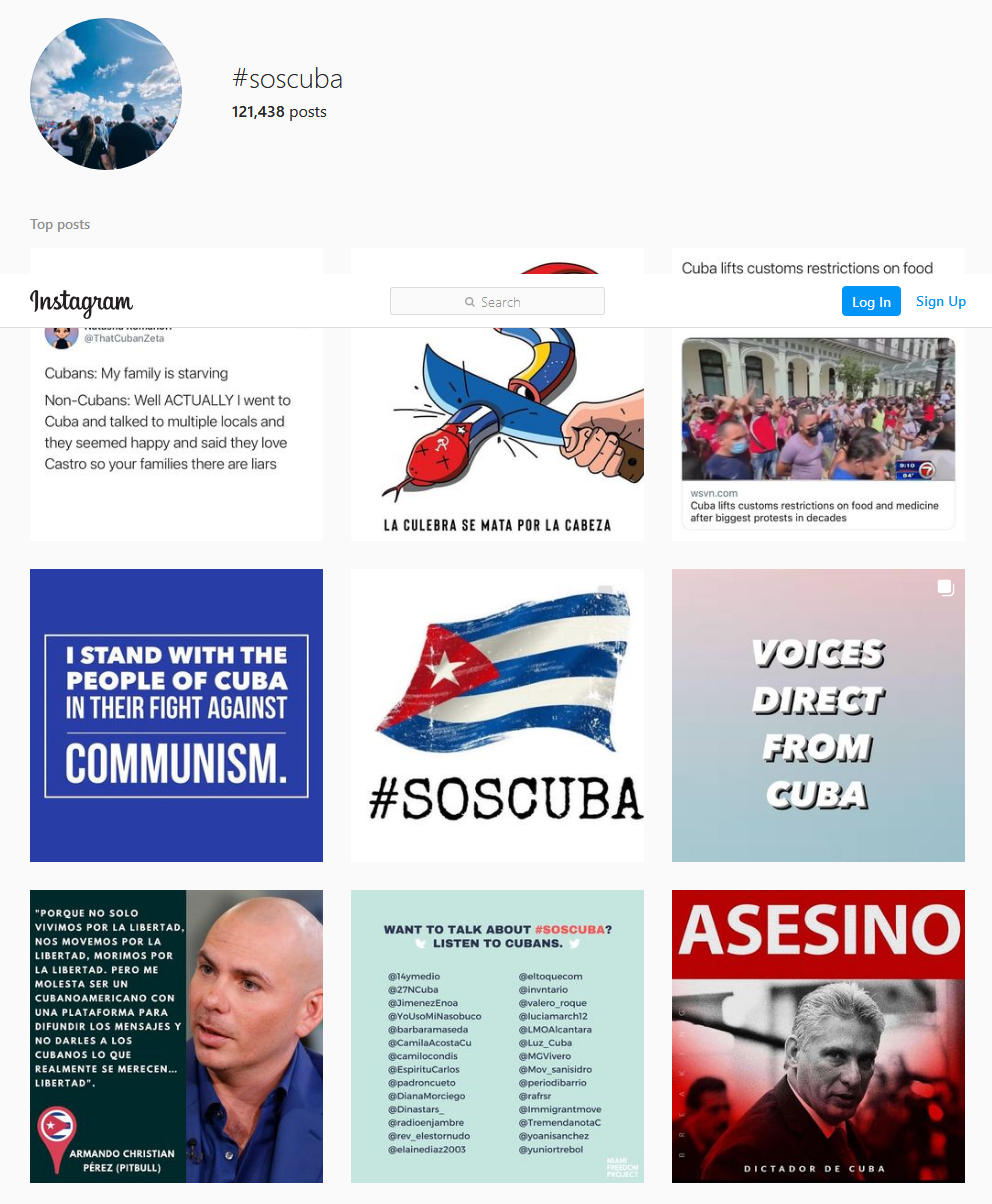
Link:Social media also played a pivotal role in turning what was a localized protest into a nationwide event. NBC’s Director of Latin America, Mary Murray, noted that it was only when live streams of the events were picked up and signal-boosted by the expat community in Miami that it “started to catch fire,” something that suggests the growth of the movement was partially artificial. After the government blocked the internet, the protests died down.
The hashtag #SOSCuba trended for over a day. There are currently over 120,000 photos on Instagram using the hashtag. But as Arnold August, the writer of a host of books on Cuba and Cuban-American relations, told MintPress, much of the attention the protests was getting was the result of inauthentic activity:
The latest attempt of regime change also has its roots in Spain. Historically, the former colonizer of Cuba plays its role in all major attempts of regime change, not only for Cuba, but also, for example, in Venezuela. The July operation made intensive use of robots, algorithms and accounts recently created for the occasion.”
August noted that the first account using #SOSCuba on Twitter was actually located in Spain. This account posted nearly 1,300 tweets on July 11. The hashtag was also buoyed by hundreds of accounts tweeting the exact same phrases in Spanish, replete with the same small typos. One common message read (translated from Spanish), “Cuba is going through the greatest humanitarian crisis since the start of the pandemic. Anyone who posts the hashtag #SOSCuba would help us a lot. Everyone who sees this should help with the hashtag.” Another text, reading “We Cubans don’t want the end of the embargo if that means the regime and dictatorship stays, we want them gone, no more communism,” was so overused that it became a meme in itself, with social media users parodying it, posting the text alongside pictures of demonstrations beside the Eiffel Tower, crowds at Disneyland, or pictures of Trump’s inauguration. Spanish journalist Julian Macías Tovar also cataloged the suspicious number of brand new accounts using the hashtag.
Much of the operation was so crude that it could not have failed to be discovered, and many of the accounts, including the first userof the #SOSCuba hashtag, have now been suspended for inauthentic behavior. Yet Twitter itself still chose to put the protests at the top of its “What’s Happening” for over 24 hours, meaning that every user would be notified, a decision that further amplified the astroturfed movement.
Twitter leadership has long displayed open hostility towards the Cuban government. In 2019, it took coordinated action to suspend virtually every Cuban state media account, as well as those belonging to the Communist Party. This was part of a wider trend of deleting or banning accounts favorable to governments the U.S. State Department considers enemies, including Venezuela, China and Russia.
In 2010, USAID secretly created a Cuban social media app called Zunzuneo, often described as Cuba’s Twitter. At its peak, it had 40,000 Cuban users — a very large number for that time on the famously Internet-sparse island. None of these users were aware that the app had been secretly designed and marketed to them by the U.S. government. The point was to create a great service that would slowly start to feed Cubans regime-change propaganda and direct them to protests and “smart mobs” aimed at triggering a color-style revolution.
In an effort to hide its ownership of the project, the U.S. government held a secret meeting with Twitter founder Jack Dorsey, aimed at getting him to invest in the project. It is unclear to what extent, if any, Dorsey helped, as he has declined to speak on the matter. This is not the only anti-government app the U.S. has funded in Cuba. Yet, considering both what happened this week and the increasingly close ties between Silicon Valley and the National Security State, it is possible the U.S. government considers further cloak-and-dagger apps unnecessary: Twitter already acts as an instrument for regime change.
By the end of the nineteenth century, the United States had effectively conquered its entire contiguous landmass; the frontier was declared closed in 1890. Almost immediately, it began to look for opportunities to expand westwards into the Pacific — to Hawaii, the Philippines and Guam. It also began looking southwards. In 1898, the U.S. intervened in the Cuban Independence War against Spain, using the mysterious sinking of the U.S.S. Maine as a pretext to invade and occupy Cuba. The U.S. operated Cuba as a client state for decades, until the Batista regime was overthrown in the 1959 revolution that brought Fidel Castro to power.
The U.S. launched a botched invasion of the island in 1961, the Bay of Pigs event driving Castro closer to the Soviet Union, laying the groundwork for the Cuban Missile Crisis the following year. The U.S. reportedly attempted to kill Castro hundreds of times, all without any luck. It did, however, carry out a bitter and protracted terroristic war against Cuba and its infrastructure, including usingbiological weapons against the island. Along with this came a long-standing economic war, the 60-year U.S. blockade of the island that throttled its development. In addition to this, it has attempted to bombard the Caribbean nation with anti-communist propaganda. TV Martí, a Florida-based media network, has cost the U.S. taxpayer well over half a billion dollars since its creation in 1990, despite the fact that the Cuban government successfully jams the signal, meaning virtually nobody watches its content.
After the dissolution of the Soviet Union in 1991, Cuba was left without its main trading partner, to which it had geared its economy. Without a guaranteed buyer for its sugar, and without subsidized Russian oil imports, the economy crashed. Sensing blood, the U.S. intensified the sanctions. Yet Cuba pulled through the grim time collectively known as the “Special Period.”
After a wave of left-wing, anti-imperialist governments came to power across Latin America in the 2000s, the Obama administration was forced to move towards normalizing diplomatic relations with the island. However, once in office, President Donald Trump reversed these actions, intensifying the blockade and halting vital remittances from Cuban-Americans to the island. Trump advisor John Bolton labeled Cuba, Venezuela and Nicaragua a “troika of tyranny” — a clear reference to George Bush’s “Axis of Evil” speech, implying that these three nations could expect military action against them soon. In its last days, the Trump administration also declared Cuba a state sponsor of terrorism.
While Biden had intimated that he might turn the U.S. Cuba policy back to the Obama days, he has, so far, done little to move away from the Trump line, his unequivocal endorsement of this week’s actions the latest example of this.
Despite monumental worldwide media coverage, encouragement and legitimation from world leaders, including the president of the United States himself, the recent action petered out after barely 24 hours. In most cases, counter-protests effectively diluted the protests, without the need for repressive forces to be deployed.
The U.S. government can cause economic misery for the Cuban people, but it cannot, it appears, convince them to overthrow their government. “The current events in Cuba constitute in reality the U.S.S. Maine of 2021,” August said. If this really was an attempted color revolution, as August is implying, it was not a very successful one, amounting to little more than a Bay of Tweets.


